Do anti-fatigue mats actually work?
Yes, at the narrow thing they do: reducing peak pressure and giving your feet somewhere to move. No, at most of what the listings claim.
By Sawyer V. · Published September 30, 2026
We earn a commission if you buy through the links on this page, at no extra cost to you. It does not affect the order of the picks - the rubric does that, and here is how we are funded. Prices were last verified September 30, 2026.
What we did and did not do
Units we claim to have tested: 0. Everyone in this category says they tested twenty chairs. We have not sat in any of these, and we say so.
What we did instead: compiled every figure each manufacturer publishes, computed the fit ranges from a cited anthropometric table, and linked the source for each number so you can check the arithmetic. Where a manufacturer does not publish a figure, we say that rather than filling the gap. The full method, including what we cannot assess, is here.
Two things a mat demonstrably does. Several it does not. And one consequence that is more practically important than either.
What they do
They reduce peak pressure under your foot. A compliant surface deforms under load, spreading contact over a larger area and lowering the highest pressure at any point. This is material physics rather than a health claim: it is the same reason a running shoe has a midsole.
A contoured mat increases how much you move. Raised edges, mounds and textured zones give your feet somewhere different to go, and people use them. This is the actual argument for the not-flat designs, and it is why we rank them above flat mats on the mat roundup: standing still on a soft surface is still standing still.
What they do not do
They do not treat plantar fasciitis, back pain, varicose veins or joint disease. Listings imply otherwise regularly. We have no basis for any of those claims and we are not going to repeat them; a mechanism is not an outcome, and a clinical outcome would need clinical evidence we are not in a position to weigh.
They also do not make prolonged standing a good idea. If you stand for four unbroken hours, the problem is the four unbroken hours. A mat improves the surface; it does not shorten the duration.
That is worth dwelling on, because it points at a different purchase. The intervention with the most leverage on unbroken standing is something to perch on, so four hours becomes two standing and two perching. A standing-desk stool does that for the price of two good mats.
The consequence nobody mentions
A mat changes your desk height by its own thickness. Stand on a 2.7-inch mat and your work surface is effectively 2.7 inches lower relative to you.
Published thicknesses run from 0.75 inches to 2.7 - a two-inch swing, which is more than most people's tolerance and more than some desks' adjustment increments. If your desk was already correct, a thick mat has just made it low. If it was slightly too high - very common on fixed-height standing desks - the mat has fixed it for free.
Your standing desk should put the surface at your standing elbow height, which published data puts between 37.4 and 46.5 inches across adults. Our fit table gives your figure. Subtract the mat, then decide.
Flat or contoured, on the evidence available
| Flat mat | Contoured mat | |
|---|---|---|
| Reduces peak foot pressure | Yes | Yes |
| Prompts foot movement | No - uniform surface | Yes - that is the feature |
| Height change | Small; 0.75-1 in typical | Large; up to 2.7 in |
| Usable stance area | Whole surface | Some zones suit standing more than others |
| Price | Lower | Roughly double |
| Doubles as a kitchen mat | Yes - many are sold for both | Less well; the terrain is a desk feature |
If you want cushioning, a flat mat delivers it and costs less. If the point is to stop standing statically, only the contoured design addresses that, and the price difference is buying a mechanism rather than more foam.
What we cannot tell you
- How long the foam lasts. Density predicts it and not one mat in our field publishes a density figure. One publishes a warranty term - seven years - which is a manufacturer betting its own money on the answer, and is the closest thing to evidence available.
- Whether it feels better after three hours. We have not stood on any of these. That is precisely what a hands-on reviewer can tell you and our method cannot.
- Whether it helps your specific aches. Not a spec question, and not one we are qualified on.
The full list of what our method cannot reach is published here, rather than left for you to discover.
Mats that publish what they are
Ranked on the published rubric. Tap a row for the full write-up; the price button goes straight to Amazon. Every figure in the write-ups is the manufacturer's own published specification, linked at the source. We have not sat in any of these.
| # | Product | Best for | Score | Price |
|---|---|---|---|---|
| 1 | 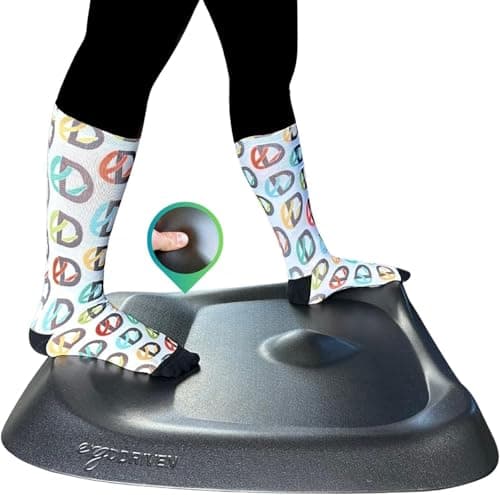 Ergodriven Topo Not-Flat Standing Mat Best Contoured | A seven-year warranty | 9.2 | $109.00 - View on Amazon #ad disclosure · September 30, 2026 |
| 2 | 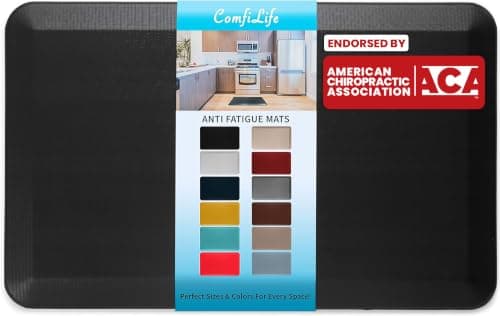 ComfiLife Anti-Fatigue Mat, 3/4 in Best Flat | Cushioning with little height change | 6.4 | $49.99 - View on Amazon #ad disclosure · September 30, 2026 |
| 3 | 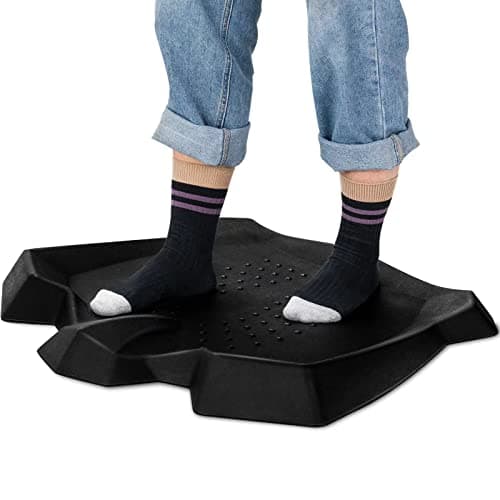 ReunionG PU Not-Flat Standing Mat Best Value Contoured | Terrain for less | 7.4 | $79.99 - View on Amazon #ad disclosure · September 30, 2026 |
01 · Best Contoured
Ergodriven Topo Not-Flat Standing Mat
9.2/10 · scored on the published rubric
2.7 in thick with a sculpted surface and a seven-year manufacturer warranty - the longest warranty term on this site. At $109 that is about $16 per warranty year, the best figure in this group.
Why you might not: It is 2.7 in tall, which changes your effective desk height by that much. If your desk is already at the top of its range, work the arithmetic before you buy.
| Thickness | 2.7 in |
|---|---|
| Footprint | 29 x 26.25 in |
| Warranty | 7 years |
| Cost per warranty year | $15.57 |
Adjustments published (2): terrain features for repositioning your feet; heel indentation for moving the mat with one foot.
Not published by the manufacturer: foam density. We have flagged these rather than guessed.
How this score was built
- Fit range9/10
- Adjustability9/10
- Size & footprint9/10
- Materials & warranty10/10
- Spec coverage9/10
The overall is the mean of these, rounded to one decimal place. Each criterion is computed from a published figure - the rubric is here.
Price as of September 30, 2026. #ad how this is funded
02 · Best Flat
ComfiLife Anti-Fatigue Mat, 3/4 in
6.4/10 · scored on the published rubric
A flat 0.75 in high-density memory foam mat at 32 by 20 in - the widest footprint in this group, which matters if you shift your stance a lot.
Why you might not: Flat. A flat mat cushions but does nothing to encourage you to move your feet, which is the whole argument for the not-flat designs.
| Thickness | 0.75 in |
|---|---|
| Footprint | 32 x 20 in |
Not published by the manufacturer: warranty term; foam density. We have flagged these rather than guessed.
How this score was built
- Fit range7/10
- Adjustability2/10
- Size & footprint10/10
- Materials & warranty6/10
- Spec coverage7/10
The overall is the mean of these, rounded to one decimal place. Each criterion is computed from a published figure - the rubric is here.
Price as of September 30, 2026. #ad how this is funded
03 · Best Value Contoured
ReunionG PU Not-Flat Standing Mat
7.4/10 · scored on the published rubric
A contoured 2 in mat with a published 80 massage points and an anti-skid grooved base, at roughly two-thirds the price of the Topo.
Why you might not: No published warranty term, so cost per warranty year cannot be computed - the Topo's strongest figure.
| Thickness | 2 in |
|---|---|
| Footprint | 27.5 x 25.5 in |
Adjustments published (3): multi-terrain surface; 80 published massage points; beveled edges.
Not published by the manufacturer: warranty term; foam density. We have flagged these rather than guessed.
How this score was built
- Fit range8/10
- Adjustability8/10
- Size & footprint8/10
- Materials & warranty6/10
- Spec coverage7/10
The overall is the mean of these, rounded to one decimal place. Each criterion is computed from a published figure - the rubric is here.
Price as of September 30, 2026. #ad how this is funded
Questions people actually ask
Do anti-fatigue mats actually work?
Do anti-fatigue mats help back pain?
Do anti-fatigue mats help plantar fasciitis?
Do anti-fatigue mats wear out?
Why do anti-fatigue mats hurt my feet?
Can anti-fatigue mats be washed?
Read next
Sources
Every figure on this page traces to one of these. Product specifications come from the manufacturer's own listing; prices come from a live lookup and carry the date they were verified.