Seat height and seat depth by your height
A table from 5 ft 0 in to 6 ft 6 in, computed from published leg-length percentiles rather than guessed - and the two measurements that beat the table.
By Sawyer V. · Published September 30, 2026
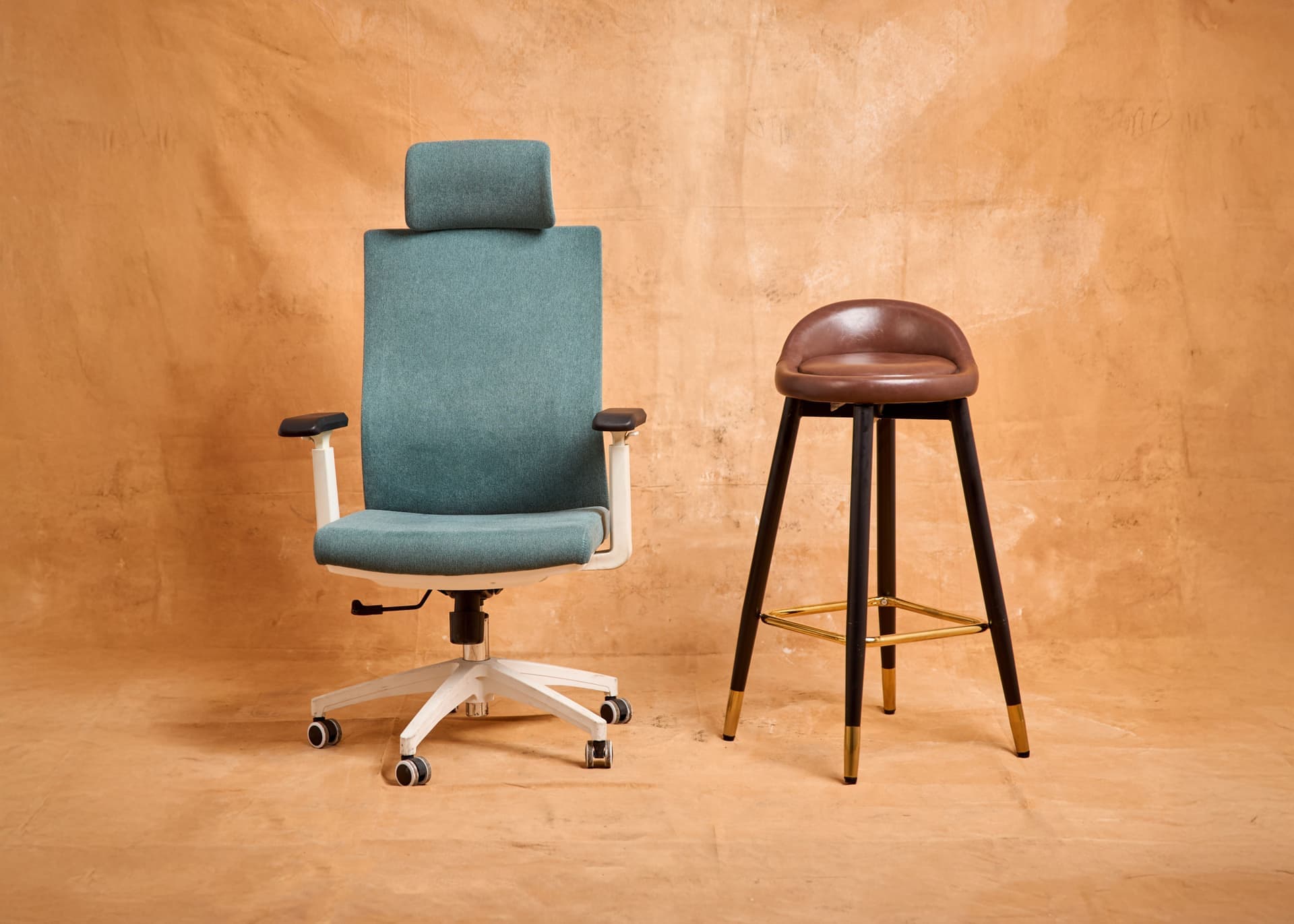
Two numbers decide whether a chair fits you, and neither one is your height. They are your popliteal height - floor to the underside of your thigh, just behind the knee, when you are seated - and your buttock-popliteal length, which is how deep the seat can be before its front edge presses into the back of your knee.
Height is a proxy for both, and a reasonable one. The table below converts it, using published percentile data rather than a rule of thumb. But if you can measure the two real numbers, do - the section after the table takes about a minute and it beats any average.
The table
| Your height | Seat height | Max seat depth | Standing-desk height |
|---|---|---|---|
| 5'0" | 15-16.6 in | 15.6 in | 37.8 in |
| 5'2" | 15.7-17.3 in | 16.7 in | 39.1 in |
| 5'4" | 16.3-17.9 in | 16.7 in | 40.2 in |
| 5'6" | 17-18.6 in | 17.7 in | 41.4 in |
| 5'8" | 17.9-19.5 in | 19.9 in | 42.8 in |
| 5'10" | 18.4-20 in | 18.8 in | 44.2 in |
| 6'0" | 19.1-20.7 in | 19.8 in | 45.6 in |
| 6'2" | 19.5-21.1 in | 20.4 in | 46.5 in |
| 6'4" | 19.5-21.1 in | 20.4 in | 46.5 in |
| 6'6" | 19.5-21.1 in | 20.4 in | 46.5 in |
Seat height includes a 1-inch shoe allowance. The band is plus or minus 0.8 inch, because two people the same height can differ by about that much in leg-to-torso proportion - which is also why a chair with a 4-inch adjustment range suits far more people than one with a 2-inch range, whatever its mid-point.
How to measure your own, properly
- Popliteal height. Sit on a hard, flat surface with your feet flat on the floor, knees at a right angle. Measure from the floor to the underside of your thigh right behind the knee. Wear the shoes you work in. That figure, as measured, is your seat height - no allowance needed, because the shoes are already on.
- Buttock-popliteal length. Sitting the same way, measure from the back of your buttock to the back of your knee. Your maximum seat depth is that figure minus 2 inches - the clearance that keeps the seat's front edge off the back of your knee.
- Check the chair against both. A chair whose published seat-height range contains your figure with an inch to spare at each end, and whose seat depth is at or below your maximum, fits you. One that fails either is the wrong chair however good it is.
Why depth is the figure people skip
Seat height gets all the attention because it adjusts. Seat depth usually does not: on most chairs under $300 it is a fixed dimension, so if it is too long for you there is no remedy. And it is the dimension OSHA singles out - the seat pan should support most of the thigh without contact between the back of the knee and the front edge of the seat pan.
This is the mechanism behind the most common complaint we see from shorter users: not that the chair is too high, but that the front edge cuts in. A 20-inch-deep seat needs a buttock-popliteal length of 22 inches, which our table puts at roughly 5 ft 9 in and above.
What to do when the chair is too tall for you
This is the common case, not the rare one. Most task chairs start at 17.5 to 19 inches, and our table says a 5 ft 2 in user wants something closer to 16. If the chair will not go low enough, you have three options and only one of them is good:
- Add a footrest. This is the real fix, and it is the single most useful cross-link on this site: a footrest restores the knee angle and gets your weight off the front edge of the seat, without touching anything else in your setup. It is also cheaper than a chair.
- Lower the desk instead, if it adjusts. Works, but only if you can then still fit your knees under it.
- Buy a chair that goes lower. The right answer if you are buying anyway - see chairs for petite users, where the seat-height floor is the ranking criterion rather than an afterthought.
And when it is too short
The mirror problem, and harder to fix: you cannot make a gas cylinder taller. A 6 ft 3 in user wants about 19.5 to 21 inches of seat height, and plenty of chairs stop at 21.7. That leaves no adjustment headroom, so you sit permanently at the top of the range with the cylinder fully extended.
Two things worth knowing. Replacement gas cylinders in taller lengths are sold separately and fit most chairs with a standard taper - not something manufacturers advertise. And a drafting chair is simply a task chair on a longer cylinder with a footrest ring added, which is why it is the usual answer for a tall user at a tall desk. Our chairs for tall people roundup ranks on the seat-height ceiling rather than on how the marketing describes the back.
The published data this is computed from
Below is the percentile table every figure on this site derives from. We show it rather than describing it, because a table you can check is worth more than an assurance that we checked it.
The percentile table, in full
| Dimension | 5th %ile W | 50th %ile W | 95th %ile W | 5th %ile M | 50th %ile M | 95th %ile M |
|---|---|---|---|---|---|---|
| Stature | 59.4 | 63.8 | 68.1 | 64.2 | 68.7 | 73.2 |
| Popliteal height | 14.6 | 16.1 | 17.7 | 16.1 | 17.7 | 19.3 |
| Buttock-popliteal length | 17.3 | 19.7 | 22 | 17.7 | 20.1 | 22.4 |
All figures in inches. Range covered: 4'11" to 6'1". Source: Pheasant & Haslegrave, Bodyspace: Anthropometry, Ergonomics and the Design of Work, as tabulated by RoyMech.
The interpolation between those points is linear. We use interpolation rather than a single ratio of stature on purpose: the popliteal-to-stature ratio drifts from about 0.245 at the short end to 0.263 at the tall end, so a single multiplier systematically under-predicts for tall people - the group already least well served by the market.
Questions people actually ask
What seat height do I need if I am 5 ft 4 in?
What is a good seat height for a 6-foot person?
How do I know if a seat is too deep for me?
Does a seat cushion change my seat height?
Should I measure with shoes on or off?
Read next
Sources
Every figure on this page traces to one of these. Product specifications come from the manufacturer's own listing; prices come from a live lookup and carry the date they were verified.