Best anti-fatigue mats for a standing desk
A mat raises you by its own thickness, so it changes your desk height before it does anything else. Work that out first; then choose flat or contoured.
By Sawyer V. · Published September 30, 2026
We earn a commission if you buy through the links on this page, at no extra cost to you. It does not affect the order of the picks - the rubric does that, and here is how we are funded. Prices were last verified September 30, 2026.
What we did and did not do
Units we claim to have tested: 0. Everyone in this category says they tested twenty chairs. We have not sat in any of these, and we say so.
What we did instead: compiled every figure each manufacturer publishes, computed the fit ranges from a cited anthropometric table, and linked the source for each number so you can check the arithmetic. Where a manufacturer does not publish a figure, we say that rather than filling the gap. The full method, including what we cannot assess, is here.
Do the arithmetic before you choose a mat, because a mat changes your desk height. Stand on a 2.7-inch mat and your work surface is effectively 2.7 inches lower relative to you. If your desk was already at the right height, it is now too low; if it was slightly too high, the mat has just fixed it for free.
This is the single most useful thing about mats that nobody mentions, and it runs in both directions. Published thicknesses here span from 0.75 inches to 2.7 - a two-inch swing in your effective desk height, which is more than most people's tolerance.
Your standing desk should sit at your standing elbow height, which published data puts between 37.4 and 46.5 inches across adults. Our fit table gives your figure. Subtract the mat, then check.
Quick picks
Ranked on the published rubric. Tap a row for the full write-up; the price button goes straight to Amazon. Every figure in the write-ups is the manufacturer's own published specification, linked at the source. We have not sat in any of these.
| # | Product | Best for | Score | Price |
|---|---|---|---|---|
| 1 | 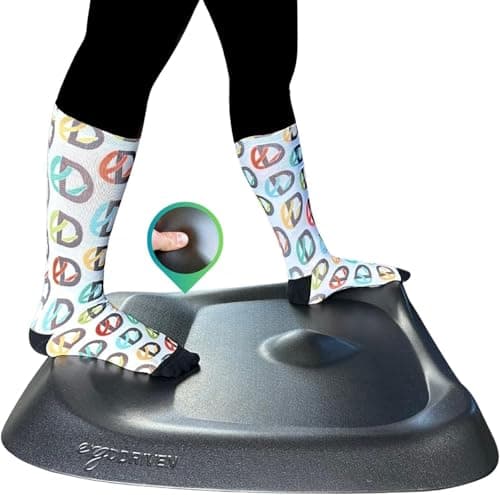 Ergodriven Topo Not-Flat Standing Mat Best Overall | A seven-year warranty | 9.2 | $109.00 - View on Amazon #ad disclosure · September 30, 2026 |
| 2 | 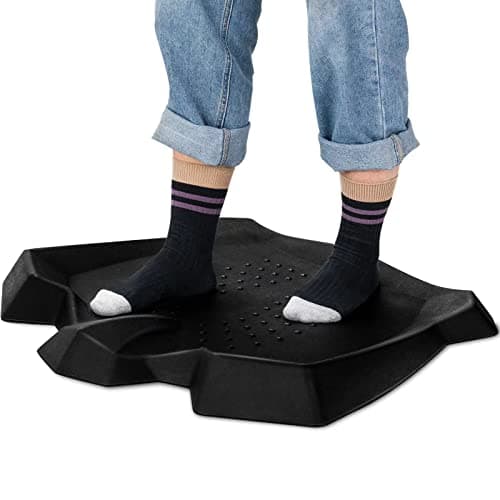 ReunionG PU Not-Flat Standing Mat Best Contoured for Less | Terrain at two-thirds the price | 7.4 | $79.99 - View on Amazon #ad disclosure · September 30, 2026 |
| 3 | 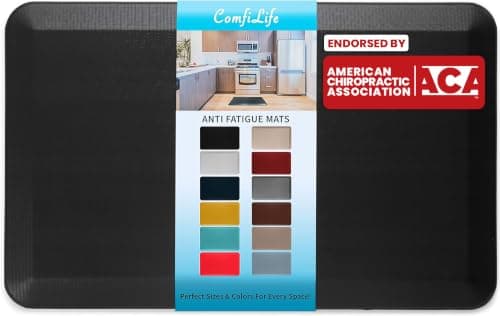 ComfiLife Anti-Fatigue Mat, 3/4 in Best Flat Mat | The widest stance | 6.4 | $49.99 - View on Amazon #ad disclosure · September 30, 2026 |
| 4 | 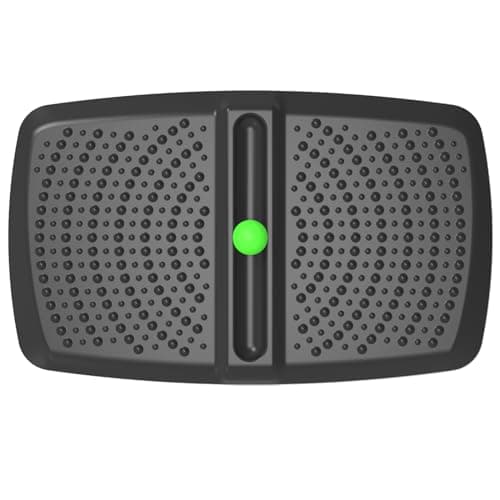 ergohead 1 in Mat with Massage Points Best Thickness for a Flat Mat | A full inch, cheaply | 6.0 | $46.99 - View on Amazon #ad disclosure · September 30, 2026 |
| 5 | 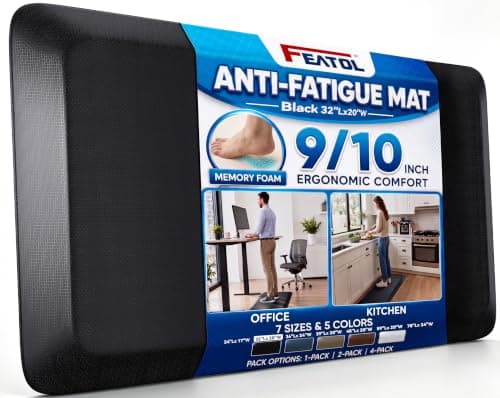 FEATOL Anti-Fatigue Mat, 9/10 in Thickest Flat Mat | Cushioning on a budget | 4.2 | $44.99 - View on Amazon #ad disclosure · September 30, 2026 |
| 6 |  Amazon Basics Anti-Fatigue Standing Mat Cheapest With Published Dimensions | Knowing what arrives | 5.6 | $44.99 - View on Amazon #ad disclosure · September 30, 2026 |
| — | 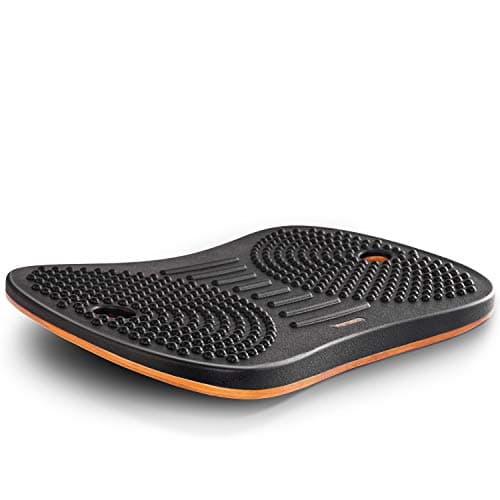 FEZIBO Standing Desk Balance Board Skip This If You Wanted a Mat | Balance training, not cushioning | 4.0 | $59.99 - View on Amazon #ad disclosure · September 30, 2026 |
01 · Best Overall
Ergodriven Topo Not-Flat Standing Mat
9.2/10 · scored on the published rubric
2.7 in thick with a sculpted surface and a seven-year manufacturer warranty - the longest warranty term on this site. At $109 that is about $16 per warranty year, the best figure in this group.
Why you might not: It is 2.7 in tall, which changes your effective desk height by that much. If your desk is already at the top of its range, work the arithmetic before you buy.
| Thickness | 2.7 in |
|---|---|
| Footprint | 29 x 26.25 in |
| Warranty | 7 years |
| Cost per warranty year | $15.57 |
Adjustments published (2): terrain features for repositioning your feet; heel indentation for moving the mat with one foot.
Not published by the manufacturer: foam density. We have flagged these rather than guessed.
How this score was built
- Fit range9/10
- Adjustability9/10
- Size & footprint9/10
- Materials & warranty10/10
- Spec coverage9/10
The overall is the mean of these, rounded to one decimal place. Each criterion is computed from a published figure - the rubric is here.
Price as of September 30, 2026. #ad how this is funded
02 · Best Contoured for Less
ReunionG PU Not-Flat Standing Mat
7.4/10 · scored on the published rubric
A contoured 2 in mat with a published 80 massage points and an anti-skid grooved base, at roughly two-thirds the price of the Topo.
Why you might not: No published warranty term, so cost per warranty year cannot be computed - the Topo's strongest figure.
| Thickness | 2 in |
|---|---|
| Footprint | 27.5 x 25.5 in |
Adjustments published (3): multi-terrain surface; 80 published massage points; beveled edges.
Not published by the manufacturer: warranty term; foam density. We have flagged these rather than guessed.
How this score was built
- Fit range8/10
- Adjustability8/10
- Size & footprint8/10
- Materials & warranty6/10
- Spec coverage7/10
The overall is the mean of these, rounded to one decimal place. Each criterion is computed from a published figure - the rubric is here.
Price as of September 30, 2026. #ad how this is funded
03 · Best Flat Mat
ComfiLife Anti-Fatigue Mat, 3/4 in
6.4/10 · scored on the published rubric
A flat 0.75 in high-density memory foam mat at 32 by 20 in - the widest footprint in this group, which matters if you shift your stance a lot.
Why you might not: Flat. A flat mat cushions but does nothing to encourage you to move your feet, which is the whole argument for the not-flat designs.
| Thickness | 0.75 in |
|---|---|
| Footprint | 32 x 20 in |
Not published by the manufacturer: warranty term; foam density. We have flagged these rather than guessed.
How this score was built
- Fit range7/10
- Adjustability2/10
- Size & footprint10/10
- Materials & warranty6/10
- Spec coverage7/10
The overall is the mean of these, rounded to one decimal place. Each criterion is computed from a published figure - the rubric is here.
Price as of September 30, 2026. #ad how this is funded
04 · Best Thickness for a Flat Mat
ergohead 1 in Mat with Massage Points
6.0/10 · scored on the published rubric
A full inch thick with massage points, and it ships with a massage ball.
Why you might not: At 28 by 17 in it is the smallest footprint in this group - noticeably less room to move your feet than the 32 in mats.
| Thickness | 1 in |
|---|---|
| Footprint | 28 x 17 in |
Adjustments published (1): raised massage points.
Not published by the manufacturer: warranty term; foam density. We have flagged these rather than guessed.
How this score was built
- Fit range7/10
- Adjustability5/10
- Size & footprint5/10
- Materials & warranty6/10
- Spec coverage7/10
The overall is the mean of these, rounded to one decimal place. Each criterion is computed from a published figure - the rubric is here.
Price as of September 30, 2026. #ad how this is funded
05 · Thickest Flat Mat
FEATOL Anti-Fatigue Mat, 9/10 in
4.2/10 · scored on the published rubric
0.9 in of high-density memory foam - the thickest flat mat here - at the lowest price in the group.
Why you might not: FEATOL does not publish the mat's dimensions on the listing, only its thickness.
| Thickness | 0.9 in |
|---|
Not published by the manufacturer: footprint; warranty term; foam density. We have flagged these rather than guessed.
How this score was built
- Fit range7/10
- Adjustability2/10
- Size & footprint2/10
- Materials & warranty6/10
- Spec coverage4/10
The overall is the mean of these, rounded to one decimal place. Each criterion is computed from a published figure - the rubric is here.
06 · Cheapest With Published Dimensions
Amazon Basics Anti-Fatigue Standing Mat
5.6/10 · scored on the published rubric
32 by 20 in at 0.75 in thick, and the cheapest mat here that publishes both figures.
Why you might not: Flat, and nothing is published beyond the dimensions - no density, no warranty, no material detail.
| Thickness | 0.75 in |
|---|---|
| Footprint | 32 x 20 in |
Not published by the manufacturer: warranty term; foam density. We have flagged these rather than guessed.
How this score was built
- Fit range6/10
- Adjustability2/10
- Size & footprint10/10
- Materials & warranty4/10
- Spec coverage6/10
The overall is the mean of these, rounded to one decimal place. Each criterion is computed from a published figure - the rubric is here.
Price as of September 30, 2026. #ad how this is funded
Skip This If You Wanted a Mat
FEZIBO Standing Desk Balance Board
4.0/10 · scored on the published rubric
Rated to 320 lb, and the only item in this group that is a moving board rather than a cushion.
Why you might not: Skip this if you wanted a mat. A balance board is a different tool with a different job: it does not cushion, and you cannot stand on it unthinkingly for three hours.
| Rated capacity | 320 lb |
|---|
Adjustments published (1): rocking balance surface.
Not published by the manufacturer: thickness; footprint; warranty term. We have flagged these rather than guessed.
How this score was built
- Fit range2/10
- Adjustability7/10
- Size & footprint2/10
- Materials & warranty6/10
- Spec coverage3/10
The overall is the mean of these, rounded to one decimal place. Each criterion is computed from a published figure - the rubric is here.
How we ranked these
The governing fit dimension here is thickness and footprint rather than seat height - rubric criterion 1 applied to what a mat actually has. The rubric is here.
- Fit - published thickness. Scored for having a figure at all, then for being in a usable band: below about 0.6 in there is not enough material to do anything, and above about 2.5 in you are changing your desk height meaningfully.
- Movement features - whether the surface does anything beyond cushion: terrain, raised points, heel cradles, a repositioning feature. This is what separates a standing-desk mat from a kitchen mat.
- Size and footprint - published length and width. More floor means more places to put your feet, which is the actual mechanism.
- Materials and build - material, base, warranty term. The Topo's seven-year warranty is the longest on this entire site.
- Spec coverage - how much is published. Two mats here do not publish their own dimensions, which is a low bar to miss.
Flat or not-flat
This is the real decision, and the two do different jobs.
A flat mat cushions. It puts compliant material between you and a hard floor, which reduces the impact loading on your feet and lower legs. That is all it does, and it does it consistently across its whole surface. The ComfiLife, FEATOL and Amazon Basics mats here are flat.
A contoured mat cushions and prompts you to move. Raised edges, mounds and a textured surface give your feet somewhere different to go, which is the mechanism behind the fatigue claim: standing still on a soft surface is still standing still. The Ergodriven Topo and the ReunionG are contoured; the Topo publishes a heel indentation specifically so you can reposition the mat with one foot without bending down, which sounds trivial and is the sort of thing you use ten times a day.
And a balance board is a third thing entirely. The FEZIBO here is a rocking board rated to 320 lb. It does not cushion, and you cannot stand on it unthinkingly for three hours - which is precisely what a mat is for. We have ranked it last and labeled it, because it keeps turning up in mat searches.
Do anti-fatigue mats actually work?
The mechanism is straightforward and the marketing goes well past it, so here is the honest boundary.
A compliant surface reduces peak pressure under the foot compared with a hard floor - that is material physics. A contoured surface increases small postural shifts, because there is somewhere to shift to. Both are real. What none of it constitutes is a treatment for plantar fasciitis, back pain or anything else, and we are not going to imply otherwise. We go further into the evidence question here.
It is also worth saying that a mat is one half of a standing-desk setup and not the more important half. If you currently stand for four unbroken hours, the intervention with the most leverage is not a mat - it is a stool to perch on so those four hours become two standing and two perching. The mat improves the standing; the stool reduces it.
Size, and why bigger is genuinely better
The footprints here run from 28 by 17 inches to 32 by 20. That sounds like a small difference and it is not: it is the difference between one foot position and several. Published sitting and standing anthropometry gives a comfortable stance width well over a foot, and a 17-inch-deep mat leaves no room to step forward and back.
If you are choosing between two otherwise-similar mats, take the bigger one. If you are choosing between a small thick mat and a large thin one, take the large one - having somewhere to move is worth more than an extra quarter inch of foam.
The things we cannot tell you
- How long the foam lasts. Almost nobody publishes density, which is the figure that predicts it. Only the Topo publishes a warranty term - seven years - which is a manufacturer putting money behind its own answer.
- Whether the surface gets slippery in socks. Every listing says non-slip; that claim is about the underside.
- How it feels after three hours. We have not stood on any of these. That is exactly the kind of thing a hands-on review can tell you and our method cannot.
The full list of what our method cannot reach is on the methodology page, and it is published rather than buried for a reason.
Questions people actually ask
Do anti-fatigue mats actually work?
How thick should a standing desk mat be?
Will a mat change my desk height?
Are kitchen mats and standing desk mats the same?
Do anti-fatigue mats help back pain?
Do anti-fatigue mats wear out?
Read next
Sources
Every figure on this page traces to one of these. Product specifications come from the manufacturer's own listing; prices come from a live lookup and carry the date they were verified.