What is a perch stool?
A tall seat, usually tilted forward, that holds you between sitting and standing with your hips open and part of your weight still on your feet.
By Sawyer V. · Published September 30, 2026
We earn a commission if you buy through the links on this page, at no extra cost to you. It does not affect the order of the picks - the rubric does that, and here is how we are funded. Prices were last verified September 30, 2026.
What we did and did not do
Units we claim to have tested: 0. Everyone in this category says they tested twenty chairs. We have not sat in any of these, and we say so.
What we did instead: compiled every figure each manufacturer publishes, computed the fit ranges from a cited anthropometric table, and linked the source for each number so you can check the arithmetic. Where a manufacturer does not publish a figure, we say that rather than filling the gap. The full method, including what we cannot assess, is here.

A perch stool is a tall seat, usually with a forward-tilted or contoured pad, designed to hold you in a half-standing position. Your hips stay open at roughly 120 to 135 degrees instead of a seated 90, your feet stay on the floor taking a real share of your weight, and you are neither sitting nor standing.
It exists because standing all day is tiring and sitting all day is static. A perch is a third position that is easy to move into and out of, which is the whole point: it is used alongside standing at a height-adjustable desk, not instead of a chair.
What makes it different from a tall stool
Four things, and the first is the one that defines the category.
- A tilted or contoured seat. A flat seat holds you square; a forward-tilted one rotates your pelvis forward and opens the hip. Without this it is a tall stool, not a perch stool.
- Height adjustment, and a lot of it. Published ranges in our field run to 34.6 inches at the top. A bar stool is one fixed height.
- A weighted pedestal rather than casters. You are only half-seated; a rolling base can move out from under you at exactly the moment you cannot catch yourself.
- Swivel and often tilt. So you can turn to reach without twisting your spine.
That said - on height alone, a bar stool is often right. A US bar stool is typically 28 to 32 inches, which is what a 38 to 42 inch desk needs. If you want to test whether perching suits you before spending, a bar stool you already own is a legitimate experiment. You just lose every adjustment.
The mechanism
Two things happen when you perch rather than sit.
Your hip angle opens. At around 120 to 135 degrees your pelvis stays rotated forward rather than tipping back, so your lumbar curve holds itself without a backrest. It is the same mechanism a kneeling chair or saddle stool uses, reached by a different route.
Your feet keep working. A real share of your weight stays on the floor, which means your legs are not fully unloaded the way they are in a chair. That is a feature for circulation and a liability if you are tired.
Are perching stools good for you?
Here is the honest boundary. The mechanism above is straightforward and describable. Whether perching produces a health outcome over months is a different sort of question, and not one we can answer from published specifications or from anything we have measured.
What we will say is that the claims attached to active seating in listings are consistently broader than the mechanism supports, and that the one defensible claim is narrower and still useful: it gives you a third position. Published ergonomic guidance consistently favors varying posture over optimizing a single one, and a perch stool is a cheap way to have another one available.
There is no clinician on this site and nothing here is medically reviewed. If you have a specific condition, a clinician is the right person to ask whether perching suits it.
Getting the height right
The one thing that decides whether a perch stool works. Seat height = your desk height minus your sitting elbow-rest height, which published data puts at 7.5 to 11.4 inches with a median of 9.5. A 42-inch desk needs a seat around 31 to 34 inches.
That matters because plenty of stools sold for standing desks cannot reach one - published ceilings in our field run from 24 inches to 34.6. The full arithmetic, with a table by desk height, is here.
When to buy something else
- Your desk does not adjust. Perching only makes sense as an alternative to standing. At a fixed 29-inch desk you want a chair.
- You sit for two hours at a time. A perch stool has no back and usually no footrest. Over a long stretch you want a drafting chair, which has both. Direct comparison here.
- You want movement, not a position. A wobble stool removes stability so you keep shifting - a different mechanism aimed at a different complaint.
- Your feet will not reach the floor. At the top of a perch stool's range most people's feet do not. Either buy one with a footrest ring - one model in our field publishes both a back and a footrest - or accept that the perch will be brief.
Perch stools worth the name
Ranked on the published rubric. Tap a row for the full write-up; the price button goes straight to Amazon. Every figure in the write-ups is the manufacturer's own published specification, linked at the source. We have not sat in any of these.
| # | Product | Best for | Score | Price |
|---|---|---|---|---|
| 1 | 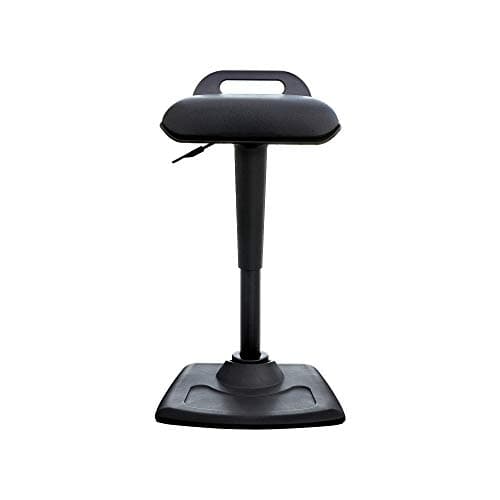 Vari Active Seat Best Overall | A true articulating lean | 7.6 | $299.00 - View on Amazon #ad disclosure · September 30, 2026 |
| 2 | 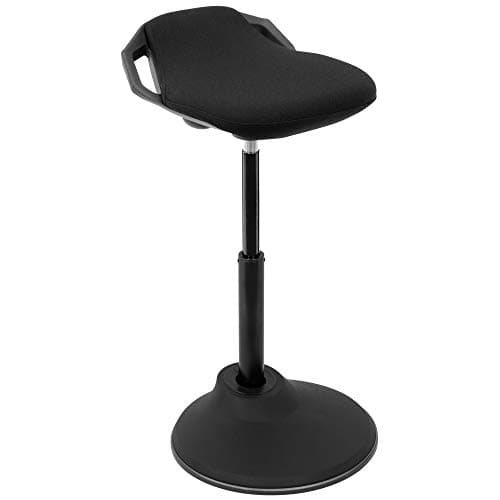 Mount-It! Ergonomic Sit-Stand Leaning Stool Best Height Range | Desks above 44 in | 7.2 | $199.99 - View on Amazon #ad disclosure · September 30, 2026 |
| 3 | 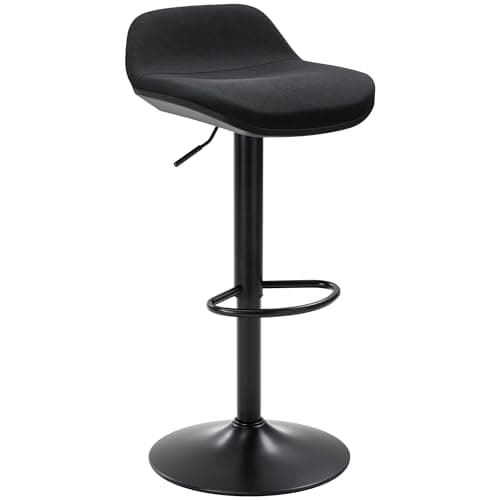 IWMH Standing Desk Stool with Backrest and Footrest Best With a Back and Footrest | Longer perching | 6.2 | $99.99 - View on Amazon #ad disclosure · September 30, 2026 |
01 · Best Overall
Vari Active Seat
7.6/10 · scored on the published rubric
Ships assembled, tops out at 32.5 in, and the articulating pedestal gives a genuine lean rather than a wobble. A handle in the seat, which sounds trivial until you move a stool twice a day.
Why you might not: The most expensive stool on the page and the extra money buys convenience, not fit: its 23-32.5 in range is narrower at the top than the Mount-It.
| Seat height | 23-32.5 in |
|---|---|
| Rated capacity | 250 lb |
Adjustments published (2): seat height (air-lift piston); fully articulating pedestal (rock, tilt, lean).
Not published by the manufacturer: seat depth; seat width; warranty term. We have flagged these rather than guessed.
How this score was built
- Fit range9/10
- Adjustability9/10
- Capacity headroom7/10
- Materials & warranty8/10
- Spec coverage5/10
The overall is the mean of these, rounded to one decimal place. Each criterion is computed from a published figure - the rubric is here.
Price as of September 30, 2026. #ad how this is funded
02 · Best Height Range
Mount-It! Ergonomic Sit-Stand Leaning Stool
7.2/10 · scored on the published rubric
The only stool here whose published range reaches 34.6 in, which is what a 44 in desk actually needs - and the reason it is the pick for tall desks and tall users.
Why you might not: No backrest and no footrest, so it is a leaning seat and nothing else. If you want to sit back for an hour at a time, this is the wrong shape.
| Seat height | 24.8-34.6 in |
|---|---|
| Rated capacity | 248 lb |
Adjustments published (2): seat height (pneumatic, button under seat); 360-degree seat tilt.
Not published by the manufacturer: seat depth; seat width; warranty term. We have flagged these rather than guessed.
How this score was built
- Fit range10/10
- Adjustability7/10
- Capacity headroom7/10
- Materials & warranty7/10
- Spec coverage5/10
The overall is the mean of these, rounded to one decimal place. Each criterion is computed from a published figure - the rubric is here.
Price as of September 30, 2026. #ad how this is funded
03 · Best With a Back and Footrest
IWMH Standing Desk Stool with Backrest and Footrest
6.2/10 · scored on the published rubric
The only stool in this group that publishes a range starting at 25.6 in and still climbing to 33.5 in, and one of very few with both a lumbar backrest and a footrest.
Why you might not: IWMH publishes no weight capacity at all. We cannot assess a figure the manufacturer will not state, so if you need capacity headroom, buy something that publishes it.
| Seat height | 25.6-33.5 in |
|---|---|
| Footrest | fixed |
Adjustments published (2): seat height (mechanism under seat, 65-85 cm); 360-degree swivel.
Not published by the manufacturer: rated capacity; seat depth; warranty term. We have flagged these rather than guessed.
How this score was built
- Fit range9/10
- Adjustability9/10
- Capacity headroom2/10
- Materials & warranty7/10
- Spec coverage4/10
The overall is the mean of these, rounded to one decimal place. Each criterion is computed from a published figure - the rubric is here.
Price as of September 30, 2026. #ad how this is funded
Questions people actually ask
What is a perch stool?
Are perching stools good for you?
What is the difference between a perch stool and a bar stool?
How high should a perch stool be?
Do you need a footrest with a perch stool?
Read next
Sources
Every figure on this page traces to one of these. Product specifications come from the manufacturer's own listing; prices come from a live lookup and carry the date they were verified.