Does lumbar support actually help?
It depends almost entirely on where it sits. A support at your lumbar curve holds a shape sitting destroys. Two inches too high and it is just pressure.
By Sawyer V. · Published September 30, 2026
We earn a commission if you buy through the links on this page, at no extra cost to you. It does not affect the order of the picks - the rubric does that, and here is how we are funded. Prices were last verified September 30, 2026.
What we did and did not do
Units we claim to have tested: 0. Everyone in this category says they tested twenty chairs. We have not sat in any of these, and we say so.
What we did instead: compiled every figure each manufacturer publishes, computed the fit ranges from a cited anthropometric table, and linked the source for each number so you can check the arithmetic. Where a manufacturer does not publish a figure, we say that rather than filling the gap. The full method, including what we cannot assess, is here.

Yes, if it is in the right place. No, if it is not - and "not" is the more common case.
The mechanism is uncontroversial. Your lower spine has a natural inward curve. Sitting flattens it, because your pelvis rotates backwards when your thighs come up to horizontal. A support placed at that curve holds it where standing would. That is straightforward mechanics and it is what every chair in the category is trying to do.
The problem is that most chairs try to do it with a molded bump in a fixed position, set for an average torso. If your torso is shorter than average, that bump sits above your lumbar curve and pushes your mid-back forward - which does not support your lower back and feels like the chair is shoving you. There is no adjustment because there is no mechanism.
Which is why OSHA's own chair guidance does not say "has lumbar support". It asks for a lumbar support that is height adjustable so it can be appropriately placed to fit the lower back. That is a specification, and most of the market does not meet it.
How to tell whether yours is in the right place
- Find your curve. Sit upright and run a hand down your spine until you find the inward hollow just above your pelvis. That is the target. It is lower than most people expect - roughly at belt height, not mid-back.
- Sit back properly and feel where the support lands. If the firmest contact is above the hollow, it is too high. If you cannot feel it at all, it is too low or too thin.
- Check what your pelvis is doing. Correct support lets you sit tall without effort. If you are arching to meet it, it is too thick. If you are slumping around it, too thin.
- Check your seat first. If the seat is too deep for you, you are sitting forward off the backrest and the support is not touching you at all - at which point none of this applies. Our fit table gives your maximum seat depth.
The figure almost nobody publishes
Apex thickness - how deep the support is at its thickest point - is what decides whether it fills the gap between your chair's existing backrest curve and your own. Of the six lumbar cushions we looked at, exactly one publishes it: 4.5 inches, with a stated user-weight band of 100 to 200 lb alongside it, because foam compresses and how much of that 4.5 inches survives depends on your weight.
Everyone else publishes a footprint and a strap arrangement. On chairs, only two makers on this entire site publish lumbar travel in inches - 2 inches over eight positions is the best of them.
Built-in or a cushion?
A genuine decision, and the answer is not always the chair.
A chair with published lumbar travel is the better buy if you are buying a chair anyway: it does not slide, you set it once, and it is integrated with the backrest's own curve. Our back-pain roundup ranks on exactly that figure.
A cushion is the better buy if you already own a chair whose bump is in the wrong place. You can strap it lower, which is the one thing the built-in version cannot do. It is also twenty dollars against two hundred. Cushions ranked on published apex thickness here.
This is one of very few places on this site where an add-on genuinely beats a built-in feature, and it is worth saying plainly because the instinct is usually the other way round.
The alternative: do not let the curve flatten
There is a completely different route to the same objective, and it is worth knowing about before you spend money on support.
Sitting flattens your lumbar curve because your pelvis rotates backwards. Open the hip angle and it does not rotate. A kneeling chair sets the trunk-to-thigh angle at around 120 degrees; a saddle stool does the same thing by shape. In both cases the curve holds itself and there is nothing to support.
That is not a better answer, it is a different one - the trade-off is that your postural muscles do the work, and both options load other parts of you. But it explains why those categories exist, and why "buy more lumbar support" is not the only possible response to a flattened curve.
Where a support cannot help
- When the seat is too deep for you. You are sitting forward, off the backrest, and the support is not in contact. Fix the seat.
- When your feet do not reach the floor. Your pelvis is rotating backwards from the bottom up, and a support at the top is arguing with gravity. A footrest is upstream of the whole chain.
- When it is too thick. Over-supporting pushes you into an arch, which is its own problem rather than a milder version of slumping.
Mechanical, not medical
This page describes mechanics: what sitting does to your lumbar curve and what a support does about it. It is not medical advice, there is no clinician on this site, and nothing here is reviewed by one.
Persistent or worsening back pain, pain radiating into a leg, numbness, tingling or weakness are reasons to see a clinician. Products in this category sometimes carry "doctor recommended" in their titles; that is a marketing phrase, not a credential, and we do not repeat it as one.
Supports that publish the figure that matters
Ranked on the published rubric. Tap a row for the full write-up; the price button goes straight to Amazon. Every figure in the write-ups is the manufacturer's own published specification, linked at the source. We have not sat in any of these.
| # | Product | Best for | Score | Price |
|---|---|---|---|---|
| 1 | 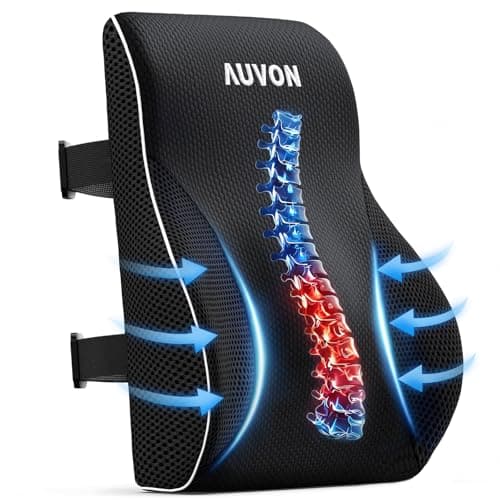 AUVON Lumbar Pillow with Bulge Only Published Apex Figure | Knowing what you are buying | 8.2 | $19.99 - View on Amazon #ad disclosure · September 30, 2026 |
| 2 | 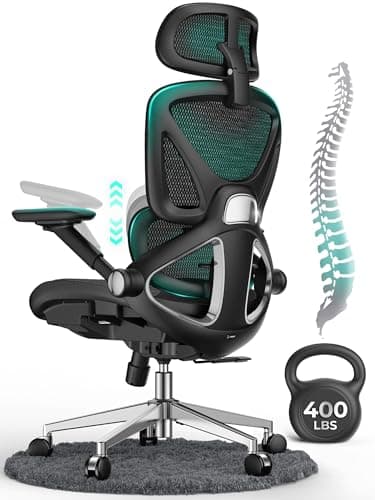 CAPOT Ergonomic Mesh Chair Best Built-In Lumbar | 2 in of travel over 8 levels | 9.8 | $199.99 - View on Amazon #ad disclosure · September 30, 2026 |
| 3 | 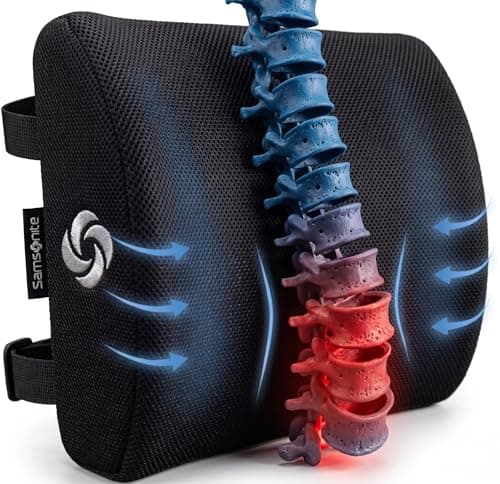 Samsonite Lumbar Support Pillow Best Compact Pad | A chair that is nearly right | 7.2 | $24.29 - View on Amazon #ad disclosure · September 30, 2026 |
01 · Only Published Apex Figure
AUVON Lumbar Pillow with Bulge
8.2/10 · scored on the published rubric
The only lumbar cushion here that publishes its thickest point - 4.5 in - and the user-weight band it was designed for, 100 to 200 lb. That is the figure to compare against your chair's own lumbar depth.
Why you might not: That 100-200 lb window is narrow and published for a reason: above it, the foam compresses further than intended.
| Thickness | 4.5 in |
|---|---|
| Footprint | 18 x 15 in |
| Rated capacity | 200 lb |
Adjustments published (1): adjustable straps.
Not published by the manufacturer: foam density; warranty term. We have flagged these rather than guessed.
How this score was built
- Fit range10/10
- Adjustability7/10
- Size & footprint8/10
- Materials & warranty7/10
- Spec coverage9/10
The overall is the mean of these, rounded to one decimal place. Each criterion is computed from a published figure - the rubric is here.
02 · Best Built-In Lumbar
CAPOT Ergonomic Mesh Chair
9.8/10 · scored on the published rubric
The only chair on this site that answers all six rubric criteria from published figures: seat range, depth, width, 400 lb capacity, a five-year warranty and eight levels of 2 in lumbar travel. At $199.99 that is $40 per warranty year.
Why you might not: It tops out at 22.05 in. If you are over about 6 ft 2 in you will run out of seat height, whatever the listing's stated window says.
| Seat height | 18.5-22.05 in |
|---|---|
| Seat depth | 19.3 in |
| Seat width | 20 in |
| Rated capacity | 400 lb |
| Warranty | 5 years |
| Cost per warranty year | $40.00 |
| Maker's stated user height | 5 ft 5 in to 6 ft 2 in |
Adjustments published (5): seat height (18.5-22.05 in); lumbar depth (2 in over 8 levels); backrest lock at 90, 110 and 125 degrees; headrest height and depth; armrests flip up 90 degrees.
How this score was built
- Fit range9/10
- Adjustability10/10
- Capacity headroom10/10
- Materials & warranty10/10
- Spec coverage10/10
The overall is the mean of these, rounded to one decimal place. Each criterion is computed from a published figure - the rubric is here.
Price as of September 30, 2026. #ad how this is funded
03 · Best Compact Pad
Samsonite Lumbar Support Pillow
7.2/10 · scored on the published rubric
The most compact published footprint here, 13.6 by 12.8 in, which is what you want if your chair's own lumbar shape is already close.
Why you might not: Smallest pad in the group, so on a large chair it can slide out of position.
| Thickness | 4.1 in |
|---|---|
| Footprint | 13.6 x 12.8 in |
Adjustments published (1): strap.
Not published by the manufacturer: foam density; warranty term; user-weight band. We have flagged these rather than guessed.
How this score was built
- Fit range8/10
- Adjustability5/10
- Size & footprint9/10
- Materials & warranty7/10
- Spec coverage7/10
The overall is the mean of these, rounded to one decimal place. Each criterion is computed from a published figure - the rubric is here.
Questions people actually ask
Does lumbar support actually help?
Does lumbar support help lower back pain?
Does lumbar support hurt at first?
Does lumbar support help posture?
Where should lumbar support sit?
Does lumbar support help sciatica?
Read next
Sources
Every figure on this page traces to one of these. Product specifications come from the manufacturer's own listing; prices come from a live lookup and carry the date they were verified.