How to sit on a saddle stool
Set it higher than you think. A saddle angles your thighs downward, so the seat height that works is two to four inches above your normal chair height.
By Sawyer V. · Published September 30, 2026
We earn a commission if you buy through the links on this page, at no extra cost to you. It does not affect the order of the picks - the rubric does that, and here is how we are funded. Prices were last verified September 30, 2026.
What we did and did not do
Units we claim to have tested: 0. Everyone in this category says they tested twenty chairs. We have not sat in any of these, and we say so.
What we did instead: compiled every figure each manufacturer publishes, computed the fit ranges from a cited anthropometric table, and linked the source for each number so you can check the arithmetic. Where a manufacturer does not publish a figure, we say that rather than filling the gap. The full method, including what we cannot assess, is here.

Set it higher than you think. This is the one thing that decides whether a saddle stool works, and it is the thing almost nobody does on the first attempt.
On a conventional chair your lower legs hang vertically, so the correct seat height is your popliteal height - floor to the underside of your thigh behind the knee. On a saddle your thighs drop away downward and outward, so your hip joint ends up above where it would be in a chair at the same desk. Set a saddle at your chair height and you will be cramped, your knees will be too high, and the open hip angle you bought will not happen.
There is no published percentile table for saddle-specific seat height, and we are not going to invent one. The practical rule, consistent across the field: take your normal seat height and add 2 to 4 inches. For a 5 ft 8 in user that means roughly 19 to 22 inches rather than 17 to 18. Your normal figure is in our fit table.
The four-step setup
- Set the height, two to four inches above your chair height. Adjust until your thighs slope clearly downward and your feet are flat with weight through them. If your knees are level with or above your hips, it is too low.
- Straddle it with your feet hip-width apart. A saddle is a tripod: two feet and one seat. Feet together turns it into a balancing act, and feet too wide over-rotates your hips.
- Let your pelvis rotate forward. Sit tall and allow the front of your pelvis to drop; your lumbar curve should appear on its own. If you are consciously arching your back, something below is wrong.
- Set the desk relationship, then the tilt. Forearms level with the desk, elbows near a right angle. Adjust seat tilt last if the stool has it - a small forward tilt opens the hip further, too much slides you off the front edge.
The inner-thigh problem, and what actually helps
Straddling a shaped seat concentrates contact on your inner thighs, and this is the complaint the category is known for. Padding helps a little; geometry helps more. Three things in order of effect:
- Raise the seat. Almost every inner-thigh complaint is a too-low seat. A shallower thigh angle means more of your inner thigh is in contact and more of your weight is on it. Going up an inch often resolves it entirely.
- Widen your feet slightly. A narrower stance rolls your thighs inward onto the seat sides. Hip-width is the target, not knees-together.
- Check the tilt. A rearward tilt pushes you back into the widest part of the seat. Level or slightly forward is where you want to be.
What does not help is a cushion. A seat cushion adds its full thickness on top of a seat whose shape is the entire product - you flatten the saddle and raise yourself, which loses the geometry and gains nothing.
Backless or with a back
Worth understanding because it changes how you sit rather than just how comfortable you are.
Backless, your torso is held by your own muscles over a forward-rotated pelvis. That is the full mechanism and it is genuinely a load - fine for stretches, demanding over a full day.
With a back, you have something to settle against periodically. Saddle backrests are small - sacral props rather than something to recline into - and they do a disproportionate amount of work for their size, precisely because they are supporting a pelvis that is already in the right position. Four of the seven stools in our field publish one.
Feet, and the height trap
Above roughly 26 inches of seat height your feet stop reaching the floor comfortably - and a saddle without feet on the floor has lost its third leg. Your weight goes onto the seat alone, concentrated on the inner thighs, which is the worst version of this seat.
So if your desk needs a seat above 26 inches, look for a footrest ring on the stool. One product in our field publishes one. A separate under-desk footrest does not solve it: most top out around 6.5 inches, nowhere near the gap. Above about 30 inches, a drafting chair is the more honest answer.
Mechanical, not medical
This page describes setup and mechanism. A saddle holds the pelvis in a more neutral tilt than a flat seat, which changes where load sits on the lower spine. That is a mechanical description, not medical advice - there is no clinician on this site and nothing here is reviewed by one.
Persistent or worsening pain, numbness or weakness is a reason to see a clinician, not to adjust a stool.
Saddle stools that publish the adjustments
Ranked on the published rubric. Tap a row for the full write-up; the price button goes straight to Amazon. Every figure in the write-ups is the manufacturer's own published specification, linked at the source. We have not sat in any of these.
| # | Product | Best for | Score | Price |
|---|---|---|---|---|
| 1 | 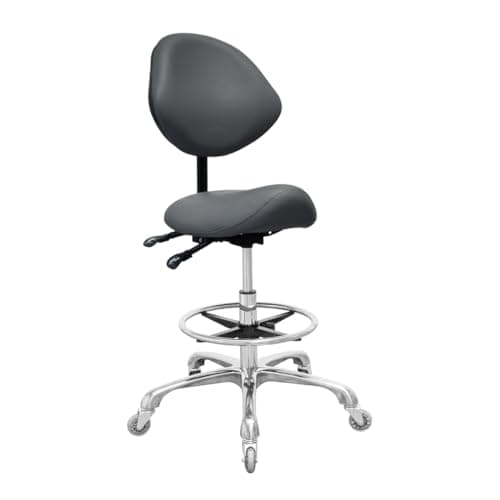 Nazalus Saddle Stool with Back and Footrest Best for Setup | Height, back and footrest | 8.0 | $179.00 - View on Amazon #ad disclosure · September 30, 2026 |
| 2 | 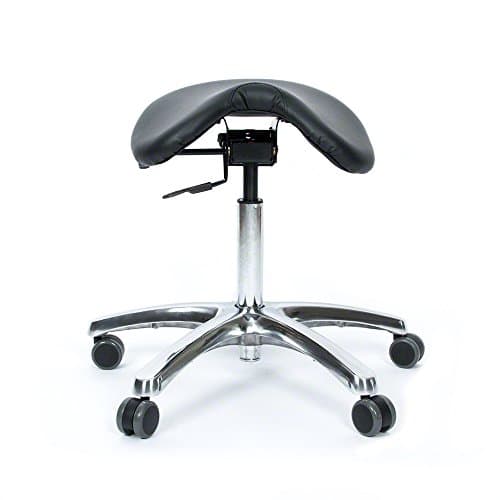 Jobri BetterPosture Saddle Chair Best Tilt Adjustment | Tuning the pelvic angle | 6.6 | $174.99 - View on Amazon #ad disclosure · September 30, 2026 |
| 3 | 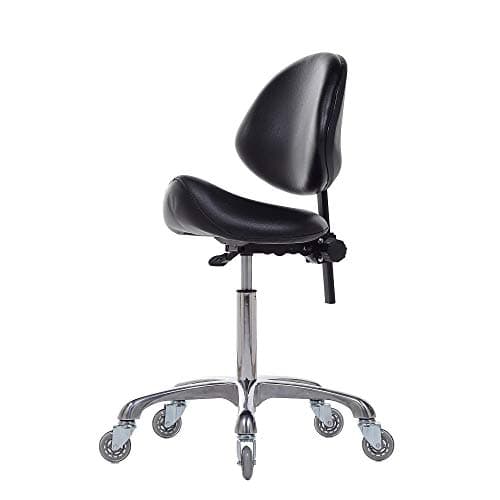 FRNIAMC Adjustable Saddle Stool with Back Support Widest Published Range | 20 to 29.5 inches | 7.8 | $159.00 - View on Amazon #ad disclosure · September 30, 2026 |
01 · Best for Setup
Nazalus Saddle Stool with Back and Footrest
8.0/10 · scored on the published rubric
The only saddle stool here that publishes a range reaching 30.4 in AND carries both a backrest and a footrest ring - the combination that makes a saddle usable at standing-desk height.
Why you might not: The most expensive saddle on the page, and the backrest is small: it is a sacral prop, not something to lean into.
| Seat height | 22.4-30.4 in |
|---|---|
| Rated capacity | 351 lb |
| Footrest | adjustable |
Adjustments published (3): seat height (hand-lever gas cylinder, 22.4-30.4 in); 360-degree swivel; footrest ring.
Not published by the manufacturer: seat depth; seat width; warranty term. We have flagged these rather than guessed.
How this score was built
- Fit range9/10
- Adjustability9/10
- Capacity headroom9/10
- Materials & warranty7/10
- Spec coverage6/10
The overall is the mean of these, rounded to one decimal place. Each criterion is computed from a published figure - the rubric is here.
Price as of September 30, 2026. #ad how this is funded
02 · Best Tilt Adjustment
Jobri BetterPosture Saddle Chair
6.6/10 · scored on the published rubric
A tilting seat pan, which is the adjustment that actually decides whether a saddle suits your hips, on a polished aluminum five-point base.
Why you might not: 250 lb is the lowest published capacity among the saddles, and it costs nearly twice the Antlu that holds 400 lb.
| Seat height | 21-28 in |
|---|---|
| Rated capacity | 250 lb |
Adjustments published (3): seat height (21-28 in); seat tilt; 360-degree swivel.
Not published by the manufacturer: seat depth; seat width; warranty term. We have flagged these rather than guessed.
How this score was built
- Fit range7/10
- Adjustability7/10
- Capacity headroom6/10
- Materials & warranty7/10
- Spec coverage6/10
The overall is the mean of these, rounded to one decimal place. Each criterion is computed from a published figure - the rubric is here.
Price as of September 30, 2026. #ad how this is funded
03 · Widest Published Range
FRNIAMC Adjustable Saddle Stool with Back Support
7.8/10 · scored on the published rubric
A 9.5 in adjustment span and the only published warranty term in the saddle group, which is what makes its cost-per-warranty-year computable at all.
Why you might not: That warranty is one year, which is the shortest term on the site. Computable is not the same as generous.
| Seat height | 20-29.5 in |
|---|---|
| Rated capacity | 350 lb |
| Warranty | 1 year |
| Cost per warranty year | $159.00 |
Adjustments published (3): seat height (20-29.5 in); 360-degree swivel; backrest position.
Not published by the manufacturer: seat depth; seat width. We have flagged these rather than guessed.
How this score was built
- Fit range8/10
- Adjustability7/10
- Capacity headroom9/10
- Materials & warranty7/10
- Spec coverage8/10
The overall is the mean of these, rounded to one decimal place. Each criterion is computed from a published figure - the rubric is here.
Price as of September 30, 2026. #ad how this is funded
Questions people actually ask
How high should a saddle stool be?
Why does my saddle stool hurt my inner thighs?
How far apart should your feet be on a saddle stool?
Are saddle stools comfortable?
Should I use a cushion on a saddle stool?
Read next
Sources
Every figure on this page traces to one of these. Product specifications come from the manufacturer's own listing; prices come from a live lookup and carry the date they were verified.