Saddle stool vs kneeling chair
Both solve the same problem - a flattened lumbar curve - by opening your hip angle. Where they differ is what carries your weight while they do it.
By Sawyer V. · Published September 30, 2026
We earn a commission if you buy through the links on this page, at no extra cost to you. It does not affect the order of the picks - the rubric does that, and here is how we are funded. Prices were last verified September 30, 2026.
What we did and did not do
Units we claim to have tested: 0. Everyone in this category says they tested twenty chairs. We have not sat in any of these, and we say so.
What we did instead: compiled every figure each manufacturer publishes, computed the fit ranges from a cited anthropometric table, and linked the source for each number so you can check the arithmetic. Where a manufacturer does not publish a figure, we say that rather than filling the gap. The full method, including what we cannot assess, is here.
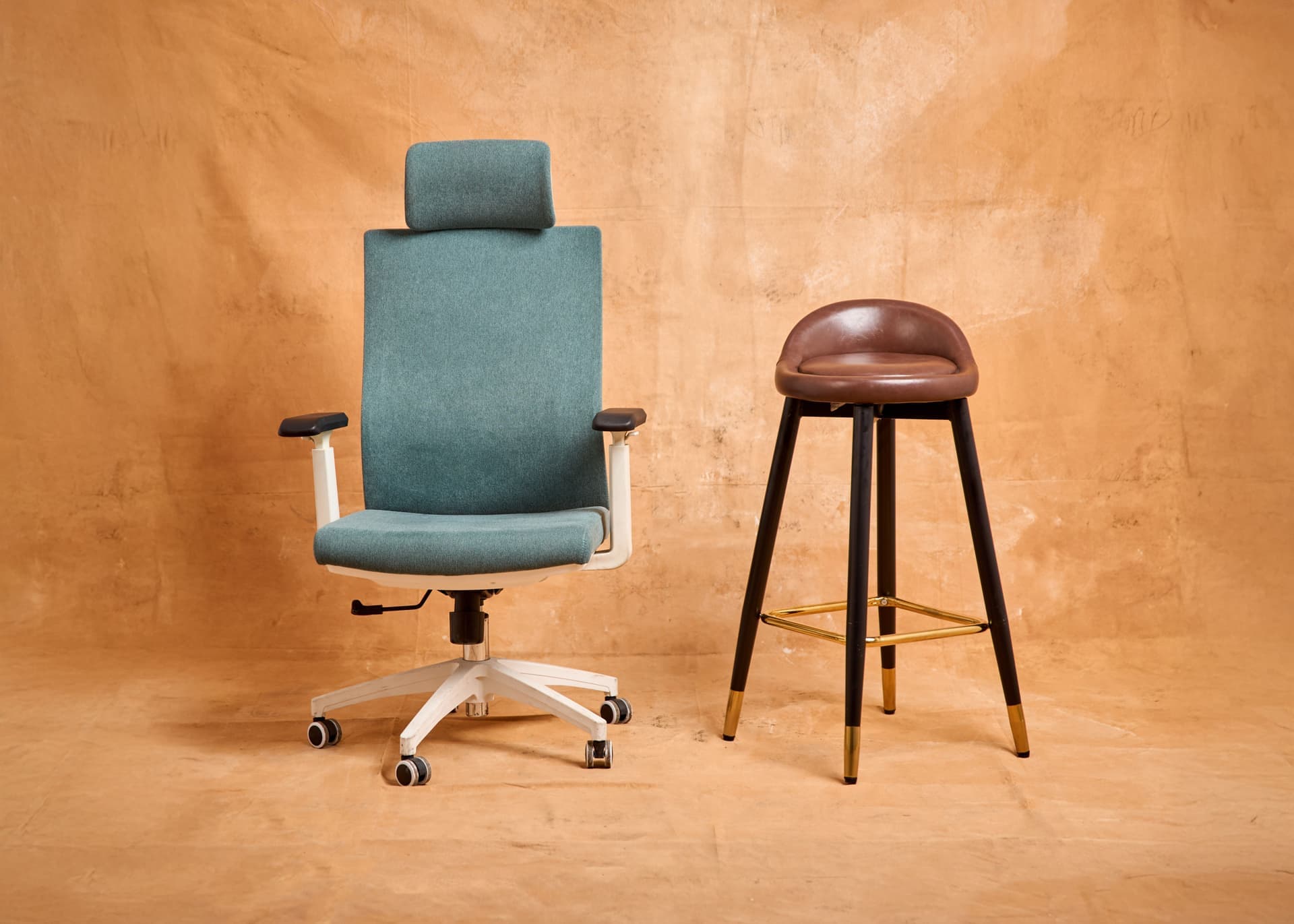
These two products answer the same question and send the bill to different parts of your body. Both open the angle between your trunk and your thighs from a seated 90 degrees to something nearer 120 to 135, which rotates your pelvis forward so the lumbar curve holds itself. That is the shared mechanism and it is genuinely the same idea.
The difference is what supports you while it happens. A saddle stool puts your weight on your sit bones, with your thighs dropping away either side of a shaped seat and your feet on the floor. A kneeling chair tips a flat seat forward and puts a share of your weight on your shins. That single distinction generates every practical difference below.
The decision table
| Saddle stool | Kneeling chair | |
|---|---|---|
| Hip angle | ~135 degrees, from the straddled seat | ~120 degrees, published by one maker |
| Weight goes through | Sit bones and feet | Sit bones and shins |
| Feet position | Flat on the floor, hip-width, weight-bearing | Behind you, not weight-bearing |
| Getting in and out | Straddle it; deliberate but quick | Place both shins; slowest of any seat here |
| Published height range | 19.7-30.4 in across the field | 21-31 in where published; often absent |
| Works at a standing desk? | Sometimes - the tallest reach 30.4 in | No - makers publish 29-35 in desk windows |
| Backrest available? | On four of seven models we looked at | On two of seven |
| Rolls? | Almost always - casters are the norm | Sometimes; wooden-frame models usually do not |
| The thing people complain about | Inner-thigh pressure, mounting and dismounting | Shin pressure, and the entry maneuver |
| Ruled out if | You get up constantly, or a rolling base worries you | You have knee, shin or ankle problems |
Which one is ruled out for you
It is usually faster to eliminate one than to choose between them.
Rule out the kneeling chair if
- You have knee, shin or ankle problems. Load goes through your shins by design. Talk to a clinician before you spend money on this specific geometry.
- Your desk is tall. Makers publish compatible desk windows of 29 to 35 inches. A 42-inch standing desk is outside every one of them - a perch stool is the answer there.
- You get up every ten minutes. Placing both shins is the slowest entry of any seat on this site.
Rule out the saddle stool if
- Inner-thigh pressure is a problem for you. Straddling a seat concentrates contact there, and no amount of padding changes the geometry.
- A rolling base worries you. Most saddles are on casters, and mounting a high castered saddle is a more committed maneuver than sitting in a chair.
- You want to lean back and think. Even the saddles with backrests have small ones - they are sacral props, not something to recline into.
If both are ruled out, the honest answer is a conventional chair with genuine lumbar adjustment - see chairs for back pain, which ranks on published lumbar travel rather than on marketing.
The height arithmetic differs, and it matters
A saddle sits you higher than a chair at the same desk. Your thighs angle downwards rather than hanging vertically, so your hip joint ends up above where it would be in a chair. Practical rule: take your normal seat height from our fit table and expect to want 2 to 4 inches more.
A kneeling chair does not have a comparable figure at all, which is why so few makers publish one. Your weight is split between two surfaces at different heights, so the seat height on its own does not tell you where your torso ends up. Most publish a compatible desk range instead - which is a different measurement and a narrower one than most desks.
That asymmetry is genuinely useful when you are choosing. You can check a saddle against your desk with arithmetic before you buy. You largely cannot check a kneeling chair, which means more of the decision is made after it arrives.
Which one for back pain specifically
This is the query behind most of this comparison, so here is the mechanical answer without a clinical one attached.
Both hold the pelvis in a more neutral tilt than a flat seat, which makes a neutral lumbar curve easier to maintain without conscious effort. Neither is better at that; they achieve it by different routes. Where they differ practically is the secondary load: a saddle asks more of your core over a long day if it is backless, and a kneeling chair asks something of your shins and knees.
So the mechanical tiebreaker is usually about what else is going on with your body rather than about your back. That is a mechanical description, not medical advice. There is no clinician on this site and nothing here is reviewed by one. Persistent or worsening pain, numbness, tingling or weakness is a reason to see a clinician - a seat is not a diagnosis.
The best-specified of each
Ranked on the published rubric. Tap a row for the full write-up; the price button goes straight to Amazon. Every figure in the write-ups is the manufacturer's own published specification, linked at the source. We have not sat in any of these.
| # | Product | Best for | Score | Price |
|---|---|---|---|---|
| 1 | 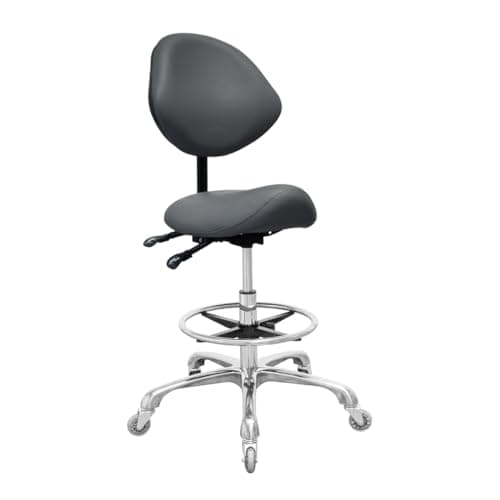 Nazalus Saddle Stool with Back and Footrest Best Saddle Stool | Height, a back and a footrest | 8.0 | $179.00 - View on Amazon #ad disclosure · September 30, 2026 |
| 2 | 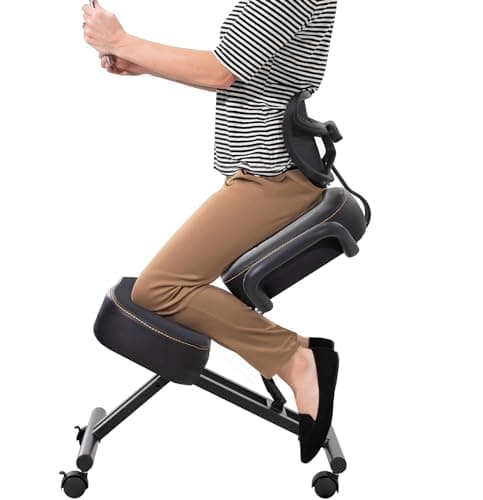 DRAGONN by VIVO Adjustable Kneeling Chair with Back Support Best Kneeling Chair | A back plus a 10 in range | 7.4 | $139.99 - View on Amazon #ad disclosure · September 30, 2026 |
| 3 | 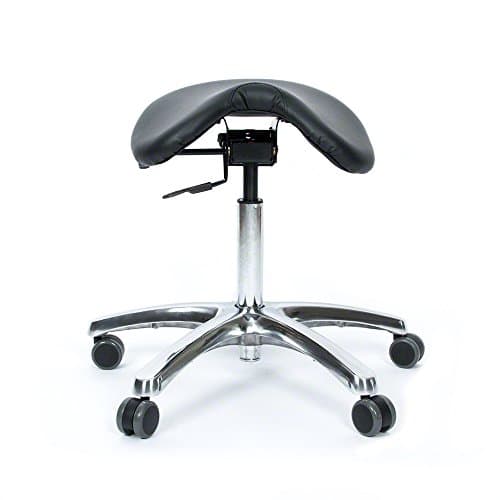 Jobri BetterPosture Saddle Chair Best Saddle With a Tilting Seat | Tuning the pelvic angle | 6.6 | $174.99 - View on Amazon #ad disclosure · September 30, 2026 |
| 4 | 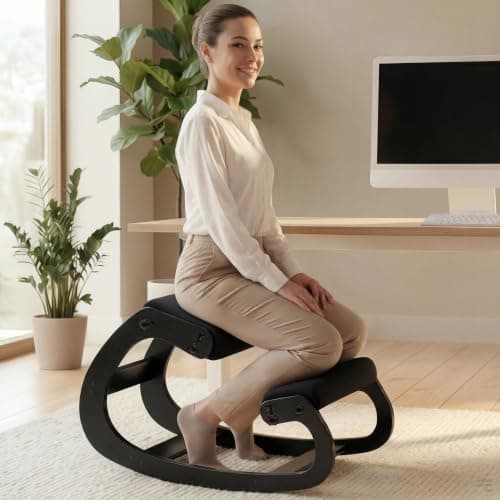 NYPOT Kneeling Chair with Adjustable Seats Longest-Warranted Kneeling Chair | Buying once | 7.0 | $189.99 - View on Amazon #ad disclosure · September 30, 2026 |
01 · Best Saddle Stool
Nazalus Saddle Stool with Back and Footrest
8.0/10 · scored on the published rubric
The only saddle stool here that publishes a range reaching 30.4 in AND carries both a backrest and a footrest ring - the combination that makes a saddle usable at standing-desk height.
Why you might not: The most expensive saddle on the page, and the backrest is small: it is a sacral prop, not something to lean into.
| Seat height | 22.4-30.4 in |
|---|---|
| Rated capacity | 351 lb |
| Footrest | adjustable |
Adjustments published (3): seat height (hand-lever gas cylinder, 22.4-30.4 in); 360-degree swivel; footrest ring.
Not published by the manufacturer: seat depth; seat width; warranty term. We have flagged these rather than guessed.
How this score was built
- Fit range9/10
- Adjustability9/10
- Capacity headroom9/10
- Materials & warranty7/10
- Spec coverage6/10
The overall is the mean of these, rounded to one decimal place. Each criterion is computed from a published figure - the rubric is here.
Price as of September 30, 2026. #ad how this is funded
02 · Best Kneeling Chair
DRAGONN by VIVO Adjustable Kneeling Chair with Back Support
7.4/10 · scored on the published rubric
A 10 in span to 31 in and a backrest, which is the combination almost nothing else in this category publishes. It is the kneeling chair that can also work at a tall desk.
Why you might not: The backrest position is not specified anywhere in the published spec, so whether it lands on your lumbar curve is not something we can tell you in advance.
| Seat height | 21-31 in |
|---|---|
| Rated capacity | 250 lb |
Adjustments published (3): seat height (21-31 in); backrest; casters.
Not published by the manufacturer: seat depth; backrest adjustment range; warranty term. We have flagged these rather than guessed.
How this score was built
- Fit range9/10
- Adjustability8/10
- Capacity headroom7/10
- Materials & warranty7/10
- Spec coverage6/10
The overall is the mean of these, rounded to one decimal place. Each criterion is computed from a published figure - the rubric is here.
Price as of September 30, 2026. #ad how this is funded
03 · Best Saddle With a Tilting Seat
Jobri BetterPosture Saddle Chair
6.6/10 · scored on the published rubric
A tilting seat pan, which is the adjustment that actually decides whether a saddle suits your hips, on a polished aluminum five-point base.
Why you might not: 250 lb is the lowest published capacity among the saddles, and it costs nearly twice the Antlu that holds 400 lb.
| Seat height | 21-28 in |
|---|---|
| Rated capacity | 250 lb |
Adjustments published (3): seat height (21-28 in); seat tilt; 360-degree swivel.
Not published by the manufacturer: seat depth; seat width; warranty term. We have flagged these rather than guessed.
How this score was built
- Fit range7/10
- Adjustability7/10
- Capacity headroom6/10
- Materials & warranty7/10
- Spec coverage6/10
The overall is the mean of these, rounded to one decimal place. Each criterion is computed from a published figure - the rubric is here.
Price as of September 30, 2026. #ad how this is funded
04 · Longest-Warranted Kneeling Chair
NYPOT Kneeling Chair with Adjustable Seats
7.0/10 · scored on the published rubric
A five-year warranty is the longest term on this site, and NYPOT states the desk-height window it suits (29-35 in) instead of leaving you to guess.
Why you might not: It publishes a desk range, not a seat-height range - a different measurement. If your desk is outside 29-35 in, there is no figure here that tells you whether it will work.
| Rated capacity | 250 lb |
|---|---|
| Warranty | 5 years |
| Cost per warranty year | $38.00 |
Adjustments published (2): independently adjustable seat and shin pads; wood-frame angle positions.
Not published by the manufacturer: seat-height range (only a compatible desk range, 29-35 in). We have flagged these rather than guessed.
How this score was built
- Fit range5/10
- Adjustability8/10
- Capacity headroom7/10
- Materials & warranty9/10
- Spec coverage6/10
The overall is the mean of these, rounded to one decimal place. Each criterion is computed from a published figure - the rubric is here.
If you want to try before committing
Worth saying, because both of these are seats people either adapt to or never do: the cheapest genuine test is not a cheaper version of either. It is a short trial at a normal desk. A saddle at 20 to 22 inches and a kneeling chair at a 29-inch desk both cost under a hundred dollars at the bottom of their fields, and both tell you within a week whether the geometry suits you.
What does not work is buying the cheapest example of each and concluding the category is bad. On both pages the bottom-ranked products fail on published specification - no seat-height range, no capacity - and a badly-fitting saddle tells you nothing about saddles.
Questions people actually ask
Which is better for back pain, a saddle stool or a kneeling chair?
Can you use a kneeling chair at a standing desk?
Is a saddle chair the same as a kneeling chair?
Which is easier to get used to?
Do either of them need a footrest?
Read next
Sources
Every figure on this page traces to one of these. Product specifications come from the manufacturer's own listing; prices come from a live lookup and carry the date they were verified.