How to sit on a kneeling chair properly
Most kneeling-chair complaints are setup problems. The seat carries your weight; the shin pads only steady you. Get that ratio right and the rest follows.
By Sawyer V. · Published September 30, 2026
We earn a commission if you buy through the links on this page, at no extra cost to you. It does not affect the order of the picks - the rubric does that, and here is how we are funded. Prices were last verified September 30, 2026.
What we did and did not do
Units we claim to have tested: 0. Everyone in this category says they tested twenty chairs. We have not sat in any of these, and we say so.
What we did instead: compiled every figure each manufacturer publishes, computed the fit ranges from a cited anthropometric table, and linked the source for each number so you can check the arithmetic. Where a manufacturer does not publish a figure, we say that rather than filling the gap. The full method, including what we cannot assess, is here.

The single most common mistake is putting your weight on your shins. A kneeling chair is not a kneeler. The seat is meant to carry most of your body weight; the shin pads are there to stop you sliding forward off it. When people report knee pain from a kneeling chair, it is usually because that ratio has inverted.
And it inverts for a mechanical reason: if the seat is set too low, gravity does the rest. A shallower thigh slope means less of your weight is supported by the seat and more of it slides down onto the pads. So the fix for shin and knee pressure is almost always raise the seat, which is the opposite of what most people try.
The five-step setup
- Set the seat height first, with your shins off the pads. Sit on the seat alone, feet on the floor, and adjust until your thighs slope down at roughly 20 to 30 degrees. That slope is what opens your hip angle; the pads do not create it.
- Place your shins, not your knees. Slide back so the pads contact the front of your shins below the kneecap. The joint should not be bearing load. If the pad is under your kneecap, the seat is too high relative to the pad, or the pad is too far forward.
- Check the weight ratio. Lift both shins off the pads for a second. Stay roughly in place with only a small shift, and the seat is doing its job. Feel yourself sliding forward, and the seat is too low.
- Let your pelvis rotate forward. Do not tuck. The whole mechanism is that the open hip angle tips your pelvis forward so your lumbar curve holds itself - sit tall and allow it, rather than gripping a position.
- Set the desk relationship last. Forearms level with the desk, elbows at roughly a right angle. If that does not come out right, the desk height is wrong and no chair adjustment fixes it.
What correct feels like, and what it does not
Right: most of your weight under your sit bones, shins touching firmly but not loaded, lower back curved inward without effort, shoulders back without trying.
Wrong: pressure building on your shins over minutes; the fronts of your thighs going numb; a conscious effort to hold yourself up; any pressure on the kneecap itself.
The first hour tells you whether the setup is right. The first week tells you whether the geometry suits you. Those are different questions and it is worth separating them before you decide the chair is wrong.
Adjusting the angles
Better kneeling chairs let you move the seat and the shin pad independently, which is the adjustment that matters. Two of the chairs in our field publish it: one gives independently adjustable seat and shin pads, another publishes 24 angle combinations.
What you are tuning is the distance between seat and pad as well as the height. Too close and your knees are over-flexed and the pad pushes into your shin; too far and you are stretched out with your weight sliding forward. There is no published figure for the right distance, and we are not going to invent one - it depends on your lower-leg length, which the fixed-frame chairs simply assume.
That is worth knowing before you buy: a fixed-geometry kneeling chair has made an assumption about your legs. If it is wrong, there is no adjustment to make.
How long to sit, and the build-up
We have not used these chairs and are not going to publish an interval as though we had. What is structurally true is that a kneeling chair puts you in a posture and asks your muscles to keep you there - it is a load rather than a rest, and loads are things you build up to.
The pattern users consistently describe is starting at an hour or two a day and keeping a conventional chair for the rest. That is also what published ergonomic guidance implies more generally: changing posture beats optimizing a single one, whatever that one is.
If you want to unload without leaving the chair, that is an argument for a model with a backrest - two in our field publish one. If you want a second posture rather than a rest, a perch stool or an ordinary task chair with real lumbar travel is the other half of the rotation.
Troubleshooting
| What you feel | Most likely cause | What to change |
|---|---|---|
| Shin or knee pressure building | Seat too low, so weight is sliding onto the pads | Raise the seat. Counter-intuitive, and it is the fix |
| Pressure on the kneecap itself | Pad too far forward, or seat too high relative to it | Move the pad back if it adjusts; lower the seat slightly if not |
| Front of thighs numb | Seat edge pressing into the thigh - depth or angle | Reduce the seat slope slightly, or the seat is too deep for you |
| Lower back aching after an hour | Postural muscles fatiguing - the mechanism, working | Shorter sessions and build up; a backrest model if it is your main seat |
| Sliding forward constantly | Seat too low, or the slope too steep for your weight | Raise the seat; check the pads are actually contacting your shins |
Mechanical, not medical
This page describes setup and mechanism. It is not medical advice, there is no clinician on this site, and nothing here is reviewed by one.
If you have existing knee, shin or ankle problems, a kneeling chair loads your shins by design and that is worth discussing with a clinician before you buy rather than after. Pain that is sharp, radiating, or accompanied by numbness or weakness is not a setup problem.
Kneeling chairs that publish the adjustments
Ranked on the published rubric. Tap a row for the full write-up; the price button goes straight to Amazon. Every figure in the write-ups is the manufacturer's own published specification, linked at the source. We have not sat in any of these.
| # | Product | Best for | Score | Price |
|---|---|---|---|---|
| 1 | 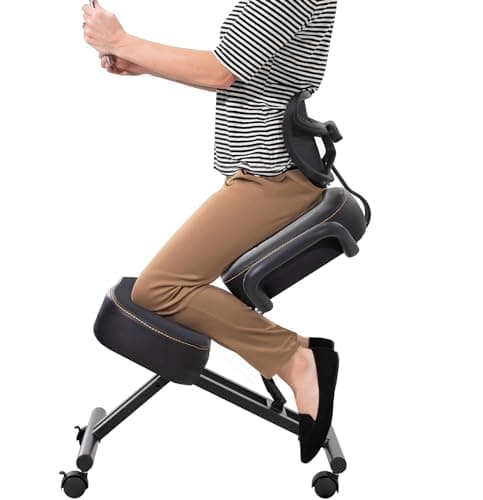 DRAGONN by VIVO Adjustable Kneeling Chair with Back Support Best for Setup Flexibility | A 10 in range plus a back | 7.4 | $139.99 - View on Amazon #ad disclosure · September 30, 2026 |
| 2 | 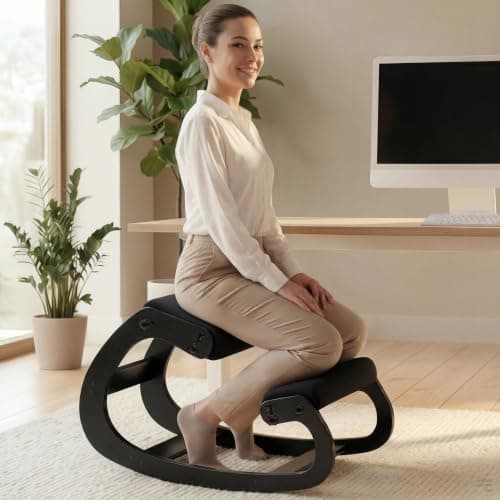 NYPOT Kneeling Chair with Adjustable Seats Best Independent Pad Adjustment | Tuning seat and shin separately | 7.0 | $189.99 - View on Amazon #ad disclosure · September 30, 2026 |
| 3 | 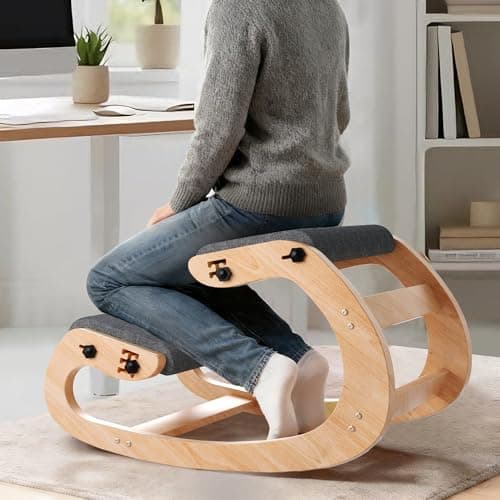 TinyHaven Kneeling Chair, Wooden Frame Most Published Positions | Finding your angle by trial | 6.0 | $99.99 - View on Amazon #ad disclosure · September 30, 2026 |
01 · Best for Setup Flexibility
DRAGONN by VIVO Adjustable Kneeling Chair with Back Support
7.4/10 · scored on the published rubric
A 10 in span to 31 in and a backrest, which is the combination almost nothing else in this category publishes. It is the kneeling chair that can also work at a tall desk.
Why you might not: The backrest position is not specified anywhere in the published spec, so whether it lands on your lumbar curve is not something we can tell you in advance.
| Seat height | 21-31 in |
|---|---|
| Rated capacity | 250 lb |
Adjustments published (3): seat height (21-31 in); backrest; casters.
Not published by the manufacturer: seat depth; backrest adjustment range; warranty term. We have flagged these rather than guessed.
How this score was built
- Fit range9/10
- Adjustability8/10
- Capacity headroom7/10
- Materials & warranty7/10
- Spec coverage6/10
The overall is the mean of these, rounded to one decimal place. Each criterion is computed from a published figure - the rubric is here.
Price as of September 30, 2026. #ad how this is funded
02 · Best Independent Pad Adjustment
NYPOT Kneeling Chair with Adjustable Seats
7.0/10 · scored on the published rubric
A five-year warranty is the longest term on this site, and NYPOT states the desk-height window it suits (29-35 in) instead of leaving you to guess.
Why you might not: It publishes a desk range, not a seat-height range - a different measurement. If your desk is outside 29-35 in, there is no figure here that tells you whether it will work.
| Rated capacity | 250 lb |
|---|---|
| Warranty | 5 years |
| Cost per warranty year | $38.00 |
Adjustments published (2): independently adjustable seat and shin pads; wood-frame angle positions.
Not published by the manufacturer: seat-height range (only a compatible desk range, 29-35 in). We have flagged these rather than guessed.
How this score was built
- Fit range5/10
- Adjustability8/10
- Capacity headroom7/10
- Materials & warranty9/10
- Spec coverage6/10
The overall is the mean of these, rounded to one decimal place. Each criterion is computed from a published figure - the rubric is here.
03 · Most Published Positions
TinyHaven Kneeling Chair, Wooden Frame
6.0/10 · scored on the published rubric
24 published angle combinations is the highest adjustment count in the kneeling group - more ways to find your thigh angle than anything else here.
Why you might not: Counting combinations is not the same as publishing a range. Without seat heights in inches, we cannot say which of those 24 positions suits you.
| Rated capacity | 250 lb |
|---|
Adjustments published (1): 24 published seat and shin-pad angle combinations.
Not published by the manufacturer: seat-height range; seat depth; warranty term. We have flagged these rather than guessed.
How this score was built
- Fit range3/10
- Adjustability9/10
- Capacity headroom7/10
- Materials & warranty7/10
- Spec coverage4/10
The overall is the mean of these, rounded to one decimal place. Each criterion is computed from a published figure - the rubric is here.
Price as of September 30, 2026. #ad how this is funded
Questions people actually ask
Where should your weight be on a kneeling chair?
Should your knees or shins be on the pad?
How do I stop my shins hurting on a kneeling chair?
How long should I sit on a kneeling chair at first?
Should I tuck my pelvis on a kneeling chair?
Read next
Sources
Every figure on this page traces to one of these. Product specifications come from the manufacturer's own listing; prices come from a live lookup and carry the date they were verified.