Are kneeling chairs bad for your knees?
Not by design - the pad belongs under your shins and the seat should carry most of your weight. When knees hurt, one of those two things has gone wrong.
By Sawyer V. · Published September 30, 2026
We earn a commission if you buy through the links on this page, at no extra cost to you. It does not affect the order of the picks - the rubric does that, and here is how we are funded. Prices were last verified September 30, 2026.
Mechanical, not medical
Everything on this page describes what a seat does mechanically - where it puts your pelvis, how it distributes load across the seat pan, what the published angles are. That is a mechanical description, not medical advice. There is no clinician on this site and nothing here is reviewed by one. If you have persistent or worsening pain, numbness or weakness, see a clinician; a chair is not a diagnosis.
What we did and did not do
Units we claim to have tested: 0. Everyone in this category says they tested twenty chairs. We have not sat in any of these, and we say so.
What we did instead: compiled every figure each manufacturer publishes, computed the fit ranges from a cited anthropometric table, and linked the source for each number so you can check the arithmetic. Where a manufacturer does not publish a figure, we say that rather than filling the gap. The full method, including what we cannot assess, is here.

The name is misleading and it causes the problem. You do not kneel on a kneeling chair. On a correctly set one the pad contacts the front of your shins, below the kneecap, and the seat carries most of your body weight. The knee joint itself should not be bearing load at all.
So when people report knee pain, it is almost always one of two setup errors rather than a property of the category.
Error one: the seat is too low
This is the big one, and the fix is counter-intuitive.
Your weight is split between the seat and the shin pad, and the split is set by the slope of the seat and the height of it. A low seat means a shallow thigh angle, which means gravity slides more of your weight forward onto the pad. The lower the seat, the more load your shins take.
So if your shins or knees hurt, raise the seat. Most people's instinct is to lower it - it feels like sinking down will take pressure off - and it does exactly the opposite.
The test takes two seconds: lift both shins off the pads. If you stay roughly in place with only a small shift forward, the seat is carrying its share. If you slide forward, the seat is too low. The full setup sequence is here.
Error two: the pad is on your kneecap
The pad should contact the front of your shin, an inch or two below the kneecap. If it is under the patella itself, you are loading a joint surface that is not built for it, and no amount of padding makes that acceptable.
This happens for two reasons. Either the pad is positioned too far forward - fixable if the chair lets you move it independently - or the chair's fixed geometry has assumed a lower-leg length that is not yours.
Which is the strongest argument for buying a kneeling chair with independently adjustable seat and shin pads. Two chairs in our field publish that: one with independently adjustable seat and pads, another with 24 published angle combinations. A fixed wooden frame has made an assumption about your legs, and if it is wrong there is no adjustment to make.
Shin pressure is not knee pain
Worth separating, because the remedies differ. Shin pressure is contact discomfort on the front of the tibia - a broad ache over the pad area. Knee pain is in the joint. The first is usually a load-share or pad-area problem; the second is a position problem.
For shin pressure, three levers: raise the seat (load share), check the pad is flat against your shin rather than catching an edge, and look at pad area. A deeper, wider pad spreads the same load over more tibia. Almost nobody publishes pad dimensions or thickness, which we score under spec coverage on the roundup rather than guess at.
Who should not use one at all
Said plainly, because this is the part that matters most on this page.
- Anyone with existing knee, shin or ankle problems. Load goes through your shins by design. Even set up correctly, this geometry puts contact pressure somewhere a conventional chair does not. That is a conversation to have with a clinician before buying, not after.
- Anyone recovering from lower-limb surgery or injury. Same reason, more so.
- Anyone who cannot get in and out comfortably. Placing both shins is a deliberate maneuver. If it is difficult, it will be difficult twenty times a day.
- Anyone with reduced circulation in their lower legs. Sustained contact pressure over the tibia is worth discussing with a clinician first.
Mechanical, not medical
Everything above describes mechanics - where load goes, what adjusts, what the published angles are. It is not medical advice, there is no clinician on this site, and nothing here is reviewed by one.
Pain that is sharp, that worsens, that radiates, or that comes with swelling, numbness or weakness is not a setup problem and no amount of adjustment addresses it. See a clinician.
If the geometry is not for you
The useful thing to know is that the kneeling chair's benefit - an open hip angle that keeps your lumbar curve intact - is available without loading your shins at all.
A [saddle stool](/active-seating/saddle-stools) gets to roughly 135 degrees of hip angle with your feet on the floor and your weight on your sit bones. No shin contact whatsoever. The direct comparison is here.
A [chair with real lumbar travel](/chairs/for-back-pain) takes the other route: it accepts the flattened curve and supports it. Less elegant mechanically, no load anywhere unusual.
Kneeling chairs that let you fix the position
Ranked on the published rubric. Tap a row for the full write-up; the price button goes straight to Amazon. Every figure in the write-ups is the manufacturer's own published specification, linked at the source. We have not sat in any of these.
| # | Product | Best for | Score | Price |
|---|---|---|---|---|
| 1 | 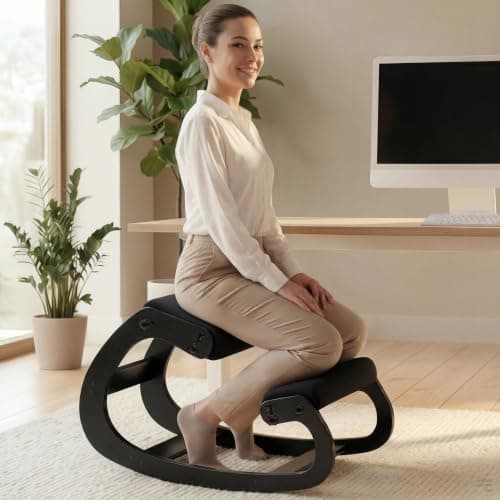 NYPOT Kneeling Chair with Adjustable Seats Best Independent Adjustment | Moving seat and pad separately | 7.0 | $189.99 - View on Amazon #ad disclosure · September 30, 2026 |
| 2 | 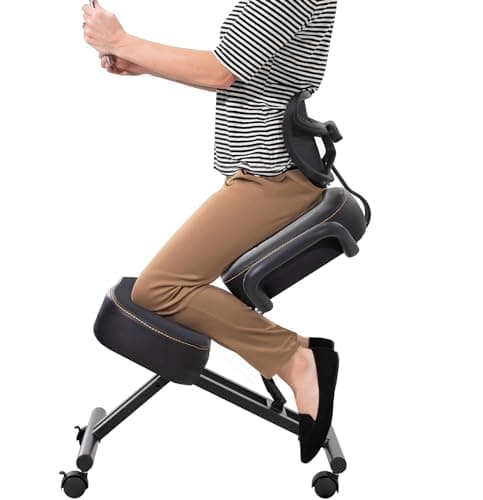 DRAGONN by VIVO Adjustable Kneeling Chair with Back Support Widest Height Range | Raising the seat when shins hurt | 7.4 | $139.99 - View on Amazon #ad disclosure · September 30, 2026 |
| 3 | 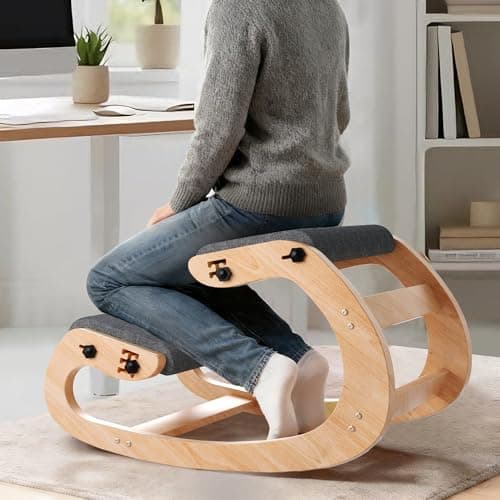 TinyHaven Kneeling Chair, Wooden Frame Most Published Positions | Trial and error, cheaply | 6.0 | $99.99 - View on Amazon #ad disclosure · September 30, 2026 |
01 · Best Independent Adjustment
NYPOT Kneeling Chair with Adjustable Seats
7.0/10 · scored on the published rubric
A five-year warranty is the longest term on this site, and NYPOT states the desk-height window it suits (29-35 in) instead of leaving you to guess.
Why you might not: It publishes a desk range, not a seat-height range - a different measurement. If your desk is outside 29-35 in, there is no figure here that tells you whether it will work.
| Rated capacity | 250 lb |
|---|---|
| Warranty | 5 years |
| Cost per warranty year | $38.00 |
Adjustments published (2): independently adjustable seat and shin pads; wood-frame angle positions.
Not published by the manufacturer: seat-height range (only a compatible desk range, 29-35 in). We have flagged these rather than guessed.
How this score was built
- Fit range5/10
- Adjustability8/10
- Capacity headroom7/10
- Materials & warranty9/10
- Spec coverage6/10
The overall is the mean of these, rounded to one decimal place. Each criterion is computed from a published figure - the rubric is here.
02 · Widest Height Range
DRAGONN by VIVO Adjustable Kneeling Chair with Back Support
7.4/10 · scored on the published rubric
A 10 in span to 31 in and a backrest, which is the combination almost nothing else in this category publishes. It is the kneeling chair that can also work at a tall desk.
Why you might not: The backrest position is not specified anywhere in the published spec, so whether it lands on your lumbar curve is not something we can tell you in advance.
| Seat height | 21-31 in |
|---|---|
| Rated capacity | 250 lb |
Adjustments published (3): seat height (21-31 in); backrest; casters.
Not published by the manufacturer: seat depth; backrest adjustment range; warranty term. We have flagged these rather than guessed.
How this score was built
- Fit range9/10
- Adjustability8/10
- Capacity headroom7/10
- Materials & warranty7/10
- Spec coverage6/10
The overall is the mean of these, rounded to one decimal place. Each criterion is computed from a published figure - the rubric is here.
Price as of September 30, 2026. #ad how this is funded
03 · Most Published Positions
TinyHaven Kneeling Chair, Wooden Frame
6.0/10 · scored on the published rubric
24 published angle combinations is the highest adjustment count in the kneeling group - more ways to find your thigh angle than anything else here.
Why you might not: Counting combinations is not the same as publishing a range. Without seat heights in inches, we cannot say which of those 24 positions suits you.
| Rated capacity | 250 lb |
|---|
Adjustments published (1): 24 published seat and shin-pad angle combinations.
Not published by the manufacturer: seat-height range; seat depth; warranty term. We have flagged these rather than guessed.
How this score was built
- Fit range3/10
- Adjustability9/10
- Capacity headroom7/10
- Materials & warranty7/10
- Spec coverage4/10
The overall is the mean of these, rounded to one decimal place. Each criterion is computed from a published figure - the rubric is here.
Price as of September 30, 2026. #ad how this is funded
Questions people actually ask
Are kneeling chairs bad for your knees?
How do I stop a kneeling chair hurting my shins?
Should the pad be under my knees or my shins?
Can kneeling chairs cause knee problems long-term?
Are kneeling chairs good for your hip flexors?
Read next
Sources
Every figure on this page traces to one of these. Product specifications come from the manufacturer's own listing; prices come from a live lookup and carry the date they were verified.