Perch STSA2: a published tilt range, and a 15-year warranty
Only two stools in this category measure their forward tilt rather than describing it, and this is the one that publishes a range. It also publishes a warranty twice as long as anything else here, and no weight limit at all.
By Sawyer V. · Published October 17, 2026
We earn a commission if you buy through the links on this page, at no extra cost to you. It does not affect the order of the picks - the rubric does that, and here is how we are funded. Prices were last verified October 17, 2026.
What we did and did not do
Units we claim to have tested: 0. Everyone in this category says they tested twenty chairs. We have not sat in any of these, and we say so.
What we did instead: compiled every figure each manufacturer publishes, computed the fit ranges from a cited anthropometric table, and linked the source for each number so you can check the arithmetic. Where a manufacturer does not publish a figure, we say that rather than filling the gap. The full method, including what we cannot assess, is here.
This stool publishes its forward tilt as a range: 3 to 11 degrees. One other product in the perch category publishes a tilt angle at all - the Uprite Ergo's 10 degrees - and the rest describe movement instead of measuring it: "360-degree tilt", "active motion", "counter-balanced". A seat that leans 3 degrees and a seat that leans 15 are both describable that way. Perch gives you both ends of the number.
It also publishes a 15-year warranty on materials and workmanship, plus replacement gas cylinders free for the life of the stool. Thirteen of the 121 products on this site publish a warranty term at all, and the next longest is seven years on a foam mat. For a stool whose single most failure-prone part is the gas cylinder, a lifetime cylinder commitment is the most substantive build claim in our set.
And it publishes no weight capacity. None. Not a figure, not a standard, nothing - on a stool you half-stand on, held up by one column. That is the gap, it is a real one, and it is why this scores 1 out of 10 on capacity headroom below even as it wins on build.
What Perch publishes
| Figure | Published value | Rubric criterion |
|---|---|---|
| Seat-height range | 21.5 to 31.5 in (10 in of travel) | Fit range |
| Forward tilt | 3 to 11 degrees | Adjustability |
| Height adjustment | One-touch pneumatic lever, full range | Adjustability |
| Foot ring | Integrated | Footrest provision |
| Seat material | High-strength polyurethane | Materials and build |
| Base | 5-leg fiberglass-reinforced nylon | Materials and build |
| Overall footprint | 26 x 26 in, 31 in height | - |
| Floor contact | Stationary caps - no casters | Materials and build |
| Warranty | 15 years, materials and workmanship | Materials and build / value |
| Cylinders | Free replacements for the life of the stool | Materials and build |
| Model | STSA2 | - |
| Rated capacity | Not published | Capacity headroom |
| Seat depth and width | Not published | Fit range |
The tilt figure, and why it is the one that matters here
A perch stool's whole job is to hold you at a forward angle so your hips stay open and some of your weight goes through your feet. The angle is the product. Which makes it remarkable that almost nobody states it.
Two products in our perch field say anything numeric about it: this one at 3 to 11 degrees, and the Uprite Ergo at 10 degrees forward and back on a center pivot. The other four publish a direction count or a verb - a 360-degree swivel, a counter-balanced tilt - and neither of those gives an amount. The perch roundup ranks the field on exactly this.
A range beats a single figure here, and that is the practical difference between this stool and the Uprite. 3 degrees is a barely-perceptible forward set for typing; 11 is a genuine lean for close work. One stool that covers both is doing something a fixed 10-degree pivot cannot.
The foot ring solves the problem the category usually ignores
At a 31.5 in seat your feet are nowhere near the floor. OSHA's seat-height criterion is that the height is right "when the entire sole of the foot can rest on the floor with the back of the knee slightly higher than the seat of the chair" - which at perching height is simply impossible, so something has to substitute for the floor or your thighs carry your legs all session.
Only two of the fourteen stools in our set publish a footrest of any kind - this one, with an integrated foot ring, and the IWMH. It is the feature a drafting chair has and a perch stool almost never does, and the absence of one was the single strongest criticism we made of the stool this review replaces. What Perch does not publish is how far the ring adjusts, or whether it adjusts at all - a gap it shares with nearly everything here: of the 38 task and drafting chairs we have verified, exactly one publishes a footrest dimension.
What the height range covers, and what it does not
Perching height is your work-surface height minus your sitting elbow-rest height, which runs 7.5 to 11.4 in across adults with a median near 9.5.
Perch height for every desk height
| Desk height | Seat height needed | Mid-point | Suits roughly |
|---|---|---|---|
| 36 in | 24.6-28.5 in | 26.4 in | outside the published range |
| 38 in | 26.6-30.5 in | 28.4 in | 4'10"-5'2" |
| 40 in | 28.6-32.5 in | 30.4 in | 5'2"-5'5" |
| 42 in | 30.6-34.5 in | 32.4 in | 5'6"-5'8" |
| 44 in | 32.6-36.5 in | 34.4 in | 5'9"-5'11" |
| 46 in | 34.6-38.5 in | 36.4 in | 6'0"-6'8" |
| 48 in | 36.6-40.5 in | 38.4 in | outside the published range |
A 36 in counter wants about 26.5 in - comfortably mid-range. A 40 in desk wants about 30.5 in, inside the range with an inch to spare. A 42 in standing desk wants about 32.5 in, which this stool does not reach. For a 42 in desk the IWMH at 33.5 in is the taller option, and above about 43 in nothing in our set publishes a high enough range at all.
So be clear about what you are buying: this is a stool for a counter, a bench or a lower standing desk, not for a tall one. The 10 inches of travel are generous and they start and stop lower than the category's tallest.
No casters, which is a choice rather than an omission
Perch publishes stationary caps rather than wheels - "without wheels - stationary caps keep the stool firmly in place unless it is lifted and carried". On a half-seated stool that is arguably the right call - a caster base can roll out from under you when you are perched rather than seated, which is the failure mode weighted and non-slip bases exist to prevent.
It is still a real trade. If you need to move between positions without standing up, this is the wrong stool and a castered one is the right one. Perch is explicit about the intent: the listing names industrial workstations, healthcare settings and offices - places where a seat that stays put is the point.
The arithmetic we can run
Cost per warranty year - price divided by published term, the figure the card below computes. At 15 years it is the lowest of any seat on this site: the next-best seat is a kneeling chair with a five-year term at nearly twice the cost per covered year, and the worst figures here are the three products carrying one-year terms, two of them 700 lb chairs. Every published term on this site, counted.
That calculation is the reason to take the price seriously rather than flinch at it. This is the most expensive stool in our field of fourteen - and the only one of them that publishes a warranty term at all, so it is also the only stool here whose cost per warranty year can be computed. Whether 15 years of cover is worth more to you than 2 inches of ceiling is a real decision, and it is the one this stool asks you to make.
Capacity headroom: not computable. Our working rule is that a seat suits a user up to about 80 percent of its rating, and there is no rating. For reference the nine stools in our set that do publish one run 220 to 330 lb, and ANSI/BIFMA X5.1 - the general office-chair standard - runs its tests around a 275 lb occupant. We are not going to estimate where this stool sits against that.
Should you buy it?
Buy it if your surface is between about 31 and 41 in, you want the forward angle actually specified rather than described, and a 15-year warranty with lifetime cylinders is worth paying for. On published figures it is the best-documented stool in this category on everything except weight.
Buy the IWMH instead if your desk is 42 in or above - it publishes 25.6 to 33.5 in, now the tallest ceiling in our field, plus a backrest and a footrest - accepting that it publishes no capacity either. Full review.
Buy the Uprite Ergo instead if the tilt figure is what you came for and the price is not. It publishes 10 degrees forward and back, a 22 to 28.5 in range and a seat size, for roughly a third of the money - with a lower ceiling again and no warranty term.
Skip all three if you need a published weight rating. None of them gives one. Drafting chairs routinely publish 300 lb and reach similar heights with an adjustable foot ring, and that is the honest alternative if capacity is your binding constraint.
We have not sat on this stool. Every figure above is read off Perch's own published specification, linked on the card, and the figures it omits are named rather than filled in. Whether 11 degrees feels like enough lean, whether a polyurethane seat is comfortable for three hours, and whether the stationary caps are a relief or an irritation are exactly what this method cannot reach. The full list of what we cannot assess.
The stool, and two alternatives
Ranked on the published rubric. Tap a row for the full write-up; the price button goes straight to Amazon. Every figure in the write-ups is the manufacturer's own published specification, linked at the source. We have not sat in any of these.
| # | Product | Best for | Score | Price |
|---|---|---|---|---|
| 1 | 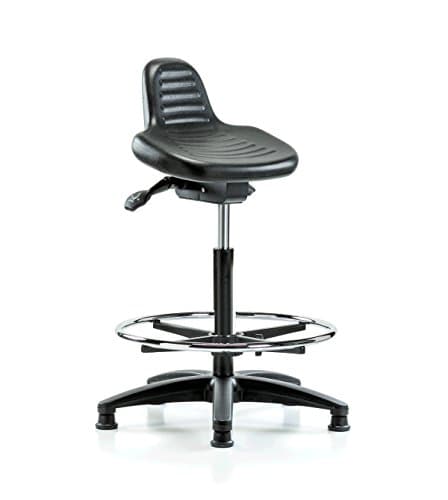 Perch Chairs & Stools STSA2 Sit-Stand Stool with Foot Ring The Stool Under Review | A measured tilt and a 15-year term | 6.8 | $305.00 - View on Amazon #ad disclosure · October 17, 2026 |
| 2 | 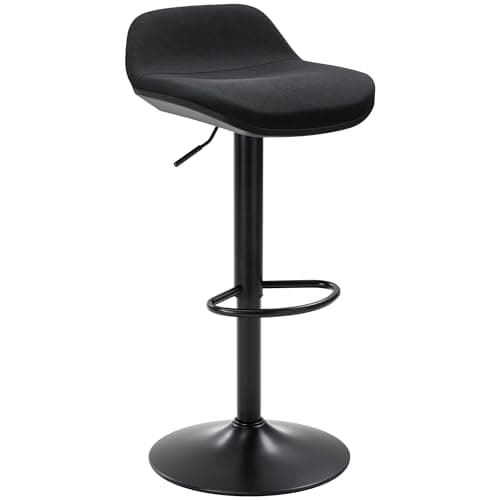 IWMH Standing Desk Stool with Backrest and Footrest The Alternative That Reaches Higher | 33.5 in, with a back | 6.4 | $99.99 - View on Amazon #ad disclosure · October 17, 2026 |
| 3 | 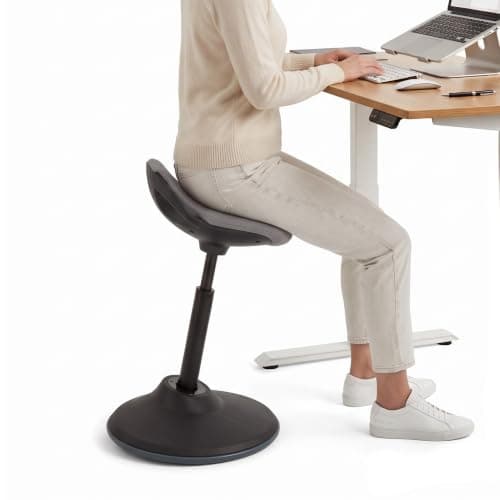 Uprite Ergo Active Desk Stool with Saddle Seat The Cheaper Published Tilt | 10 degrees, far less money | 5.2 | $114.99 - View on Amazon #ad disclosure · October 17, 2026 |
01 · The Stool Under Review
Perch Chairs & Stools STSA2 Sit-Stand Stool with Foot Ring
6.8/10 · scored on the published rubric
The only stool on this site that publishes its forward tilt as a range - 3 to 11 degrees - alongside a 15-year warranty and free replacement gas cylinders for the life of the stool. It is also one of only two stools here that publish a footrest at all.
Why you might not: A 31.5 in ceiling stops two inches short of the tallest stool here, and Perch publishes no rated capacity at all. Stationary caps rather than casters, so it stays where you put it unless you carry it.
| Seat height | 21.5-31.5 in |
|---|---|
| Footrest | fixed |
| Warranty | 15 years |
| Cost per warranty year | $20.33 |
Adjustments published (3): seat height (21.5-31.5 in, one-touch pneumatic lever); forward tilt, 3 to 11 degrees; integrated foot ring.
Not published by the manufacturer: rated capacity; seat depth; seat width; foot ring adjustment. We have flagged these rather than guessed.
How this score was built
- Fit range7/10
- Adjustability9/10
- Capacity headroom1/10
- Materials & warranty10/10
- Spec coverage7/10
The overall is the mean of these, rounded to one decimal place. Each criterion is computed from a published figure - the rubric is here.
Price as of October 17, 2026. #ad how this is funded
02 · The Alternative That Reaches Higher
IWMH Standing Desk Stool with Backrest and Footrest
6.4/10 · scored on the published rubric
The only stool in this group that publishes a range starting at 25.6 in and still climbing to 33.5 in, and one of very few with both a lumbar backrest and a footrest.
Why you might not: IWMH publishes no weight capacity at all. We cannot assess a figure the manufacturer will not state, so if you need capacity headroom, buy something that publishes it.
| Seat height | 25.6-33.5 in |
|---|---|
| Footrest | fixed |
Adjustments published (2): seat height (mechanism under seat, 65-85 cm); 360-degree swivel.
Not published by the manufacturer: rated capacity; seat depth; warranty term. We have flagged these rather than guessed.
How this score was built
- Fit range10/10
- Adjustability9/10
- Capacity headroom2/10
- Materials & warranty7/10
- Spec coverage4/10
The overall is the mean of these, rounded to one decimal place. Each criterion is computed from a published figure - the rubric is here.
Price as of October 17, 2026. #ad how this is funded
03 · The Cheaper Published Tilt
Uprite Ergo Active Desk Stool with Saddle Seat
5.2/10 · scored on the published rubric
The only stool in this field that publishes its tilt as an angle - 10 degrees forward and back on a center pivot - and it publishes a seat size and a pad thickness as well, which almost nothing here does.
Why you might not: A 28.5 in ceiling is the shortest in this field by a wide margin, so it suits a 36-38 in surface rather than a 42 in standing desk. Uprite Ergo publishes no rated capacity at all.
| Seat height | 22-28.5 in |
|---|---|
| Seat depth | 15.5 in |
| Seat width | 14.5 in |
| Thickness | 2.5 in |
Adjustments published (2): seat height (22-28.5 in, a published 6.5 in of travel); center pivot, tilting up to 10 degrees forward and backward.
Not published by the manufacturer: rated capacity; warranty term. We have flagged these rather than guessed.
How this score was built
- Fit range4/10
- Adjustability8/10
- Capacity headroom1/10
- Materials & warranty7/10
- Spec coverage6/10
The overall is the mean of these, rounded to one decimal place. Each criterion is computed from a published figure - the rubric is here.
Questions people actually ask
How far does the Perch STSA2 tilt?
What is the Perch STSA2 seat height?
What is the Perch STSA2 weight capacity?
Does the Perch STSA2 have a footrest?
Does the Perch STSA2 have wheels?
What warranty does the Perch STSA2 come with?
Have you tested the Perch STSA2?
Read next
Sources
Every figure on this page traces to one of these. Product specifications come from the manufacturer's own listing; prices come from a live lookup and carry the date they were verified.
- Perch STSA2 sit-stand stool - manufacturer's published specification on the Amazon listing
- OSHA eTool, Computer Workstations - Chairs
- Pheasant & Haslegrave, Bodyspace: Anthropometry, Ergonomics and the Design of Work - percentile table as tabulated by RoyMech
- ANSI/BIFMA X5.1, General Purpose Office Chairs - test summary (Micom Laboratories)