Should you use a footrest at your desk?
There is a one-minute test, and it gives a yes-or-no answer. Most people who need one do not know it, because they solved the problem by lowering the chair.
By Sawyer V. · Published September 30, 2026
We earn a commission if you buy through the links on this page, at no extra cost to you. It does not affect the order of the picks - the rubric does that, and here is how we are funded. Prices were last verified September 30, 2026.
What we did and did not do
Units we claim to have tested: 0. Everyone in this category says they tested twenty chairs. We have not sat in any of these, and we say so.
What we did instead: compiled every figure each manufacturer publishes, computed the fit ranges from a cited anthropometric table, and linked the source for each number so you can check the arithmetic. Where a manufacturer does not publish a figure, we say that rather than filling the gap. The full method, including what we cannot assess, is here.

The test takes a minute and the answer is yes or no.
- Set your chair so your forearms are level with the desk and your elbows near a right angle. That is your correct seat height, whatever it does to your feet.
- Now look at your feet. If the whole sole rests flat on the floor with your knees at roughly a right angle, you do not need a footrest.
- If your feet dangle, or only your toes reach, or you have tucked them under the chair, you need one - and the gap between the sole of your foot and the floor is the height to buy.
The reason most people who need one do not realize it is step one. They set the chair for their feet instead of the desk, which resolves the visible problem and creates an invisible one: shoulders raised, wrists extended, and a reach up to the keyboard held for eight hours.
Why the desk is the real culprit
A standard desk is 29 to 30 inches. Published data puts the right work-surface height for seated typing at your seated elbow height, which for most adults means a desk somewhere between about 25 and 30 inches. The standard is set near the top of that band - which is to say it is set for a tall user.
If you are shorter than about 5 ft 8 in and your desk does not adjust, you are being asked to choose between correct elbows and correct feet. A footrest removes the choice. That is its entire function and it is not a small one.
What it does mechanically
Three things follow from having your feet supported, and they compound.
It restores the knee angle. OSHA's criterion is the whole sole of the foot resting on a surface with the back of the knee slightly higher than the seat. Dangling feet fail that directly.
It gets your weight off the seat edge. With nothing under your feet, the front edge of the seat carries load it was not designed for, pressing into the underside of your thigh. This is the source of a great deal of "the chair is uncomfortable" that is not actually about the chair.
It stops your pelvis rotating backwards. Which matters because a backward-rotated pelvis is what flattens your lumbar curve - so a footrest acts upstream of your chair's lumbar support rather than instead of it. That is why our lumbar guide points at footrests, and why fixing your feet sometimes resolves a back complaint that a lumbar cushion did not.
Sizing one to your gap
Measure the gap - sole of foot to floor, chair at correct height, lower legs vertical - then buy to it. Most seated gaps land between 3 and 7 inches.
| Your gap | What to look for | Published examples |
|---|---|---|
| Under 2 in | Nothing. Lower the chair slightly instead | - |
| 3-6 in | Continuous adjustment, so you can match it exactly | Mind Reader, 3.25-6.25 in |
| 4-6.5 in | Stepped is fine if a step lands on your gap | HUANUO, 3.9 / 5.3 / 6.5 in |
| 6-7.5 in | The taller stepped options | Nockovi, 6.1 / 7.3 in |
| Over 10 in | A foot ring on the chair, not a footrest | See drafting chairs |
And get one that tilts if you can. A flat platform holds your ankle at one angle all day; a tilting one lets it change, which is the same argument as adjustability anywhere else on this site. The widest published tilt range in our field is 0 to 30 degrees. Full ranking here.
When a footrest is the wrong answer
- Your desk adjusts. Lower the desk instead - as long as your knees still fit under it. That fixes the cause rather than compensating for it.
- You are on a tall stool or drafting chair. At 30-plus inches of seat height the gap is far beyond what any under-desk footrest covers. You want a ring attached to the seat, which moves with it.
- Your problem is seat depth, not height. If the seat edge presses your calf even with your feet supported, the seat is too deep for you and a footrest does not touch that. Check your maximum depth here.
- You just want somewhere to put your feet up. That is an ottoman, and there is nothing wrong with wanting one - but it is not the ergonomic case.
Footrests, sized by gap
Ranked on the published rubric. Tap a row for the full write-up; the price button goes straight to Amazon. Every figure in the write-ups is the manufacturer's own published specification, linked at the source. We have not sat in any of these.
| # | Product | Best for | Score | Price |
|---|---|---|---|---|
| 1 | 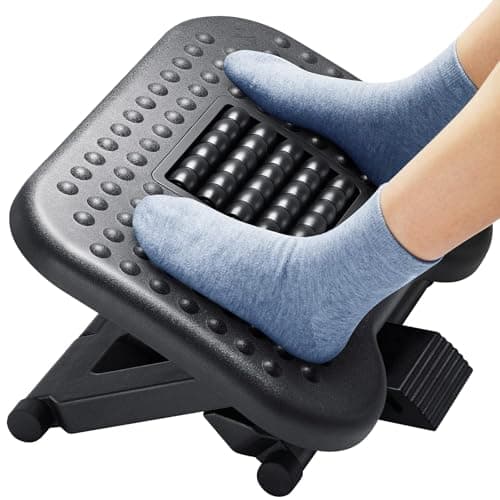 HUANUO Adjustable Footrest Best Overall | Three heights plus 30-degree tilt | 8.2 | $35.99 - View on Amazon #ad disclosure · September 30, 2026 |
| 2 | 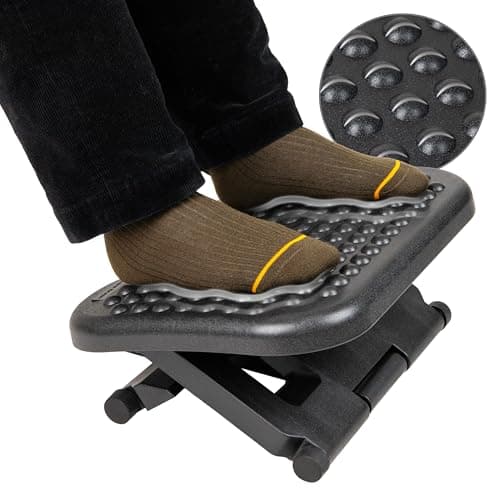 Mind Reader Height-Adjustable Foot Rest Best for a Small Gap | Continuous, from 3.25 in | 7.4 | $26.99 - View on Amazon #ad disclosure · September 30, 2026 |
| 3 | 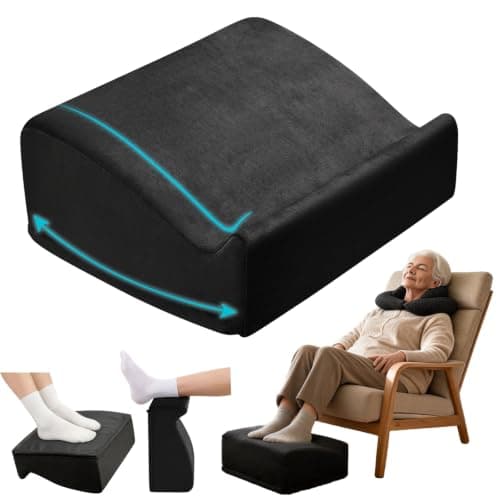 Nockovi Rocking Footrest Best for a Large Gap | 6.1 and 7.3 in, with tilt | 6.8 | $29.99 - View on Amazon #ad disclosure · September 30, 2026 |
01 · Best Overall
HUANUO Adjustable Footrest
8.2/10 · scored on the published rubric
Three published heights and a 30 degree tilt range - the most adjustment of any footrest here, and the reason it is the pick for a chair you cannot lower far enough.
Why you might not: The three heights are fixed positions, not a continuous range, so if your gap is 4.6 in you are choosing between too low and too high.
| Platform height | 3.9-6.5 in |
|---|---|
| Footprint | 17.3 x 13.1 in |
Adjustments published (2): three platform heights: 3.9, 5.3 and 6.5 in; tilt 0-30 degrees.
Not published by the manufacturer: rated capacity; warranty term. We have flagged these rather than guessed.
How this score was built
- Fit range9/10
- Adjustability10/10
- Size & footprint8/10
- Materials & warranty7/10
- Spec coverage7/10
The overall is the mean of these, rounded to one decimal place. Each criterion is computed from a published figure - the rubric is here.
Price as of September 30, 2026. #ad how this is funded
02 · Best for a Small Gap
Mind Reader Height-Adjustable Foot Rest
7.4/10 · scored on the published rubric
A 3 in continuous adjustment span from the lowest published start height here (3.25 in), which is what a short gap actually needs.
Why you might not: No published tilt, so the platform angle is whatever it is - and angle is half of what a footrest does.
| Platform height | 3.25-6.25 in |
|---|---|
| Footprint | 17 x 13 in |
Adjustments published (1): platform height 3.25-6.25 in.
Not published by the manufacturer: rated capacity; tilt range; warranty term. We have flagged these rather than guessed.
How this score was built
- Fit range10/10
- Adjustability7/10
- Size & footprint8/10
- Materials & warranty6/10
- Spec coverage6/10
The overall is the mean of these, rounded to one decimal place. Each criterion is computed from a published figure - the rubric is here.
Price as of September 30, 2026. #ad how this is funded
03 · Best for a Large Gap
Nockovi Rocking Footrest
6.8/10 · scored on the published rubric
The tallest published pair of heights here (6.1 and 7.3 in) with a 15 degree angle built in - the right shape for a chair that is genuinely too high for you.
Why you might not: Two positions only, and 6.1 in is its floor. On a chair you can lower, it will be too tall.
| Platform height | 6.1-7.3 in |
|---|---|
| Footprint | 15 x 12.6 in |
Adjustments published (3): two heights: 6.1 in and 7.3 in; 15 degree fixed tilt; rocking base.
Not published by the manufacturer: rated capacity; warranty term. We have flagged these rather than guessed.
How this score was built
- Fit range8/10
- Adjustability8/10
- Size & footprint6/10
- Materials & warranty6/10
- Spec coverage6/10
The overall is the mean of these, rounded to one decimal place. Each criterion is computed from a published figure - the rubric is here.
Questions people actually ask
Should I use a footrest at my desk?
Is a footrest worth it?
How high should a footrest be?
Why use a footrest at work?
Can a footrest help with back pain?
Should a footrest be flat or angled?
Read next
Sources
Every figure on this page traces to one of these. Product specifications come from the manufacturer's own listing; prices come from a live lookup and carry the date they were verified.