Coceeb saddle chair: the only saddle seat here that publishes a seat width
Nearly every saddle listing sells you a shape and leaves out the dimensions of it. Coceeb publishes the width, the range, the capacity and the cylinder class - and still never says how far the seat tilts.
By Sawyer V. · Published November 16, 2026
We earn a commission if you buy through the links on this page, at no extra cost to you. It does not affect the order of the picks - the rubric does that, and here is how we are funded. Prices were last verified November 17, 2026.
What we did and did not do
Units we claim to have tested: 0. Everyone in this category says they tested twenty chairs. We have not sat in any of these, and we say so.
What we did instead: compiled every figure each manufacturer publishes, computed the fit ranges from a cited anthropometric table, and linked the source for each number so you can check the arithmetic. Where a manufacturer does not publish a figure, we say that rather than filling the gap. The full method, including what we cannot assess, is here.
Coceeb publishes an 18.1 in seat width, and no other saddle seat on this site publishes one at all. That sounds like a small thing and it is not. A saddle is a shape you straddle rather than a pan you sit back in, so its width is what decides whether your thighs are supported or your legs are splayed over an edge - and it is the single figure the category almost universally leaves out, in favor of photographs and the word *ergonomic*.
The rest of the sheet is unusually complete for the money: a 23.6 to 30.7 in seat-height range, a 400 lb rating, an SGS-tested Level 3 gas lift, a height-adjustable foot ring and a backrest whose height *and* arc move on a multi-function tray. On this site's clinical saddle page that combination is what puts it at rank 1.
And it still never says how far the seat tilts forward - which is the mechanism the entire saddle category is sold on. That is the blank worth knowing about before you buy, and it is the reason this page exists.
Buy it if you work at a clinical or salon height and you want the fit figures in writing rather than inferred. Buy the JMU instead if you want an angle published in degrees and will pay roughly double for it. Buy the Nazalus instead if your working height sits lower and you would rather not pay for a ceiling you will never wind up to.
What Coceeb publishes
| Figure | Published value | Rubric criterion |
|---|---|---|
| Seat-height range | 23.6-30.7 in, 7.1 in of travel | Fit range |
| Seat width | 18.1 in - the only one published in this field | Fit range |
| Rated capacity | 400 lb | Capacity headroom |
| Gas cylinder | SGS-tested Level 3 | Materials and build |
| Foot ring | Height-adjustable | Footrest provision |
| Backrest | Height and arc, on a multi-function tray | Adjustability |
| Base | Reinforced 5-leg aluminum | Materials and build |
| Casters | Reinforced nylon dual swivel, hard or soft floors | Materials and build |
| Seat depth | Not published | Fit range |
| Forward tilt range | Not published - the category's defining mechanism | Adjustability |
| Backrest travel | Not published - movement claimed, no figure | Adjustability |
| Warranty | Not published | Cost per warranty year |
Eight answered lines against four blanks, and the split is the interesting part. Everything that decides whether the stool physically reaches your working height and carries you is stated. Everything that decides how the seat is *angled* once you are on it - tilt, backrest travel - is claimed in words and never in numbers.
The 23.6 in floor is the whole argument
Clinical and salon seating is bought to reach a height someone else sets. A hygienist's working height is decided by where the patient's mouth sits once the treatment chair is positioned; a stylist's by the client's head. Neither is a desk, and both are higher than a desk. That is why the height range matters more here than almost anywhere else on this site.
Coceeb's range runs 23.6 to 30.7 in. Read it against the field on our clinical saddle page and the useful property is not the ceiling, it is the floor: at 23.6 in the stool is already inside the clinical band at its lowest setting, so the whole 7.1 in of travel is usable working height rather than part of it being spent getting up off the ground.
That cuts the other way too, and it is the honest cost of the design. A 23.6 in floor is far too high to double as a desk stool - a standard 29 to 30 in desk wants a seat somewhere near 19 in for most adults. This is a one-job chair. If you want a saddle you can also pull up to a desk, the general saddle-stool page has the lower-floored options, and the arithmetic for your own height is in the fit table here.
The figure nobody in this field publishes
A saddle seat works by tilting forward. That is the mechanism: the front of the pad drops, your pelvis rotates forward with it, your hip angle opens past what a flat seat allows, and your lumbar curve is held closer to where it sits when you stand. We explain the geometry in full here. The tilt is not a feature of the category - it *is* the category.
Coceeb publishes no tilt angle. Neither does anyone else in this field, which is the genuinely remarkable part: on a page of eight clinical saddle stools, not one states a forward tilt in degrees. The closest thing to an angle anywhere in the field is the JMU's 75 to 115 degree backrest arc, and a backrest arc is a different measurement from a seat tilt.
So the honest position is this: we cannot tell you how far this seat tilts, how far any of its rivals tilt, or whether Coceeb's pad is flatter or steeper than the one next to it. We are not going to estimate it from a photograph. On a chair that publishes more than anything else in its field, this is the conspicuous gap, and it is the one place where the Coceeb's spec-sheet advantage runs out.
Seat width, and why it is the scarce figure
18.1 in. Across every saddle seat in the registry - clinical, salon and desk - this is the only published width. The others give a photograph of a shape and a sentence about comfort.
Width does a specific job on a saddle that it does not do on a task chair. On a flat pan, width is mostly about hip room. On a saddle you are astride it, so the width sets how far your thighs are carried before the pad runs out from under them - and a saddle that is too narrow concentrates your weight on a smaller area of soft tissue rather than spreading it down the thighs, which is the thing the shape is supposed to achieve. Coceeb also describes the pad as oversized with a curved padded back; the 18.1 in is the only part of that sentence you can check.
The matching blank: it publishes no seat depth. On a saddle that matters less than on a task chair - there is no backrest-to-front-edge distance pressing behind your knee, because you are not sitting back against anything - but it is still absent, and we list it as absent rather than waving it away.
Capacity, the cylinder, and the base
400 lb on a reinforced 5-leg aluminum base, with an SGS-tested Level 3 gas lift named explicitly. The cylinder class is the part of a height-adjustable stool that quietly sinks under you when it is cheap, and naming it is rare at this price. Coceeb also specifies reinforced nylon dual swivel casters rated for hard or soft floors, which matters in an operatory or salon where the floor is vinyl or tile rather than carpet.
Two things to keep straight. SGS Level 3 is a cylinder test, not a whole-chair certification - it is not an ANSI/BIFMA X5.1 pass, and X5.1 itself tests around a 275 lb occupant. Our working rule across this site is that a seat suits a user up to roughly 80 percent of its stated rating. And Coceeb publishes no warranty term at all, so the cost-per-warranty-year figure we use elsewhere cannot be computed for it. How to read a chair spec sheet, including which certifications mean what, is covered here.
One thing a specification cannot tell either of us, and it is the one that matters most in a clinic: how the upholstery survives repeated disinfection. CDC's dental infection-prevention guidance treats operatory surfaces as clinical contact surfaces, to be barrier-protected or wiped between patients with an EPA-registered hospital disinfectant. Coceeb says the upholstery is black and that is all it says about it. Nothing on this page should be read as infection-control advice.
The two it competes with
| Seat height | Seat width | Capacity | Foot ring | Angle published | |
|---|---|---|---|---|---|
| Coceeb | 23.6-30.7 in | 18.1 in | 400 lb | Adjustable | No |
| JMU PLST-229 | 23-30 in | Not published | 350 lb | Not published | Backrest arc, 75-115 deg |
| [Nazalus](/reviews/nazalus-saddle-stool) | 22.4-30.4 in | Not published | 351 lb | Adjustable | No |
The JMU is the only one with an angle in degrees, and it costs roughly double. What that money buys is a published backrest arc - useful if you lean back between patients and want to know how far the back travels - plus a slightly narrower height range. It does not buy a seat width, and it does not buy a published foot-ring adjustment.
The Nazalus is the closer rival, and the gap is narrow: a 22.4 in floor rather than 23.6, a 30.4 in ceiling rather than 30.7, 351 lb rather than 400, an adjustable ring on both. It sits in the middle of the price band. If your working height is at the lower end, its lower floor is a genuine advantage and the Coceeb's extra inch of ceiling is money you will not use. Our full review of it is here.
The awkward fact for both rivals is the price. The Coceeb publishes the most of the three and sits at the bottom of this field's price band rather than the top - which is the opposite of how specification usually correlates with cost, and we are not going to talk around it.
Should you buy it?
If you work at a clinical, salon or lab height, yes, on the figures. You get the only published seat width in the field, a range that is usable working height end to end, 400 lb, a named cylinder class and a foot ring that adjusts - from the cheapest stool on the page. For a one-job chair bought to reach a specific height, that is a good trade.
If you want to know how far the seat tilts, no listing in this field will tell you, and that includes this one. If the forward tilt is the thing you are buying on - because you have sat on a saddle before and know the angle you want - then this is a purchase you are making on the shape in the photograph, not on a specification, whichever of these you choose.
And if you wanted a saddle for a desk, this is the wrong one. The 23.6 in floor settles it. The desk-height saddle options are ranked here, and if you are buying for someone else rather than yourself, the gift version of this decision is here.
The chair under review, and the two it competes with
Ranked on the published rubric. Tap a row for the full write-up; the price button goes straight to Amazon. Every figure in the write-ups is the manufacturer's own published specification, linked at the source. We have not sat in any of these.
| # | Product | Best for | Score | Price |
|---|---|---|---|---|
| 1 | 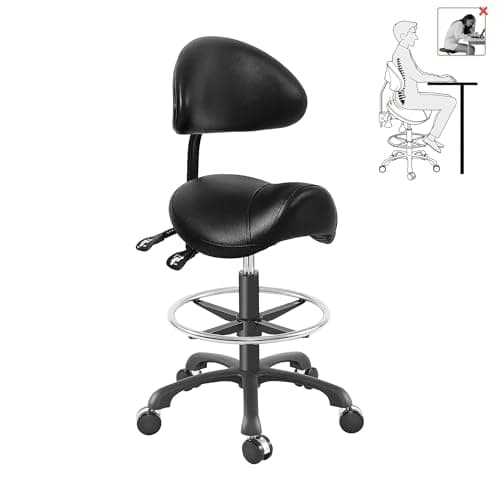 Coceeb Saddle Chair with Backrest and Foot Ring The Chair Under Review | 18.1 in of published seat width | 8.8 | $139.90 - View on Amazon #ad disclosure · November 17, 2026 |
| 2 | 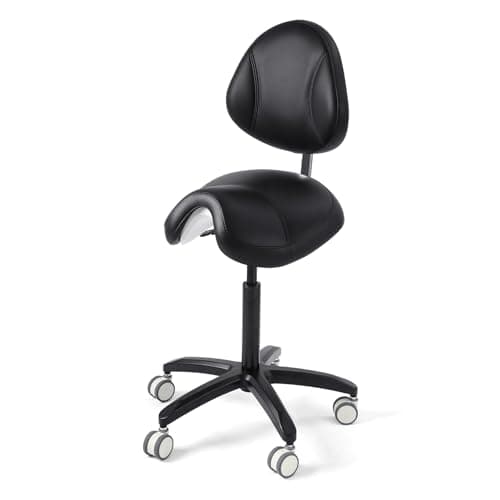 JMU PLST-229 Saddle Stool with Adjustable Backrest The One That Publishes an Angle | A backrest arc stated in degrees | 6.3 | $269.00 - View on Amazon #ad disclosure · November 17, 2026 |
| 3 | 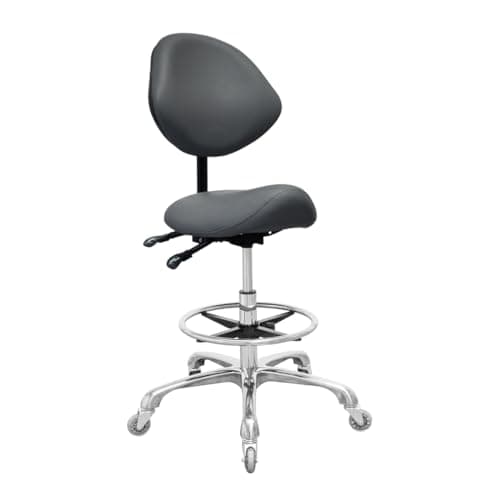 Nazalus Saddle Stool with Back and Footrest The Mid-Price Alternative | An adjustable ring at a lower ceiling | 8.0 | $179.00 - View on Amazon #ad disclosure · November 17, 2026 |
01 · The Chair Under Review
Coceeb Saddle Chair with Backrest and Foot Ring
8.8/10 · scored on the published rubric
The only saddle seat on this site that publishes a seat width - 18.1 in - alongside a 23.6 in floor, which keeps it in the clinical height band through its whole range rather than part of it.
Why you might not: A 23.6 in floor is too high to double as a desk stool, so this is a one-job chair. No seat depth and no warranty term published.
| Seat height | 23.6-30.7 in |
|---|---|
| Seat width | 18.1 in |
| Rated capacity | 400 lb |
| Footrest | adjustable |
Adjustments published (4): seat height (23.6-30.7 in, SGS-certified Class 3 gas lift); backrest height and arc, via a multi-function tray; foot ring height; dual-wheel swivel casters.
Not published by the manufacturer: seat depth; warranty term; seat tilt range; backrest travel. We have flagged these rather than guessed.
How this score was built
- Fit range9/10
- Adjustability9/10
- Capacity headroom9/10
- Footrest provision10/10
- Materials & warranty8/10
- Spec coverage8/10
The overall is the mean of these, rounded to one decimal place. Each criterion is computed from a published figure - the rubric is here.
Price as of November 17, 2026. #ad how this is funded
02 · The One That Publishes an Angle
JMU PLST-229 Saddle Stool with Adjustable Backrest
6.3/10 · scored on the published rubric
The only stool in this field that puts a backrest arc in writing as a number - 75 to 115 degrees - on a published 23 to 30 in Class 4 gas lift, and one of only two that say anything at all about which disinfectants the upholstery tolerates.
Why you might not: No foot ring and no armrests at all, which is what separates this model from the clinical stools above it, and JMU still publishes no seat width, no seat depth and no warranty term - so you cannot compute cost per warranty year on it.
| Seat height | 23-30 in |
|---|---|
| Rated capacity | 350 lb |
Adjustments published (2): seat height (23-30 in, 180 mm Class 4 gas lift); backrest tilt, 75-115 degrees.
Not published by the manufacturer: seat width; seat depth; warranty term; forward seat tilt in degrees. We have flagged these rather than guessed.
How this score was built
- Fit range8/10
- Adjustability6/10
- Capacity headroom8/10
- Footrest provision1/10
- Materials & warranty8/10
- Spec coverage7/10
The overall is the mean of these, rounded to one decimal place. Each criterion is computed from a published figure - the rubric is here.
Price as of November 17, 2026. #ad how this is funded
03 · The Mid-Price Alternative
Nazalus Saddle Stool with Back and Footrest
8.0/10 · scored on the published rubric
The only saddle stool here that publishes a range reaching 30.4 in AND carries both a backrest and a footrest ring - the combination that makes a saddle usable at standing-desk height.
Why you might not: The most expensive saddle on the page, and the backrest is small: it is a sacral prop, not something to lean into.
| Seat height | 22.4-30.4 in |
|---|---|
| Rated capacity | 351 lb |
| Footrest | adjustable |
Adjustments published (3): seat height (hand-lever gas cylinder, 22.4-30.4 in); 360-degree swivel; footrest ring.
Not published by the manufacturer: seat depth; seat width; warranty term. We have flagged these rather than guessed.
How this score was built
- Fit range8/10
- Adjustability8/10
- Capacity headroom8/10
- Footrest provision10/10
- Materials & warranty7/10
- Spec coverage7/10
The overall is the mean of these, rounded to one decimal place. Each criterion is computed from a published figure - the rubric is here.
Price as of November 17, 2026. #ad how this is funded
Questions people actually ask
What is the Coceeb saddle chair's seat height range?
How wide is the Coceeb saddle seat?
How far does the Coceeb saddle seat tilt forward?
Can you use the Coceeb saddle chair at a normal desk?
Is the Coceeb's 400 lb capacity trustworthy?
Does the Coceeb saddle chair come with a warranty?
Have you tested the Coceeb saddle chair?
Read next
Sources
Every figure on this page traces to one of these. Product specifications come from the manufacturer's own listing; prices come from a live lookup and carry the date they were verified.
- Coceeb Saddle Ergonomic Chair with Backrest Footrest Wheels - manufacturer's published specification on the Amazon listing
- Best Practices for Environmental Infection Prevention and Control, Dental Infection Prevention and Control - Centers for Disease Control and Prevention
- Pheasant & Haslegrave, Bodyspace: Anthropometry, Ergonomics and the Design of Work - percentile table as tabulated by RoyMech
- OSHA eTool, Computer Workstations - Chairs
- ANSI/BIFMA X5.1, General Purpose Office Chairs - test summary (Micom Laboratories)