What is a saddle stool?
A seat you straddle rather than sit back on. The shape opens your hip angle to roughly 135 degrees, which is the entire point - and it is why the height rules are different.
By Sawyer V. · Published October 10, 2026
We earn a commission if you buy through the links on this page, at no extra cost to you. It does not affect the order of the picks - the rubric does that, and here is how we are funded. Prices were last verified October 11, 2026.
What we did and did not do
Units we claim to have tested: 0. Everyone in this category says they tested twenty chairs. We have not sat in any of these, and we say so.
What we did instead: compiled every figure each manufacturer publishes, computed the fit ranges from a cited anthropometric table, and linked the source for each number so you can check the arithmetic. Where a manufacturer does not publish a figure, we say that rather than filling the gap. The full method, including what we cannot assess, is here.
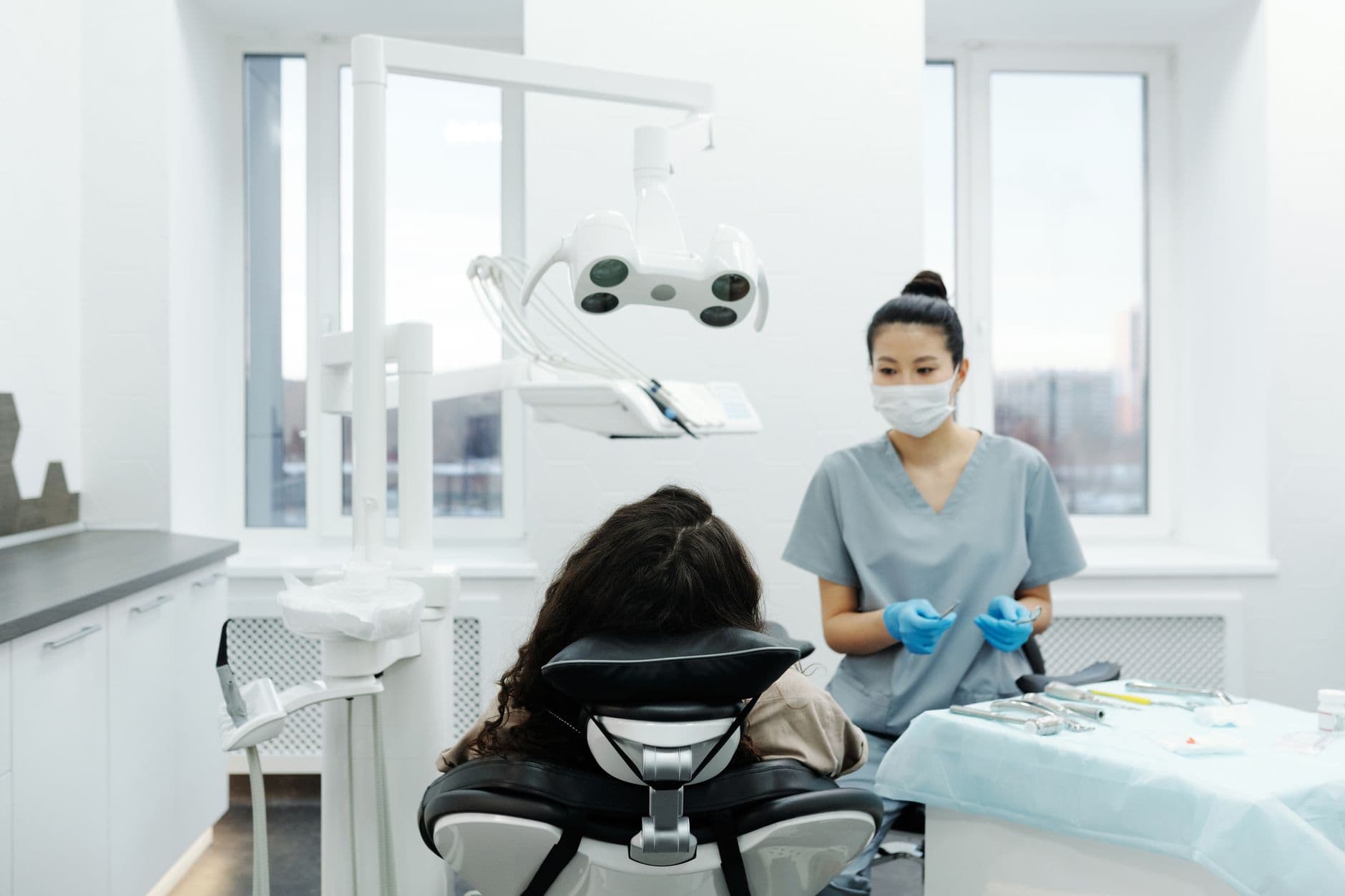
A saddle stool is a backless seat shaped like a horse saddle, which you straddle rather than sit back on. Your thighs drop away either side of a raised center ridge, your feet stay flat on the floor carrying some of your weight, and your pelvis tips forward so your lower back holds its own inward curve. That is the whole product and the whole mechanism.
The number that matters is the hip angle. A conventional chair sets the angle between your trunk and your thighs at roughly 90 degrees, which rotates your pelvis backwards and flattens the lumbar curve. A saddle seat opens it to around 135. Nothing is pushing on your back - the geometry of the seat does it, which is why saddle stools have no lumbar support and do not need one.
The practical consequence most people get wrong: a saddle stool sits HIGHER than your old chair, by two to four inches. Because your thighs angle down instead of sitting horizontal, your hips need to be further off the floor for your knees to land correctly. Set a saddle seat at your old chair height and it feels wrong immediately - and almost everyone who dislikes one on day one set it too low. The full setup sequence is here.
Where the shape comes from
Saddle seats were a clinical product before they were a desk product, and they still mostly are. Dentists, hygienists, dental assistants, veterinarians, tattoo artists and hairstylists are the core market: all jobs where you work leaning forward over something, need to roll to it rather than walk, and cannot be reclining into a backrest.
That origin explains the features you see on the listings. Casters as standard rather than an upgrade. Heights that reach well past a desk, because a reclined patient chair is higher than a desk. Wipe-clean PU upholstery. A split seat on the clinical models, which is a two-part pan with a gap down the center line - sold on perineal pressure relief and airflow, and barely seen outside the clinical aisle. Clinical and dental saddle stools are ranked separately here, because the figures that decide them are different.
What a saddle stool is not
- Not a kneeling chair. Both open your hip angle; they put the load in different places. A saddle carries you on your sit bones with your feet on the floor. A kneeling chair tips a flat seat forward and puts a share of your weight through your shins. Head to head.
- Not a wobble stool. A wobble stool is a flat seat on an unstable base - the seat moves. A saddle seat is shaped and usually stable; the geometry does the work, not the instability. Three stool shapes compared.
- Not a perch stool. A perch or leaning stool has a sloped flat seat you lean forward onto at standing-desk height, with your feet taking real weight. A saddle is a seat you sit ON, straddled, usually at desk height. What a perch stool is.
- Not a bar stool. Bar stools reach similar heights and are not work seating: no height adjustment, no tilt, no casters, no published capacity standard, and a flat pan that does nothing to your hip angle.
- Not the same as a "saddle chair". The terms are used interchangeably in listings. Where there is a difference, a "saddle chair" usually has a backrest bolted on and a "saddle stool" does not - and five of the fifteen we verified have one. The seat shape is identical.
The published heights, across every saddle seat we verified
| Saddle seat | Published seat height | Rated capacity | Back? |
|---|---|---|---|
| LIMKOMES saddle chair | 19.7-25.6 in - lowest floor | Not published | Yes |
| Ailyful, 12-degree tilt | 19.7-26.8 in | 485 lb | No |
| FRNIAMC | 20-29.5 in | 350 lb | Yes |
| TIMARIZE | 20-27 in | 350 lb | Yes |
| LIMKOMES split seat | 19.69-31.51 in - widest span | 500 lb | Yes |
| Antlu | 21-28 in | 400 lb | No |
| Jobri BetterPosture | 21-28 in | 250 lb | No |
| Ailyful split seat | 21.26-26.77 in | 485 lb | No |
| JMYSD split seat | 21.3-28.3 in | 660 lb - highest | Yes |
| Kaleurrier | 22-30 in | 350 lb | No |
| Nazalus | 22.4-30.4 in | 351 lb | Yes |
| JMU dental | 23-30 in | 350 lb | Yes |
| Coceeb | 23.6-30.7 in - highest floor | 400 lb | Yes |
Two things to take from that table. The usable band for desk work is roughly 20 to 28 inches, which is three to eight inches above a task chair - exactly the offset described above. And capacity in this category is unusually generous: twelve of fifteen publish a figure and four publish 485 lb or more, which is far better than the kneeling-chair field next door, where 265 lb is the ceiling.
The figure almost nobody gives is seat width. Of fifteen saddle seats we verified, exactly one publishes it (18.1 in). On a seat you straddle, the width is what decides whether the ridge lands where it should on your body - so this is a category where returning it if it is wrong matters more than usual.
Who a saddle stool suits
It suits you if you lean forward into your work for long stretches, you want your hip angle open without a mechanism pressing on your spine, you need to roll between positions, or a conventional chair's backrest is something you never actually use because you are always at the front of the seat anyway.
Skip it if you want to sit back and be supported for a full working day - there is no backrest on most of them and the five with one are providing a lumbar touch-point, not a recliner. Skip it if your desk is at standing height: the tallest here reaches 31.51 in and a 42 in desk needs a seat around 32 to 34, which is standing-desk stool territory. And skip it if you cannot straddle a seat comfortably - getting on and off is a deliberate movement, not a sit-down.
The adjustment period is real, and one maker says so
Most listings in this category are silent about it. One - the 2xhome listing - states plainly that the stool "is designed differently from a traditional office chair" and that "some users may need a short adjustment period to get used to the saddle seating design". That is the most honest sentence in the category and it is worth repeating.
What it means practically: your inner thighs and your lower back are doing work they were not doing before, because nothing is holding you up. Expect that to be noticeable for the first week and to settle. Pain that is sharp rather than achy, or that does not settle, is more likely to mean the height is wrong than that you need to persevere - and the height is wrong in the same direction almost every time, which is too low.
What this cannot tell you
We have not sat on any saddle stool. Every figure on this page is read off a manufacturer's published specification with the listing linked, and every angle in the mechanism description is either published by a maker or basic geometry. Whether a particular seat's ridge suits your body is not something a specification answers, and with one seat width published across the whole category, it is not something the market will tell you either. The full list of what this method cannot reach.
Three saddle seats, if you want one
Ranked on the published rubric. Tap a row for the full write-up; the price button goes straight to Amazon. Every figure in the write-ups is the manufacturer's own published specification, linked at the source. We have not sat in any of these.
| # | Product | Best for | Score | Price |
|---|---|---|---|---|
| 1 | 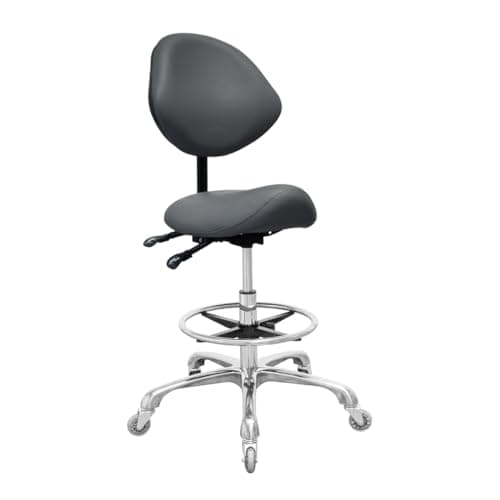 Nazalus Saddle Stool with Back and Footrest Best Overall Saddle Stool | A back, a footrest and 30.4 in | 8.0 | $179.00 - View on Amazon #ad disclosure · October 11, 2026 |
| 2 | 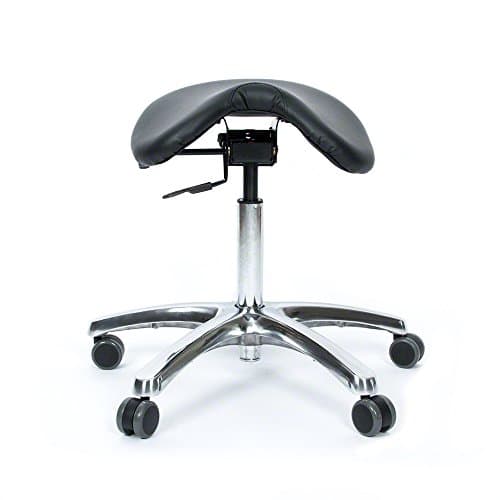 Jobri BetterPosture Saddle Chair Best Tilting Seat | Tuning the pelvic angle | 6.6 | $174.99 - View on Amazon #ad disclosure · October 11, 2026 |
| 3 | 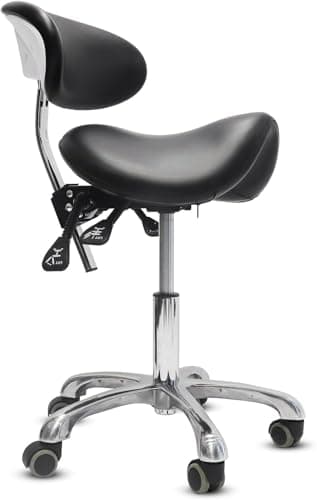 LIMKOMES Saddle Chair with Back Support Lowest Published Start Height | Shorter users at a normal desk | 4.0 | $199.99 - View on Amazon #ad disclosure · October 11, 2026 |
01 · Best Overall Saddle Stool
Nazalus Saddle Stool with Back and Footrest
8.0/10 · scored on the published rubric
The only saddle stool here that publishes a range reaching 30.4 in AND carries both a backrest and a footrest ring - the combination that makes a saddle usable at standing-desk height.
Why you might not: The most expensive saddle on the page, and the backrest is small: it is a sacral prop, not something to lean into.
| Seat height | 22.4-30.4 in |
|---|---|
| Rated capacity | 351 lb |
| Footrest | adjustable |
Adjustments published (3): seat height (hand-lever gas cylinder, 22.4-30.4 in); 360-degree swivel; footrest ring.
Not published by the manufacturer: seat depth; seat width; warranty term. We have flagged these rather than guessed.
How this score was built
- Fit range9/10
- Adjustability9/10
- Capacity headroom9/10
- Materials & warranty7/10
- Spec coverage6/10
The overall is the mean of these, rounded to one decimal place. Each criterion is computed from a published figure - the rubric is here.
Price as of October 11, 2026. #ad how this is funded
02 · Best Tilting Seat
Jobri BetterPosture Saddle Chair
6.6/10 · scored on the published rubric
A tilting seat pan, which is the adjustment that actually decides whether a saddle suits your hips, on a polished aluminum five-point base.
Why you might not: 250 lb is the lowest published capacity among the saddles, and it costs nearly twice the Antlu that holds 400 lb.
| Seat height | 21-28 in |
|---|---|
| Rated capacity | 250 lb |
Adjustments published (3): seat height (21-28 in); seat tilt; 360-degree swivel.
Not published by the manufacturer: seat depth; seat width; warranty term. We have flagged these rather than guessed.
How this score was built
- Fit range7/10
- Adjustability7/10
- Capacity headroom6/10
- Materials & warranty7/10
- Spec coverage6/10
The overall is the mean of these, rounded to one decimal place. Each criterion is computed from a published figure - the rubric is here.
Price as of October 11, 2026. #ad how this is funded
03 · Lowest Published Start Height
LIMKOMES Saddle Chair with Back Support
4.0/10 · scored on the published rubric
A proper backrest on a saddle seat, and the lowest published start height in the group at 19.7 in - genuinely useful if you are short.
Why you might not: Skip this if your desk is tall. A 25.6 in ceiling puts it at roughly a 33-38 in surface, and no capacity is published either.
| Seat height | 19.7-25.6 in |
|---|
Adjustments published (3): seat height (19.7-25.6 in); 360-degree rotation; backrest.
Not published by the manufacturer: rated capacity; seat depth; seat width; warranty term. We have flagged these rather than guessed.
How this score was built
- Fit range6/10
- Adjustability5/10
- Capacity headroom1/10
- Materials & warranty5/10
- Spec coverage3/10
The overall is the mean of these, rounded to one decimal place. Each criterion is computed from a published figure - the rubric is here.
Price as of October 11, 2026. #ad how this is funded
Questions people actually ask
What is a saddle stool?
What is a saddle stool used for?
How high should a saddle stool be?
Are saddle stools good for your back?
Is a saddle stool the same as a saddle chair?
What is the difference between a saddle stool and a kneeling chair?
Do saddle stools have a weight limit?
Read next
Sources
Every figure on this page traces to one of these. Product specifications come from the manufacturer's own listing; prices come from a live lookup and carry the date they were verified.