Best office chairs for spinal stenosis
Of 38 chairs we verified, nine publish a recline range in degrees. On this page that is the only figure that matters, and the OSHA minimum is the bar to clear.
By Sawyer V. · Published October 6, 2026
We earn a commission if you buy through the links on this page, at no extra cost to you. It does not affect the order of the picks - the rubric does that, and here is how we are funded. Prices were last verified October 6, 2026.
What we did and did not do
Units we claim to have tested: 0. Everyone in this category says they tested twenty chairs. We have not sat in any of these, and we say so.
What we did instead: compiled every figure each manufacturer publishes, computed the fit ranges from a cited anthropometric table, and linked the source for each number so you can check the arithmetic. Where a manufacturer does not publish a figure, we say that rather than filling the gap. The full method, including what we cannot assess, is here.

If your symptoms ease when you lean forward or sit down and worsen when you stand up straight, buy the chair with the widest published recline range you can afford - and on current prices that is the NOBLEWELL at 90 to 135 degrees, for about a hundred dollars. If you also want the support itself to move, the CAPOT is the better chair: it locks at 90, 110 and 125 degrees and is one of only four chairs on this site that publish how far the lumbar support travels.
Here is why that is the recommendation rather than a padding or a lumbar-bump recommendation. OrthoInfo, the American Academy of Orthopaedic Surgeons' patient library, puts the mechanism plainly: "People with spinal stenosis often feel better when they lean forward or sit down", and "standing up straight or walking usually make the pain worse", because "leaning forward can increase the space available for the nerves".
A chair cannot change your canal. What it can change is whether you are able to hold an open, unloaded, slightly-reclined position for an hour without fighting the backrest - and that is a number on a spec sheet. Of the 38 task and drafting chairs we have verified, nine publish a recline range in degrees. Those nine are the shortlist. Everything else on the market is asking you to take "ergonomic" on trust.
Quick picks
Ranked on the published rubric. Tap a row for the full write-up; the price button goes straight to Amazon. Every figure in the write-ups is the manufacturer's own published specification, linked at the source. We have not sat in any of these.
| # | Product | Best for | Score | Price |
|---|---|---|---|---|
| 1 | 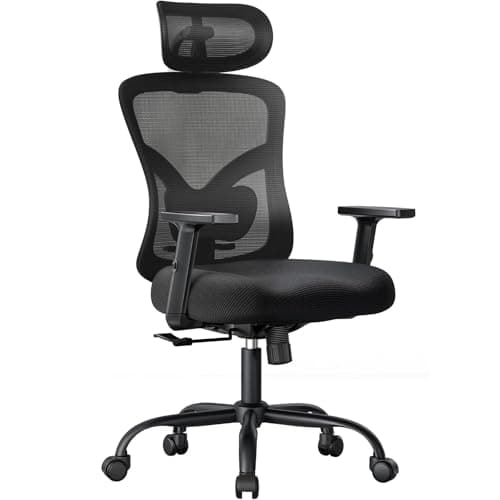 NOBLEWELL Mesh Chair with Independent Headrest, Lumbar and Arms Best Overall | 45 degrees of recline | 6.8 | $104.49 - View on Amazon #ad disclosure · October 6, 2026 |
| 2 | 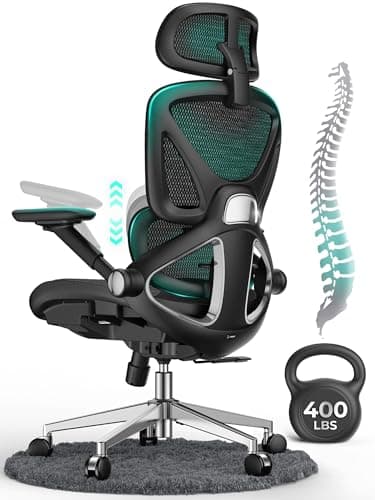 CAPOT Ergonomic Mesh Chair Best Lumbar Positioning | Moving the support off your curve | 9.6 | $159.99 - View on Amazon #ad disclosure · October 6, 2026 |
| 3 | 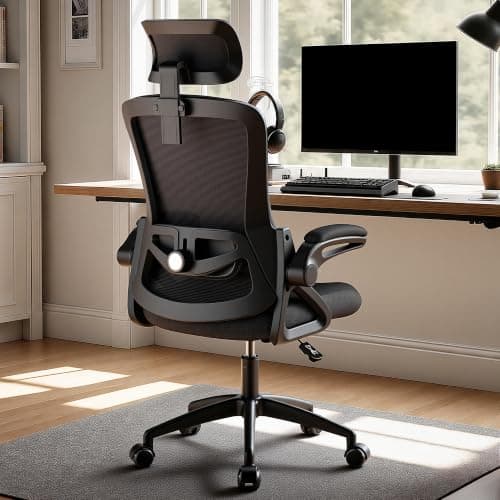 NIHABRO Mesh Chair with 2D Headrest Most Recline With a Capacity Figure | 35 degrees at 400 lb | 7.0 | $95.95 - View on Amazon #ad disclosure · October 6, 2026 |
| 4 | 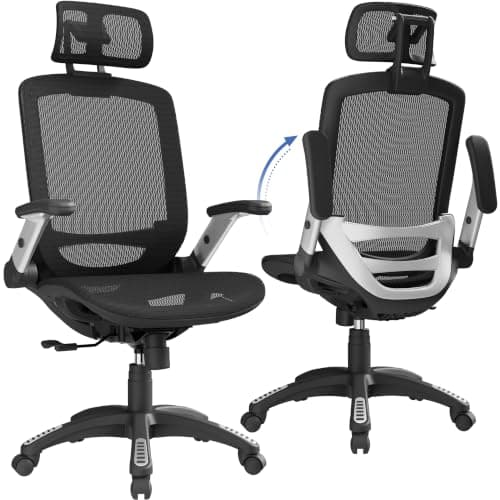 GABRYLLY Ergonomic Mesh Office Chair Best Specified Chair Here | Checking the fit before you buy | 8.0 | $189.91 - View on Amazon #ad disclosure · October 6, 2026 |
| 5 | 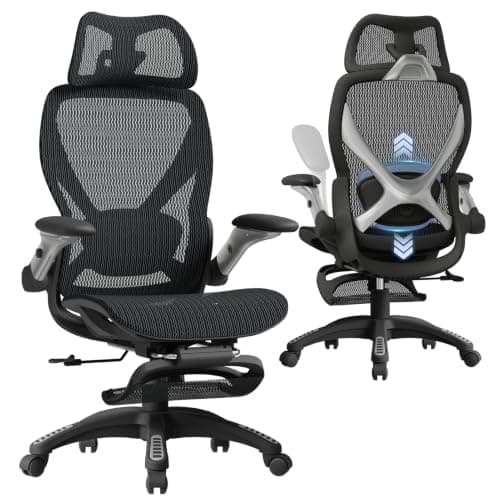 ELABEST X100 Mesh Chair with Footrest Best for Reclining With Your Legs Up | Getting your feet off the floor | 7.4 | $349.99 - View on Amazon #ad disclosure · October 6, 2026 |
| — | 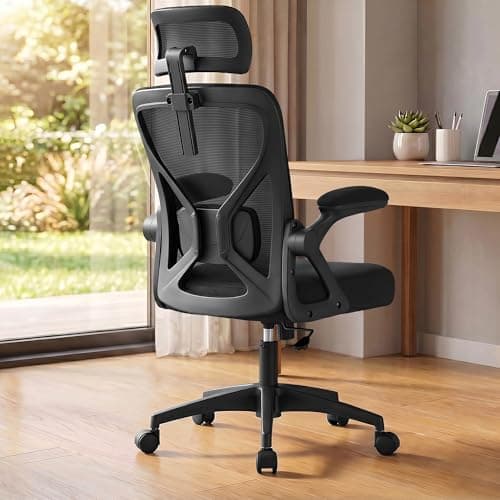 SONGMICS Ergonomic Mesh Chair Skip This If Reclining Is the Point | The bare OSHA minimum | 5.8 | $60.79 - View on Amazon #ad disclosure · October 6, 2026 |
01 · Best Overall
NOBLEWELL Mesh Chair with Independent Headrest, Lumbar and Arms
6.8/10 · scored on the published rubric
A published 90-135 degree recline - the widest span of any chair on this site - and the only listing that uses the word INDEPENDENTLY about its headrest, lumbar and armrests together.
Why you might not: Every one of those four adjustments is named without a figure, and NOBLEWELL publishes no seat-height range at all. It passes SGS and BIFMA at 300 lb without naming the protocol.
| Rated capacity | 300 lb |
|---|
Adjustments published (5): independently adjustable headrest; independently adjustable lumbar; independently adjustable armrests; seat cushion height; recline 90-135 degrees.
Not published by the manufacturer: seat-height range; seat depth; seat width; warranty term; headrest travel; lumbar travel. We have flagged these rather than guessed.
How this score was built
- Fit range10/10
- Adjustability8/10
- Capacity headroom8/10
- Materials & warranty5/10
- Spec coverage3/10
The overall is the mean of these, rounded to one decimal place. Each criterion is computed from a published figure - the rubric is here.
02 · Best Lumbar Positioning
CAPOT Ergonomic Mesh Chair
9.6/10 · scored on the published rubric
The only chair on this site that answers all six rubric criteria from published figures: seat range, depth, width, 400 lb capacity, a five-year warranty and eight levels of 2 in lumbar travel. At $199.99 that is $40 per warranty year.
Why you might not: It tops out at 22.05 in. If you are over about 6 ft 2 in you will run out of seat height, whatever the listing's stated window says.
| Seat height | 18.5-22.05 in |
|---|---|
| Seat depth | 19.3 in |
| Seat width | 20 in |
| Rated capacity | 400 lb |
| Warranty | 5 years |
| Cost per warranty year | $32.00 |
| Maker's stated user height | 5 ft 5 in to 6 ft 2 in |
Adjustments published (5): seat height (18.5-22.05 in); lumbar depth (2 in over 8 levels); backrest lock at 90, 110 and 125 degrees; headrest height and depth; armrests flip up 90 degrees.
How this score was built
- Fit range8/10
- Adjustability10/10
- Capacity headroom10/10
- Materials & warranty10/10
- Spec coverage10/10
The overall is the mean of these, rounded to one decimal place. Each criterion is computed from a published figure - the rubric is here.
03 · Most Recline With a Capacity Figure
NIHABRO Mesh Chair with 2D Headrest
7.0/10 · scored on the published rubric
400 lb and a published 35-degree recline span on a chair whose headrest and armrests both move in more than one axis, at under a hundred dollars.
Why you might not: No seat-height range, no seat depth, no seat width. It tells you what moves and never how far, so you cannot check it against your own measurements.
| Rated capacity | 400 lb |
|---|
Adjustments published (5): 2D headrest (height and tilt); lumbar height; 3D flip-up armrests (slide, rotate, flip); recline 90-125 degrees with a tension knob; seat height (certified Class 3 gas lift).
Not published by the manufacturer: seat-height range; seat depth; seat width; warranty term; headrest travel; lumbar travel. We have flagged these rather than guessed.
How this score was built
- Fit range9/10
- Adjustability8/10
- Capacity headroom10/10
- Materials & warranty5/10
- Spec coverage3/10
The overall is the mean of these, rounded to one decimal place. Each criterion is computed from a published figure - the rubric is here.
04 · Best Specified Chair Here
GABRYLLY Ergonomic Mesh Office Chair
8.0/10 · scored on the published rubric
Five of six rubric criteria answered with published figures: 18.9-23.6 in seat, 20.5 in wide, 20 in deep, 300 lb, three-year warranty. Its 23.6 in ceiling is the highest of any ordinary task chair here, which is what makes it the tall-user pick.
Why you might not: A 20 in seat depth is long. Our arithmetic says that is too deep for anyone under about 5 ft 8 in - the front edge will reach the back of your knees, which is the thing OSHA specifically tells you to avoid.
| Seat height | 18.9-23.6 in |
|---|---|
| Seat depth | 20 in |
| Seat width | 20.5 in |
| Rated capacity | 300 lb |
| Warranty | 3 years |
| Cost per warranty year | $63.30 |
| Maker's stated user height | 5 ft 2 in to 6 ft 1 in |
Adjustments published (4): seat height (18.9-23.6 in); flip-up armrests (45 degrees); recline 90-120 degrees; headrest.
Not published by the manufacturer: lumbar adjustment range. We have flagged these rather than guessed.
How this score was built
- Fit range7/10
- Adjustability7/10
- Capacity headroom8/10
- Materials & warranty8/10
- Spec coverage10/10
The overall is the mean of these, rounded to one decimal place. Each criterion is computed from a published figure - the rubric is here.
05 · Best for Reclining With Your Legs Up
ELABEST X100 Mesh Chair with Footrest
7.4/10 · scored on the published rubric
Five separately adjustable systems and a five-year warranty. The 18 in extendable footrest is a real footrest, not a foot ring, and it is the only one in our set whose length is published.
Why you might not: $349.99 makes it the most expensive chair on the site, and at $70 per warranty year the CAPOT is better value on our own arithmetic.
| Seat height | 18.3-23 in |
|---|---|
| Rated capacity | 300 lb |
| Footrest | adjustable |
| Warranty | 5 years |
| Cost per warranty year | $70.00 |
Adjustments published (6): seat height (18.3-23 in); lumbar height (2 in), depth (1.6 in) and 15-degree rotation, lockable; 5D armrests (height, width, forward, back, rotate), plus flip-up; 3D headrest (axes not specified); 18 in extendable footrest, two angles; three-stage recline.
Not published by the manufacturer: seat depth; seat width; headrest travel. We have flagged these rather than guessed.
How this score was built
- Fit range5/10
- Adjustability10/10
- Capacity headroom8/10
- Materials & warranty9/10
- Spec coverage5/10
The overall is the mean of these, rounded to one decimal place. Each criterion is computed from a published figure - the rubric is here.
Price as of October 6, 2026. #ad how this is funded
Skip This If Reclining Is the Point
SONGMICS Ergonomic Mesh Chair
5.8/10 · scored on the published rubric
331 lb and a published 3.5 in cushion at the lowest price of any chair on this site that publishes a seat-height range at all.
Why you might not: The recline stops at 105 degrees, which is barely a recline, and the seat depth is not published - the one figure a shorter user most needs.
| Seat height | 17.7-21.7 in |
|---|---|
| Seat width | 19.7 in |
| Thickness | 3.5 in |
| Rated capacity | 331 lb |
Adjustments published (4): seat height (17.7-21.7 in); flip-up armrests; tilt 90-105 degrees; lumbar support.
Not published by the manufacturer: seat depth; warranty term. We have flagged these rather than guessed.
How this score was built
- Fit range2/10
- Adjustability6/10
- Capacity headroom9/10
- Materials & warranty5/10
- Spec coverage7/10
The overall is the mean of these, rounded to one decimal place. Each criterion is computed from a published figure - the rubric is here.
Which of our condition pages you actually want
Worth two minutes before you read further, because these five pages recommend different chairs for different reasons and one of them is the opposite of this one.
| If your problem is | Read | Because it ranks on |
|---|---|---|
| General lower-back ache from sitting | For lower-back pain | Published lumbar adjustment travel |
| Nerve pain radiating down a leg | For sciatica | Seat depth, pressure distribution, recline |
| Spinal stenosis, better when you lean forward | For spinal stenosis | Published recline range against the OSHA 15-degree minimum |
| A herniated, bulging or degenerating disc | For a herniated disc | Whether the lumbar support moves, and how far |
| Neck, shoulder or upper-back pain | For neck and shoulder pain | Published headrest and armrest travel |
The distinction that matters most: stenosis typically eases in forward flexion. A disc problem often does not. Those are opposite directional preferences, which is why the chair that is right on this page can be wrong on the herniated-disc page - and why we will not write one generic back-pain page and point everyone at it.
How we ranked these
- Fit range - on this page that is the published recline range in degrees, scored against the OSHA chair criterion that a backrest should recline "at least 15 degrees from the vertical". A chair publishing 90-135 degrees gives you 45 degrees of travel, three times the minimum. A chair publishing nothing scores zero here no matter what else it does.
- Adjustability - countable published mechanisms, weighted towards the two that matter in a reclined position: how far the lumbar support moves, and whether the recline locks at intermediate positions rather than only free-floating or upright.
- Capacity headroom - rated capacity against a 275 lb reference, the occupant basis behind ANSI/BIFMA X5.1.
- Materials and warranty - warranty term, cylinder class, base material, named certification. This criterion is where the budget chairs at the top of this page lose ground, and we are not going to hide it.
- Spec coverage - how many of the six rubric figures the maker publishes. The top two picks here publish very little beyond the recline figure, which is the honest trade-off this page makes: the governing figure beats the complete sheet, but you should know what you are not getting.
Note what that does to the ranking. The NOBLEWELL wins on a 3 out of 10 for spec coverage - it publishes no seat-height range, no seat depth and no seat width. It wins anyway, because it publishes the widest recline span in our set and this page ranks on recline. The CAPOT answers all six criteria and still places second, because its maximum is 125 degrees rather than 135. A better chair can be the wrong chair, and the reverse is also true.
The recline numbers, side by side
| Chair | Published recline | Degrees from vertical | Clears the OSHA 15-degree minimum? |
|---|---|---|---|
| NOBLEWELL (rank 1) | 90-135 degrees | 45 | Yes, by 3x |
| Dowinx wide-armrest | 90-135 degrees | 45 | Yes, by 3x |
| Dowinx cross-legged | 90-135 degrees | 45 | Yes, by 3x |
| NIHABRO (rank 3) | 90-125 degrees | 35 | Yes |
| CAPOT (rank 2) | Locks at 90, 110, 125 | 35 at the top lock | Yes |
| GABRYLLY (rank 4) | 90-120 degrees | 30 | Yes |
| MOLENTS | 90-120 degrees, three positions | 30 | Yes |
| DUMOS executive mesh | 90-120 degrees | 30 | Yes |
| Hayelf criss-cross | 90-120 degrees | 30 | Yes |
| SONGMICS (rank 6) | 90-105 degrees | 15 | Exactly, and no further |
The SONGMICS row is the reason this table is on the page. 90 to 105 degrees is not a bad chair - it is a 331 lb chair with a published seat-height range and a 3.5 in cushion, and it is a pick on two other pages here. It is just exactly at the floor of what OSHA considers a backrest and nowhere above it. If recline is the thing you are buying, 15 degrees is not a feature.
What else changes when forward flexion is what helps
A lumbar support you can get OUT of the way
This is the part almost no buying guide says out loud. The entire ergonomic chair market is built to push your lower back forward into lordosis - that is what a lumbar bump does. If your relief comes from flexion, a fixed molded prominence sitting at your curve is working against you, and there is no adjustment because there is no mechanism.
So the useful figure is not "has lumbar support". It is how far the support moves - because travel means you can place it low, soften its effect, or move it out of the way entirely on the days you need to sit forward. OSHA's own chair criterion asks for exactly this: "a lumbar support that is height adjustable so it can be appropriately placed to fit the lower back". Four chairs on this entire site publish a travel figure. The CAPOT's 2 inches over eight levels is the best of them, and it is why that chair outranks three chairs with more recline.
Reclining takes your feet off the floor
A real consequence that catches people out. Open the backrest to 135 degrees and your hips slide forward, your knees rise, and the chair you set up for level forearms no longer puts your feet flat. OSHA's seat-height criterion - "the entire sole of the foot can rest on the floor with the back of the knee slightly higher than the seat" - stops being true the moment you lean back.
Two fixes, both cheap. The ELABEST X100 at rank 5 has an 18-inch extendable footrest built in - the only footrest on a chair in our set whose length is actually published, which makes it a reclining chair rather than a task chair that leans. Or spend thirty dollars on an under-desk footrest and set it to the height your reclined position actually wants. Either beats reclining with your legs dangling.
The active-seating answer does not apply here, and we are not going to pretend it does
Most of this site is about perching, saddle seats and kneeling chairs. They work by opening your hip angle so your pelvis rotates forward and your lumbar curve holds itself - lumbar extension, deliberately. That is the opposite of the direction OrthoInfo describes as relieving stenosis symptoms.
We sell nothing, we are not a clinic, and the only thing we lose by telling you this is a sale. If you have stenosis, do not buy a kneeling chair or a saddle stool because this site is enthusiastic about them. Read the kneeling-chair page to understand the mechanism and then decide with someone qualified whether that direction is yours.
Standing desks are not automatically the fix either
People often arrive at active seating from "sit less, stand more". OrthoInfo's own sentence is "standing up straight or walking usually make the pain worse" - which makes a sit-stand setup a more complicated recommendation here than it is for anyone else. We do not cover desks; what we can tell you is that if you do stand, the seat you perch on between bouts matters more for you than for most people, and a perch stool keeps your hips open in a way a bar stool does not.
Where this page stops
Everything above describes what a seat does mechanically, and every figure in it comes from a manufacturer's own published specification or a named standard. None of it is medical advice. There is no clinician on this site, nothing here is medically reviewed, and we do not know what is causing your symptoms.
A chair changes how your body is loaded while you sit in it. It does not treat anything. Pain that is severe, worsening, radiating into a limb, or accompanied by numbness, tingling, weakness or any change in bladder or bowel function is a reason to see a clinician promptly - not a reason to buy a chair. "Doctor recommended" on a product listing is a marketing phrase, not a credential, and we will not repeat it for them.
What we looked at and left out
Exclusions are explainable or they are not exclusions. Each of these failed a published disqualifier, and the reason is the spec, not a preference.
| Product | Why it is not ranked |
|---|---|
| DRAGONN by VIVO Adjustable Kneeling Chair with Back Support | Excluded deliberately, and it is the most important exclusion on this site. A kneeling chair works by rotating your pelvis forward and restoring lumbar lordosis - it puts your lower spine into **extension**, which is the direction OrthoInfo describes as making stenosis pain worse. Most of this site is built around active seating. On this page it is the wrong answer, and we would rather say so than sell it to you. |
| SIHOO M18 | SIHOO publishes no seat-height range, no seat depth and no seat width for the M18. It is a well-specified chair in other respects - 331 lb, a three-year warranty, a BIFMA pass - and on a page that ranks by body fit there is nothing to rank it on. [Our full write-up is here](/reviews/sihoo-m18). |
| TRALT Ergonomic Chair with Adjustable Lumbar | A well-specified chair - 17.7-21.7 in, a 17.3 in seat depth, 330 lb, a two-year warranty - with no published recline range at all. It is the top pick on [our petite-user page](/chairs/for-petite-users), where the figures it does publish are the ones that count. |
Questions people actually ask
What kind of office chair is best for spinal stenosis?
Should I buy a kneeling chair if I have spinal stenosis?
How far should an office chair recline?
Is sitting or standing better for spinal stenosis?
Does lumbar support help spinal stenosis?
Have you tested these chairs?
Read next
Sources
Every figure on this page traces to one of these. Product specifications come from the manufacturer's own listing; prices come from a live lookup and carry the date they were verified.
- Lumbar Spinal Stenosis - OrthoInfo, American Academy of Orthopaedic Surgeons
- OSHA eTool, Computer Workstations - Chairs
- OSHA eTool, Computer Workstations - Good Working Positions
- Pheasant & Haslegrave, Bodyspace: Anthropometry, Ergonomics and the Design of Work - percentile table as tabulated by RoyMech
- ANSI/BIFMA X5.1, General Purpose Office Chairs - test summary (Micom Laboratories)