Best office chairs for neck and shoulder pain
Armrest height decides where your shoulders sit, and your shoulders decide where your neck sits. That makes armrest travel the figure, and the headrest second.
By Sawyer V. · Published October 6, 2026
We earn a commission if you buy through the links on this page, at no extra cost to you. It does not affect the order of the picks - the rubric does that, and here is how we are funded. Prices were last verified October 6, 2026.
What we did and did not do
Units we claim to have tested: 0. Everyone in this category says they tested twenty chairs. We have not sat in any of these, and we say so.
What we did instead: compiled every figure each manufacturer publishes, computed the fit ranges from a cited anthropometric table, and linked the source for each number so you can check the arithmetic. Where a manufacturer does not publish a figure, we say that rather than filling the gap. The full method, including what we cannot assess, is here.

Start with the armrests, not the headrest. The ELABEST X100 is the pick, because it publishes five separate armrest axes - height, width, forward, back and rotate - and more armrest adjustment than anything else on this site. If your budget is $100 rather than $350, the honest answer is different and cheaper: buy a $48 clamp-on headrest and set the chair you already own properly. It publishes 3.14 inches of height travel and 36 degrees of tilt, which is more headrest movement than any complete chair in our set.
Here is the reasoning, and it is the opposite of how these chairs are marketed. OSHA's working-position guidance asks that "shoulders are relaxed and upper arms hang normally at the side of the body", that "elbows stay in close to the body and are bent between 90 and 120 degrees", and that your "head is level, forward facing, and balanced... in-line with the torso".
Read those in order. An armrest set too high lifts your shoulder into a permanent shrug. An armrest set too low or too wide drops the shoulder and loads the upper trapezius to hold your arm out. Either way your head leaves the in-line position, and the neck pays for it. The headrest is downstream: it supports your head when you lean back, which is useful, and it does nothing for a shoulder that is shrugged for seven hours.
Quick picks
Ranked on the published rubric. Tap a row for the full write-up; the price button goes straight to Amazon. Every figure in the write-ups is the manufacturer's own published specification, linked at the source. We have not sat in any of these.
| # | Product | Best for | Score | Price |
|---|---|---|---|---|
| 1 | 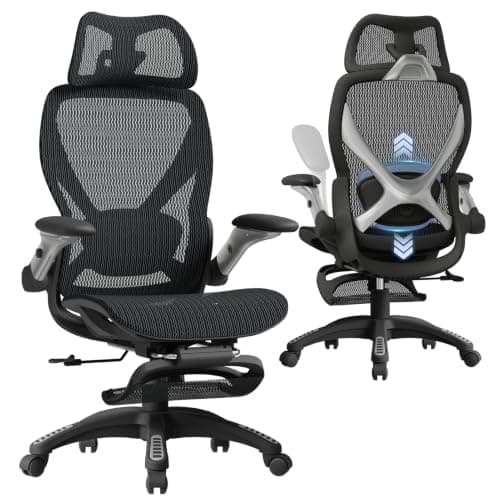 ELABEST X100 Mesh Chair with Footrest Best Overall | 5 armrest axes, published | 8.4 | $349.99 - View on Amazon #ad disclosure · October 6, 2026 |
| 2 | 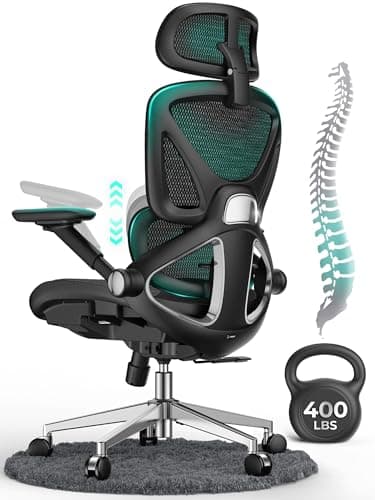 CAPOT Ergonomic Mesh Chair Best Headrest on a Chair | Height AND depth on the headrest | 9.6 | $159.99 - View on Amazon #ad disclosure · October 6, 2026 |
| 3 | 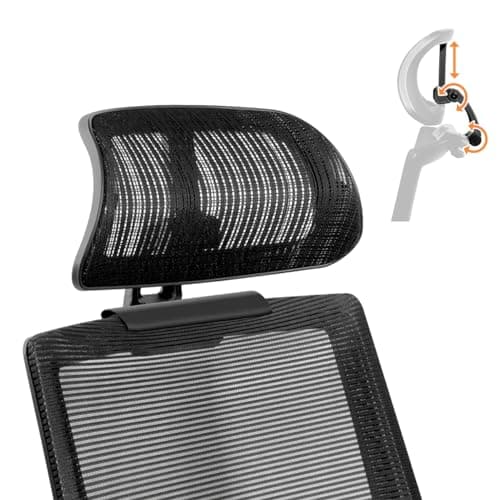 Omhuzsyo Clamp-On Headrest Attachment Best Fix for the Chair You Own | 3.14 in and 36 degrees, for $48 | 5.8 | $48.50 - View on Amazon #ad disclosure · October 6, 2026 |
| 4 | 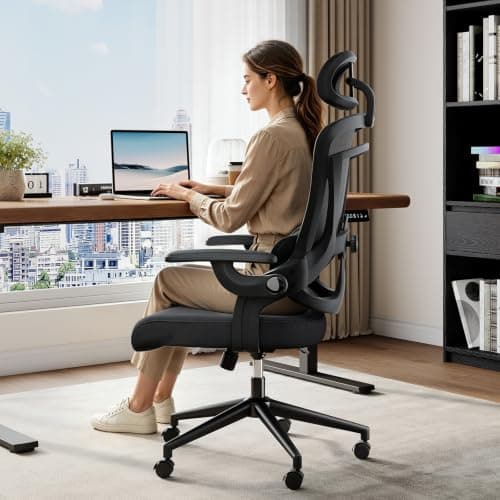 DUMOS Executive Mesh Chair with 42-Degree Headrest Only Published Headrest ANGLE | 42 degrees, cheaply | 5.8 | $79.99 - View on Amazon #ad disclosure · October 6, 2026 |
| 5 | 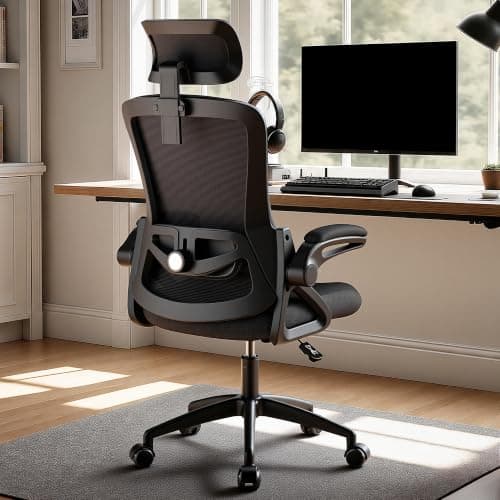 NIHABRO Mesh Chair with 2D Headrest Best Headrest and Arm Combination | 2D headrest, 3D arms, 400 lb | 6.6 | $95.95 - View on Amazon #ad disclosure · October 6, 2026 |
| 6 | 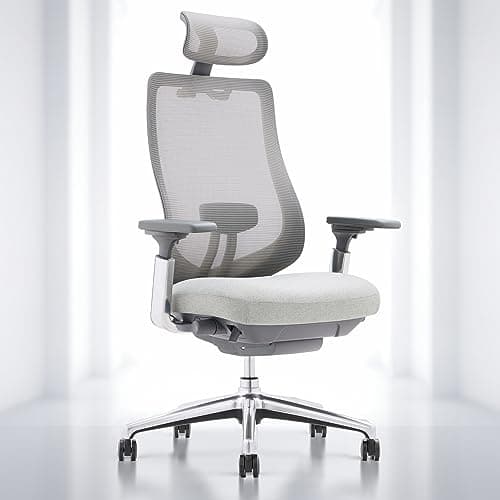 COLAMY Atlas Mesh Chair with 4D Arms and Sliding Seat Best Specified Chair Here | 4D arms with real dimensions | 7.8 | $289.99 - View on Amazon #ad disclosure · October 6, 2026 |
| — | 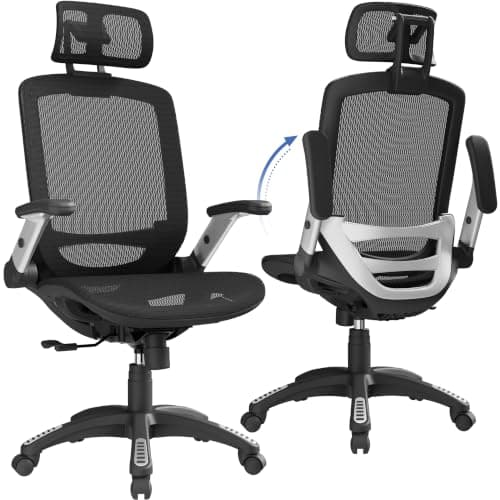 GABRYLLY Ergonomic Mesh Office Chair Skip This If the Headrest Is Why You Are Buying | Everything except the headrest | 7.2 | $189.91 - View on Amazon #ad disclosure · October 6, 2026 |
01 · Best Overall
ELABEST X100 Mesh Chair with Footrest
8.4/10 · scored on the published rubric
Five separately adjustable systems and a five-year warranty. The 18 in extendable footrest is a real footrest, not a foot ring, and it is the only one in our set whose length is published.
Why you might not: $349.99 makes it the most expensive chair on the site, and at $70 per warranty year the CAPOT is better value on our own arithmetic.
| Seat height | 18.3-23 in |
|---|---|
| Rated capacity | 300 lb |
| Footrest | adjustable |
| Warranty | 5 years |
| Cost per warranty year | $70.00 |
Adjustments published (6): seat height (18.3-23 in); lumbar height (2 in), depth (1.6 in) and 15-degree rotation, lockable; 5D armrests (height, width, forward, back, rotate), plus flip-up; 3D headrest (axes not specified); 18 in extendable footrest, two angles; three-stage recline.
Not published by the manufacturer: seat depth; seat width; headrest travel. We have flagged these rather than guessed.
How this score was built
- Fit range10/10
- Adjustability10/10
- Capacity headroom8/10
- Materials & warranty9/10
- Spec coverage5/10
The overall is the mean of these, rounded to one decimal place. Each criterion is computed from a published figure - the rubric is here.
Price as of October 6, 2026. #ad how this is funded
02 · Best Headrest on a Chair
CAPOT Ergonomic Mesh Chair
9.6/10 · scored on the published rubric
The only chair on this site that answers all six rubric criteria from published figures: seat range, depth, width, 400 lb capacity, a five-year warranty and eight levels of 2 in lumbar travel. At $199.99 that is $40 per warranty year.
Why you might not: It tops out at 22.05 in. If you are over about 6 ft 2 in you will run out of seat height, whatever the listing's stated window says.
| Seat height | 18.5-22.05 in |
|---|---|
| Seat depth | 19.3 in |
| Seat width | 20 in |
| Rated capacity | 400 lb |
| Warranty | 5 years |
| Cost per warranty year | $32.00 |
| Maker's stated user height | 5 ft 5 in to 6 ft 2 in |
Adjustments published (5): seat height (18.5-22.05 in); lumbar depth (2 in over 8 levels); backrest lock at 90, 110 and 125 degrees; headrest height and depth; armrests flip up 90 degrees.
How this score was built
- Fit range8/10
- Adjustability10/10
- Capacity headroom10/10
- Materials & warranty10/10
- Spec coverage10/10
The overall is the mean of these, rounded to one decimal place. Each criterion is computed from a published figure - the rubric is here.
03 · Best Fix for the Chair You Own
Omhuzsyo Clamp-On Headrest Attachment
5.8/10 · scored on the published rubric
Publishes more headrest travel than any CHAIR on this site does - 3.14 in of height, 36 degrees of tilt and a front-to-back adjustment - and bolts onto the chair you already own.
Why you might not: It only fits a backrest 0.7 to 0.98 in thick, so measure yours before you buy. On a mesh-framed back with no flat panel it will not attach at all.
| Platform height | 7.5-10.6 in |
|---|---|
| Footprint | 14 x 5.5 in |
Adjustments published (3): height (7.5-10.6 in, 3.14 in of travel); tilt angle (36 degrees); front-to-back distance.
Not published by the manufacturer: warranty term; load rating; foam density. We have flagged these rather than guessed.
How this score was built
- Fit range10/10
- Adjustability9/10
- Capacity headroom2/10
- Materials & warranty3/10
- Spec coverage5/10
The overall is the mean of these, rounded to one decimal place. Each criterion is computed from a published figure - the rubric is here.
Price as of October 6, 2026. #ad how this is funded
04 · Only Published Headrest ANGLE
DUMOS Executive Mesh Chair with 42-Degree Headrest
5.8/10 · scored on the published rubric
Publishes its headrest angle as 42 degrees, which almost nothing in this category does, on the cheapest chair in our set with a moving headrest at all.
Why you might not: The headrest angle is the only travel figure on the listing. The armrests flip up and do nothing else, and no seat dimension is published.
| Rated capacity | 300 lb |
|---|
Adjustments published (5): headrest height and angle (42 degrees); lumbar height; flip-up armrests; recline to 120 degrees; seat height.
Not published by the manufacturer: seat-height range; seat depth; seat width; warranty term; headrest height travel; lumbar travel. We have flagged these rather than guessed.
How this score was built
- Fit range7/10
- Adjustability7/10
- Capacity headroom8/10
- Materials & warranty4/10
- Spec coverage3/10
The overall is the mean of these, rounded to one decimal place. Each criterion is computed from a published figure - the rubric is here.
05 · Best Headrest and Arm Combination
NIHABRO Mesh Chair with 2D Headrest
6.6/10 · scored on the published rubric
400 lb and a published 35-degree recline span on a chair whose headrest and armrests both move in more than one axis, at under a hundred dollars.
Why you might not: No seat-height range, no seat depth, no seat width. It tells you what moves and never how far, so you cannot check it against your own measurements.
| Rated capacity | 400 lb |
|---|
Adjustments published (5): 2D headrest (height and tilt); lumbar height; 3D flip-up armrests (slide, rotate, flip); recline 90-125 degrees with a tension knob; seat height (certified Class 3 gas lift).
Not published by the manufacturer: seat-height range; seat depth; seat width; warranty term; headrest travel; lumbar travel. We have flagged these rather than guessed.
How this score was built
- Fit range7/10
- Adjustability8/10
- Capacity headroom10/10
- Materials & warranty5/10
- Spec coverage3/10
The overall is the mean of these, rounded to one decimal place. Each criterion is computed from a published figure - the rubric is here.
06 · Best Specified Chair Here
COLAMY Atlas Mesh Chair with 4D Arms and Sliding Seat
7.8/10 · scored on the published rubric
The only chair on this site that publishes a seat depth you can CHANGE - a sliding pan from 15.75 to 17.72 in - which is the one dimension almost every other chair fixes at the factory.
Why you might not: A 21.06 in ceiling is low for a tall user, and COLAMY names a BIFMA certification, a headrest, a lumbar support and 4D arms without publishing a single travel figure for any of them.
| Seat height | 16.73-21.06 in |
|---|---|
| Seat depth | 17.72 in |
| Seat width | 19.88 in |
| Thickness | 6.3 in |
| Rated capacity | 300 lb |
Adjustments published (6): seat height (16.73-21.06 in, Class 4 gas lift); seat depth (sliding seat, 15.75-17.72 in); 4D armrests; 4-position tilt lock with tension adjustment; headrest; lumbar support.
Not published by the manufacturer: warranty term; headrest travel; lumbar travel; armrest travel; recline range in degrees; which BIFMA protocol was passed. We have flagged these rather than guessed.
How this score was built
- Fit range8/10
- Adjustability9/10
- Capacity headroom8/10
- Materials & warranty6/10
- Spec coverage8/10
The overall is the mean of these, rounded to one decimal place. Each criterion is computed from a published figure - the rubric is here.
Price as of October 6, 2026. #ad how this is funded
Skip This If the Headrest Is Why You Are Buying
GABRYLLY Ergonomic Mesh Office Chair
7.2/10 · scored on the published rubric
Five of six rubric criteria answered with published figures: 18.9-23.6 in seat, 20.5 in wide, 20 in deep, 300 lb, three-year warranty. Its 23.6 in ceiling is the highest of any ordinary task chair here, which is what makes it the tall-user pick.
Why you might not: A 20 in seat depth is long. Our arithmetic says that is too deep for anyone under about 5 ft 8 in - the front edge will reach the back of your knees, which is the thing OSHA specifically tells you to avoid.
| Seat height | 18.9-23.6 in |
|---|---|
| Seat depth | 20 in |
| Seat width | 20.5 in |
| Rated capacity | 300 lb |
| Warranty | 3 years |
| Cost per warranty year | $63.30 |
| Maker's stated user height | 5 ft 2 in to 6 ft 1 in |
Adjustments published (4): seat height (18.9-23.6 in); flip-up armrests (45 degrees); recline 90-120 degrees; headrest.
Not published by the manufacturer: lumbar adjustment range. We have flagged these rather than guessed.
How this score was built
- Fit range5/10
- Adjustability5/10
- Capacity headroom8/10
- Materials & warranty8/10
- Spec coverage10/10
The overall is the mean of these, rounded to one decimal place. Each criterion is computed from a published figure - the rubric is here.
Which of our condition pages you actually want
| If your problem is | Read | Because it ranks on |
|---|---|---|
| General lower-back ache from sitting | For lower-back pain | Published lumbar adjustment travel |
| Nerve pain radiating down a leg | For sciatica | Seat depth, pressure distribution, recline |
| Spinal stenosis, better when you lean forward | For spinal stenosis | Published recline range against the OSHA 15-degree minimum |
| A herniated, bulging or degenerating disc | For a herniated disc | Whether the lumbar support moves, and how far |
| Neck, shoulder or upper-back pain | For neck and shoulder pain | Published headrest and armrest travel |
How we ranked these
- Fit range - on this page that is published armrest adjustment axes plus published headrest travel. "3D armrests" and "4D armrests" are countable claims and we count them. A number in inches or degrees outranks a letter-and-D label, which is why a $48 accessory outranks most of the chairs.
- Adjustability - every other countable published mechanism, weighted towards recline, because a headrest only carries your head once the backrest is open far enough for your head to rest on it.
- Capacity headroom - rated capacity against a 275 lb reference. The headrest attachment scores 2 here by construction: it is a clamp, not a chair, and it has no occupant rating.
- Materials and warranty - warranty term, cylinder class, base material, named certification.
- Spec coverage - how many of the six rubric figures the maker publishes. This is where the GABRYLLY's seventh place comes from and where the DUMOS loses ground despite publishing the one figure nobody else gives.
The GABRYLLY at rank 7 deserves an explanation, because it is the top pick on [our tall-user page](/chairs/for-tall-people) and one of the best-documented chairs on this site: 18.9 to 23.6 inches of seat height, a 20-inch seat depth, 300 lb, a three-year warranty, a published 90-120 degree recline and a stated user-height window. It has a headrest. GABRYLLY publishes nothing about how far that headrest moves. On a page about headrest and armrest travel, a great chair with the wrong figures ranks last.
The armrest and headrest figures, side by side
| Product | Armrests | Headrest | Recline published |
|---|---|---|---|
| ELABEST X100 (rank 1) | 5D: height, width, forward, back, rotate | 3D, travel not published | Three-stage, no degrees |
| CAPOT (rank 2) | Adjustable, axes not counted | Height AND depth | Locks at 90, 110, 125 |
| Clamp-on headrest (rank 3) | n/a | 3.14 in height, 36 deg tilt, front-to-back | n/a |
| DUMOS (rank 4) | Flip-up only | Height + 42 degrees | 90-120 degrees |
| NIHABRO (rank 5) | 3D: slide, rotate, flip | 2D: height and tilt | 90-125 degrees |
| COLAMY Atlas (rank 6) | 4D, unspecified travel | Adjustable, travel not published | 4 lock positions |
| GABRYLLY (rank 7) | Flip-up 45 degrees | Present, travel not published | 90-120 degrees |
| MOLENTS | 3D: height, width, angle | No headrest | 90-120 degrees, three positions |
| ELABEST T96 | 3D: height, width, angle | No headrest | Synchro-tilt, no degrees |
| SIHOO M18 | Named, axes not published | Named, travel not published | Named, no degrees |
Two things fall out of that table. First, the only three products that publish a headrest movement as a number are the CAPOT, the DUMOS and a $48 clamp. Second, nobody in this field publishes an armrest travel figure in inches - the best you get is a count of axes. Both of those are the market's problem, not yours, and the way to shop around it is to buy on counted axes and keep the receipt.
What else changes when the pain is above your shoulder blades
Set the armrests from your elbow, not from the desk
The order most people get wrong. Set your seat height first so your forearms are level with the desk surface - that is what decides your elbow height. Then bring the armrests up to meet your elbows where they already are, with your upper arms hanging. If the armrests are doing the lifting, they are too high; if your shoulder drops to reach them, too low or too wide.
This is why armrest width matters as much as armrest height and almost nothing publishes it. OSHA's criterion is that armrests let your "elbows stay close to your body"; a pair of arms fixed 22 inches apart does the opposite for a narrow frame. Of our set, only the ELABEST X100 (5D, width included), MOLENTS and ELABEST T96 (3D, width included) and the COLAMY (4D) publish width as an adjustable axis at all.
A headrest you cannot reach is decoration
A headrest only works when the backrest is open far enough that your head actually rests on it - which for most people means somewhere past 110 degrees. A fixed headrest on an upright chair sits behind your head and touches nothing. That is why this page ranks recline alongside the headrest, and why the two chairs here with the widest published recline both carry headrests that move.
A fixed headrest also lands on whoever has an average torso. Set for a 5 ft 6 in user it hits a 6 ft 4 in user across the shoulders, which is worse than no headrest - it pushes your head forward into exactly the position OSHA's guidance tells you to avoid. Our tall-chair page covers the backrest-height arithmetic behind that.
The monitor is probably the actual problem, and we do not sell monitors
Worth saying on a page about chairs. If your screen is below eye level you will flex your neck forward all day, and no chair, headrest or cushion fixes a geometry problem somewhere else. A chair that sets your shoulders correctly and a screen 6 inches too low still gives you a forward head position.
We cover seating and nothing else, so this is as far as we can usefully take you: set the chair from your elbows, then raise the screen until your head is level, then come back to the headrest. If you are trying to fix all three at once you will not know which change helped.
Change position, because OSHA says so in as many words
The OSHA working-position page is explicit that no single posture should be held indefinitely, and lists adjusting the backrest, standing and walking periodically, and alternating tasks between sitting and standing. A chair that reclines 45 degrees is partly useful because it gives you a second posture, not because reclined sitting is better than upright sitting. That is also the argument for active seating - a seat that moves is a seat you cannot hold still in.
Where this page stops
Everything above describes what a seat does mechanically, and every figure in it comes from a manufacturer's own published specification or a named standard. None of it is medical advice. There is no clinician on this site, nothing here is medically reviewed, and we do not know what is causing your symptoms.
A chair changes how your body is loaded while you sit in it. It does not treat anything. Pain that is severe, worsening, radiating into a limb, or accompanied by numbness, tingling, weakness or any change in bladder or bowel function is a reason to see a clinician promptly - not a reason to buy a chair. "Doctor recommended" on a product listing is a marketing phrase, not a credential, and we will not repeat it for them.
What we looked at and left out
Exclusions are explainable or they are not exclusions. Each of these failed a published disqualifier, and the reason is the spec, not a preference.
| Product | Why it is not ranked |
|---|---|
| SIHOO M18 | SIHOO publishes no seat-height range, no seat depth and no seat width for the M18. It is a well-specified chair in other respects - 331 lb, a three-year warranty, a BIFMA pass - and on a page that ranks by body fit there is nothing to rank it on. [Our full write-up is here](/reviews/sihoo-m18). |
| Modway Articulate Mesh Chair | No headrest at all, and "height-adjustable armrests" with no travel figure and no statement about whether the two sides move independently. It publishes a 6 in cushion thickness and a 331 lb rating, which are the wrong figures for this page. |
| TRALT Ergonomic Chair with Adjustable Lumbar | Publishes seat height, depth, width, capacity and a warranty - a genuinely well-documented chair - and nothing whatsoever about its armrests or a headrest. Excluded on the governing figure, not on quality. |
Questions people actually ask
What office chair is best for neck and shoulder pain?
Do office chair headrests actually help neck pain?
Can I add a headrest to my office chair?
How high should office chair armrests be?
Is mesh or cushioned better for shoulder pain?
Have you tested these chairs?
Read next
Sources
Every figure on this page traces to one of these. Product specifications come from the manufacturer's own listing; prices come from a live lookup and carry the date they were verified.
- OSHA eTool, Computer Workstations - Good Working Positions
- OSHA eTool, Computer Workstations - Chairs
- Pheasant & Haslegrave, Bodyspace: Anthropometry, Ergonomics and the Design of Work - percentile table as tabulated by RoyMech
- ANSI/BIFMA X5.1, General Purpose Office Chairs - test summary (Micom Laboratories)