ELABEST X100: the figures, and the percentages
ELABEST publishes more measured adjustment than any chair we have checked. It also publishes six percentages nobody can verify. Both facts are on the same listing.
By Sawyer V. · Published October 6, 2026
We earn a commission if you buy through the links on this page, at no extra cost to you. It does not affect the order of the picks - the rubric does that, and here is how we are funded. Prices were last verified October 6, 2026.
What we did and did not do
Units we claim to have tested: 0. Everyone in this category says they tested twenty chairs. We have not sat in any of these, and we say so.
What we did instead: compiled every figure each manufacturer publishes, computed the fit ranges from a cited anthropometric table, and linked the source for each number so you can check the arithmetic. Where a manufacturer does not publish a figure, we say that rather than filling the gap. The full method, including what we cannot assess, is here.
The ELABEST X100 publishes more measured adjustment than any chair on this site: 2 inches of lumbar height, 1.6 inches of lumbar depth, 15 degrees of lumbar rotation, five armrest axes, an 18-inch extendable footrest with two angle positions, and a 4.7-inch seat-height range - with a five-year term behind it. If adjustment range is what you are buying, it is the best-documented chair we have found, and at $349.99 it is also the most expensive one here.
And the same listing contains six numbers that are not measurements. "12hrs+ fatigue reduction" certified by a body called the American Ergonomics Partnership. "31% neck strain" reduction. "38% better airflow." "25% higher elasticity." "27% denser EVA foam." A "17-point micro-adjustment system." Collaboration with "California-based orthopedic specialists."
None of those is checkable from the listing, none names a test method or a comparison baseline, and we are not going to repeat any of them as a fact. That contrast - a genuinely well-measured chair wrapped in unverifiable percentages - is what this review is about, and separating the two is the most useful thing we can do for anyone comparing this chair against a cheaper one.
What ELABEST measures
| Figure | Published value | Rubric criterion |
|---|---|---|
| Seat-height range | 18.3-23 in (4.7 in of travel) | Fit range |
| Lumbar height travel | 2 in, lockable | Adjustability |
| Lumbar depth travel | 1.6 in, lockable, spring-loaded | Adjustability |
| Lumbar rotation | 15 degrees | Adjustability |
| Armrest axes | 5 - height, width, forward, back, rotate - plus flip-up | Adjustability |
| Footrest | 18 in extendable, 2 angle positions | Footrest provision |
| Headrest | 3D, no travel figure given | Adjustability |
| Recline | Three-stage, no degrees given | Adjustability |
| Rated capacity | 300 lb | Capacity headroom |
| Cylinder | Grade 4 central column | Materials and build |
| Certification | BIFMA-certified structure (protocol not named) | Materials and build |
| Warranty | 5 years | Materials and build / value |
| Model number | ELX100BB | - |
That is a strong sheet. Four of those figures are things almost nobody in this market publishes at all: of the 38 task and drafting chairs we have verified, four publish a lumbar travel figure, one publishes a footrest length, eight publish a warranty term, and nobody else publishes a lumbar rotation. How often each chair figure gets published, counted.
What ELABEST does not publish
- Seat depth. The dimension that decides whether the front edge clears the back of your knee, and the one that is fixed on almost every chair in this price range. This is the significant omission on an otherwise detailed sheet, and it is the reason the X100 is not a pick on our tall-user page, which ranks on ceiling and depth together.
- Seat width.
- Headrest travel. The headrest is described as 3D and extra-wide; how far it moves in any of those three directions is not stated.
- Recline in degrees. "Three-stage reclining mechanism" tells you it locks in three places and not where they are. The CAPOT, for less money, publishes 90, 110 and 125.
- Which BIFMA protocol it passed. "BIFMA-certified structure" is not a protocol. X5.1 tests around a 275 lb occupant; X5.11 covers 253-400 lb and specifies a minimum seat width. They are different tests.
The six claims, and why we are not repeating them
Our editorial policy is that we republish a manufacturer's figure when it is a measurement with a stated basis, and name it as a claim when it is not. Here is where each of these falls:
| The claim | What is missing |
|---|---|
| "Certified by AEP for 12hrs+ fatigue reduction" | What the American Ergonomics Partnership is. We looked and could not establish it as a recognized standards or certification body. The recognized certification body for ergonomics in the United States is the Board of Certification in Professional Ergonomics, which certifies people rather than furniture. No protocol, test population or report is named either. Compare BIFMA X5.1, where the method is published and a third-party lab summary is linkable. |
| "Reduces 31% neck strain" | A baseline, a measurement method, and a population. 31 percent relative to which chair, measured how, on how many people? |
| "38% better airflow", "25% higher elasticity" | A comparison chair and a test. "Than standard mesh" is not a baseline - standard mesh is not a specification. |
| "27% denser EVA foam" | The density itself, in kg/m3. A percentage without the absolute figure cannot be compared to any other chair. |
| "17-point micro-adjustment system" | The list of 17 points. We count 13 named adjustments across six systems on the listing - seat height, three lumbar axes, five armrest axes plus flip, footrest extension and angle, and a three-stage recline - with a headrest whose axes are not specified. Our count is in the table above so you can check it. |
| "Collaboration with California-based orthopedic specialists" | Names, or a published outcome. This is also the pattern behind "doctor recommended" on product listings generally - a marketing phrase rather than a credential. |
To be clear about what this does and does not mean. It does not mean the chair is bad - the measured figures above are real and they are better than its competitors'. It does not mean the claims are false; we have no way to know. It means you should buy this chair for the 2 inches of lumbar travel and the five-year warranty, not for the 31 percent. One of those you can check against a competitor. The other is a sentence.
The arithmetic we can run
Cost per warranty year. ELABEST publishes five years, which makes the figure computable - the live price is in the card below, and at $349.99 it works out near $70 per warranty year. For context, the best figure on this site is about $40 per warranty year and the worst is about $190, from a 700 lb chair with a one-year term. So the X100 sits in the better half of the field on value-per-year despite being the most expensive chair here, which is exactly the kind of thing a sticker price hides.
Fit, from the published range. An 18.3 to 23-inch seat-height range covers a stature band of roughly 5 ft 5 in to beyond 6 ft 4 in on our arithmetic - seat height is your popliteal height plus about an inch for shoes. The 23-inch ceiling is generous; the 18.3-inch floor is ordinary, and a user under about 5 ft 4 in will be at the bottom of the travel with a footrest doing the real work. Our table computes the band from your height.
Capacity headroom. 300 lb against the 275 lb occupant basis behind ANSI/BIFMA X5.1 gives ordinary headroom - our working rule is that a chair suits a user up to about 80 percent of its rating, so call it 240 lb. If capacity is your binding constraint this is not the chair; big and tall ranks 400 to 700 lb chairs on rating and seat width.
Which pages this chair wins, and which it does not
Useful as a summary, because the X100 appears on several of our rankings in very different positions and the reason is always the same: the figures it publishes are superb and the figure it omits is seat depth.
- Wins [neck and shoulder pain](/chairs/for-neck-and-shoulder-pain) - five published armrest axes, the most on this site, and armrest position is what sets your shoulder.
- Wins [scoliosis](/chairs/for-scoliosis) - same five axes, which is the closest the market gets to setting each side independently.
- Second on [a herniated disc](/chairs/for-herniated-disc) - the only chair here publishing lumbar DEPTH as well as height, beaten only on price and completeness by the CAPOT.
- Fifth on [spinal stenosis](/chairs/for-spinal-stenosis) - because that page ranks published recline in degrees, and "three-stage" is not degrees.
- Not a pick on [chairs for tall people](/chairs/for-tall-people) - a 23-inch ceiling is good; without a published seat depth there is nothing to rank a long femur against.
- Fourth on [pregnancy](/chairs/for-pregnancy) - the footrest and the moving lumbar help; the unpublished, unadjustable seat depth is the ceiling on how high it can place.
Should you buy it?
Buy it if adjustment range is the thing you need and you have the budget. Nothing else we have verified publishes five armrest axes, lumbar movement in three directions, and a footrest length. If you are shopping because the chair you have cannot be set up to fit you, this is the chair with the most places to put things.
Buy the CAPOT instead if you want to check the fit before your money leaves. It is about a third less, it answers all six of our rubric criteria - the only chair on this site that does - and it publishes a 19.3-inch seat depth, a 20-inch seat width, 400 lb, a named BIFMA X5.1 certification, a five-year warranty and its recline in degrees. It has less adjustment and more disclosure. Our full CAPOT review.
Buy the COLAMY Atlas instead if seat depth is your problem specifically. It is the only chair on this site with a seat pan you can slide - 15.75 to 17.72 inches - which is the one dimension the X100 does not address at all.
And if what you actually want to know is whether it is comfortable after six months, we are the wrong source and we will say so rather than improvise. We have not sat in this chair. Whether 17 adjustment points is useful or just 17 things to get wrong, whether the spring-loaded lumbar tracking works as described, whether the mesh holds its tension - those need someone who owns one. The full list of what this method cannot reach is published here.
The chair, and two alternatives
Ranked on the published rubric. Tap a row for the full write-up; the price button goes straight to Amazon. Every figure in the write-ups is the manufacturer's own published specification, linked at the source. We have not sat in any of these.
| # | Product | Best for | Score | Price |
|---|---|---|---|---|
| 1 | 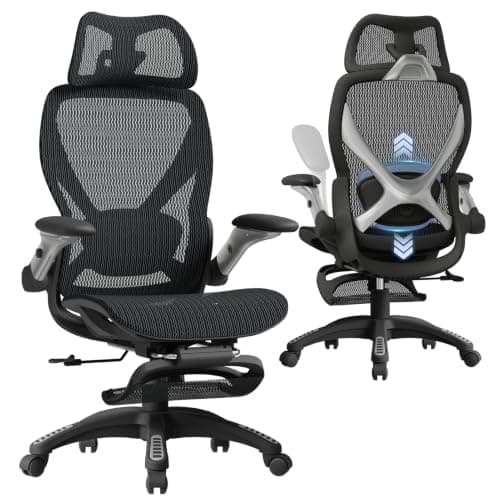 ELABEST X100 Mesh Chair with Footrest The Chair Under Review | More measured adjustment than anything here | 8.0 | $349.99 - View on Amazon #ad disclosure · October 6, 2026 |
| 2 | 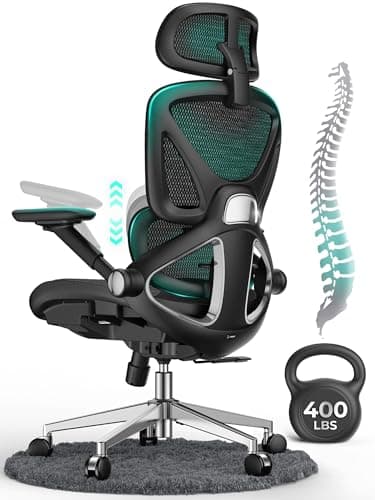 CAPOT Ergonomic Mesh Chair The Alternative That Answers Everything | All six criteria, for less money | 9.8 | $159.99 - View on Amazon #ad disclosure · October 6, 2026 |
| 3 | 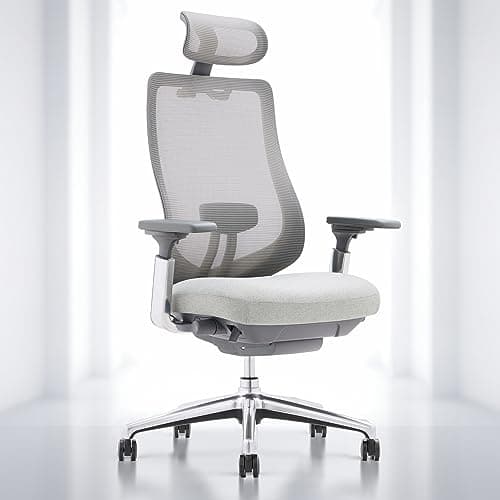 COLAMY Atlas Mesh Chair with 4D Arms and Sliding Seat The Alternative With a Sliding Seat | A seat depth that moves | 7.8 | $289.99 - View on Amazon #ad disclosure · October 6, 2026 |
01 · The Chair Under Review
ELABEST X100 Mesh Chair with Footrest
8.0/10 · scored on the published rubric
Five separately adjustable systems and a five-year warranty. The 18 in extendable footrest is a real footrest, not a foot ring, and it is the only one in our set whose length is published.
Why you might not: $349.99 makes it the most expensive chair on the site, and at $70 per warranty year the CAPOT is better value on our own arithmetic.
| Seat height | 18.3-23 in |
|---|---|
| Rated capacity | 300 lb |
| Footrest | adjustable |
| Warranty | 5 years |
| Cost per warranty year | $70.00 |
Adjustments published (6): seat height (18.3-23 in); lumbar height (2 in), depth (1.6 in) and 15-degree rotation, lockable; 5D armrests (height, width, forward, back, rotate), plus flip-up; 3D headrest (axes not specified); 18 in extendable footrest, two angles; three-stage recline.
Not published by the manufacturer: seat depth; seat width; headrest travel. We have flagged these rather than guessed.
How this score was built
- Fit range8/10
- Adjustability10/10
- Capacity headroom8/10
- Materials & warranty9/10
- Spec coverage5/10
The overall is the mean of these, rounded to one decimal place. Each criterion is computed from a published figure - the rubric is here.
Price as of October 6, 2026. #ad how this is funded
02 · The Alternative That Answers Everything
CAPOT Ergonomic Mesh Chair
9.8/10 · scored on the published rubric
The only chair on this site that answers all six rubric criteria from published figures: seat range, depth, width, 400 lb capacity, a five-year warranty and eight levels of 2 in lumbar travel. At $199.99 that is $40 per warranty year.
Why you might not: It tops out at 22.05 in. If you are over about 6 ft 2 in you will run out of seat height, whatever the listing's stated window says.
| Seat height | 18.5-22.05 in |
|---|---|
| Seat depth | 19.3 in |
| Seat width | 20 in |
| Rated capacity | 400 lb |
| Warranty | 5 years |
| Cost per warranty year | $32.00 |
| Maker's stated user height | 5 ft 5 in to 6 ft 2 in |
Adjustments published (5): seat height (18.5-22.05 in); lumbar depth (2 in over 8 levels); backrest lock at 90, 110 and 125 degrees; headrest height and depth; armrests flip up 90 degrees.
How this score was built
- Fit range9/10
- Adjustability10/10
- Capacity headroom10/10
- Materials & warranty10/10
- Spec coverage10/10
The overall is the mean of these, rounded to one decimal place. Each criterion is computed from a published figure - the rubric is here.
03 · The Alternative With a Sliding Seat
COLAMY Atlas Mesh Chair with 4D Arms and Sliding Seat
7.8/10 · scored on the published rubric
The only chair on this site that publishes a seat depth you can CHANGE - a sliding pan from 15.75 to 17.72 in - which is the one dimension almost every other chair fixes at the factory.
Why you might not: A 21.06 in ceiling is low for a tall user, and COLAMY names a BIFMA certification, a headrest, a lumbar support and 4D arms without publishing a single travel figure for any of them.
| Seat height | 16.73-21.06 in |
|---|---|
| Seat depth | 17.72 in |
| Seat width | 19.88 in |
| Thickness | 6.3 in |
| Rated capacity | 300 lb |
Adjustments published (6): seat height (16.73-21.06 in, Class 4 gas lift); seat depth (sliding seat, 15.75-17.72 in); 4D armrests; 4-position tilt lock with tension adjustment; headrest; lumbar support.
Not published by the manufacturer: warranty term; headrest travel; lumbar travel; armrest travel; recline range in degrees; which BIFMA protocol was passed. We have flagged these rather than guessed.
How this score was built
- Fit range8/10
- Adjustability9/10
- Capacity headroom8/10
- Materials & warranty6/10
- Spec coverage8/10
The overall is the mean of these, rounded to one decimal place. Each criterion is computed from a published figure - the rubric is here.
Price as of October 6, 2026. #ad how this is funded
Questions people actually ask
Is the ELABEST X100 worth $350?
What is the ELABEST X100 seat height?
What is the ELABEST X100 seat depth?
Does the ELABEST X100 have a headrest?
Is the ELABEST X100 certified?
How long is the ELABEST X100 warranty?
Have you tested the ELABEST X100?
Read next
Sources
Every figure on this page traces to one of these. Product specifications come from the manufacturer's own listing; prices come from a live lookup and carry the date they were verified.
- ELABEST X100 - manufacturer's published specification on the Amazon listing
- ANSI/BIFMA X5.1, General Purpose Office Chairs - test summary (Micom Laboratories)
- ANSI/BIFMA X5.11, General Purpose Large Occupant Office Chairs - test summary (Micom Laboratories)
- Board of Certification in Professional Ergonomics - the recognized, IEA-affiliated ergonomics certification body in the United States (it certifies people, not furniture)
- Pheasant & Haslegrave, Bodyspace: Anthropometry, Ergonomics and the Design of Work - percentile table as tabulated by RoyMech
- OSHA eTool, Computer Workstations - Chairs