Office chair armrest height: where they should sit
Armrests are set from your seated elbow height, not from the desk. Get that one number and everything else about them - too high, too low, remove them - answers itself.
By Sawyer V. · Published October 17, 2026
We earn a commission if you buy through the links on this page, at no extra cost to you. It does not affect the order of the picks - the rubric does that, and here is how we are funded. Prices were last verified October 17, 2026.
What we did and did not do
Units we claim to have tested: 0. Everyone in this category says they tested twenty chairs. We have not sat in any of these, and we say so.
What we did instead: compiled every figure each manufacturer publishes, computed the fit ranges from a cited anthropometric table, and linked the source for each number so you can check the arithmetic. Where a manufacturer does not publish a figure, we say that rather than filling the gap. The full method, including what we cannot assess, is here.

Set your armrests from your elbows, not your desk. The target is the one OSHA publishes for seated computer work: shoulders relaxed, upper arms hanging close to the body, elbows bent between 90 and 120 degrees. Your armrests should meet your forearms exactly where they already are when you hold that position - not lift them, not make you reach down.
That gives one number to measure: seated elbow height, the distance from the compressed seat surface to the underside of your elbow with your arm hanging and bent to 90 degrees. For most adults it falls between 7 and 11 in. Measure it once, write it down, and every armrest question you will ever have is answered by comparing a published figure to it.
The order matters. Set your seat height first, then your armrests, then your desk - never the other way round. Armrests set to a desk that is wrong just lock in the error. Seat height first, here.
Measure your seated elbow height, in one minute
- Sit on the chair you actually use, feet flat on the floor or on a footrest, back against the backrest. Let the seat compress - measuring an unloaded seat gives you a number that is an inch out before you start.
- Let your upper arms hang straight down, close to your sides, shoulders relaxed and down. This is the position people get wrong: if you are holding your shoulders up to make the measurement, you will set your armrests to a shrug.
- Bend your elbows to about 90 degrees, forearms level with the floor.
- Measure from the seat surface, under your sit bones, up to the underside of your elbow. That number is your armrest height. Most adults land between 7 and 11 in.
- Now check your chair. Published armrest heights are usually given as a range above the seat. If yours does not adjust, measure where it actually sits and compare.
The sanity check
Rest your forearms on the armrests and let go. If your shoulders rise, the armrests are too high. If you had to drop a shoulder or lean to reach them, they are too low. If nothing moved and your shoulders stayed where they were, they are right - and that is the entire test.
What goes wrong at each extreme
| What you do about it | What you feel by 4 pm | |
|---|---|---|
| Too high | You shrug. The upper trapezius holds your shoulder girdle up all day because the armrest is where your shoulder wants to come down to | Tight neck and upper shoulders, headaches at the base of the skull |
| Too low | You drop one shoulder to reach, or you abandon the armrests and your forearms land on the desk edge | One-sided shoulder ache, or pressure across the underside of the forearm from the desk edge |
| Too far apart | You abduct at the shoulder to reach them, which is a shrug sideways | The same upper-trapezius ache as too-high, plus elbows out wide while typing |
| Hard, at the right height | Nothing wrong with the geometry. The pressure is concentrated where the ulnar nerve passes the elbow | Numbness or tingling in the ring and little fingers |
The last row is the one people misdiagnose most often. If the height is right and your elbows still hurt, you have a pressure problem rather than a height problem - and the fix is softness rather than adjustment. That is what armrest pads are actually for, and the thin ones are the right ones in that case.
If your armrests do not adjust
Most chairs under about $200 have fixed arms, which leaves three honest options and one bad one.
- Too low: add thickness. An armrest pad raises the armrest by its own published thickness, and in our field that runs from 1.2 in to 4 in. This is the one case where a pad is a genuine fit fix rather than a comfort accessory. Measure the gap, then buy the thickness that closes it.
- Too high: take them off. Most fixed arms unbolt. An armless chair with your forearms supported by the desk is better than a shrug you hold for eight hours, and plenty of drafting stools ship armless on purpose for exactly this reason.
- Too high and they do not come off: raise the seat and add a footrest. Raising the seat brings your elbows up to meet the armrests. It also lifts your feet off the floor, which is why the footrest is not optional - the arithmetic is here.
- The bad option: lowering your desk to suit fixed armrests. That sets your keyboard height from a chair part instead of from your elbow, and you will feel it in your wrists within a week.
Should you use armrests at all?
Not while you are typing - that is the part most people have backwards. With your hands on the keyboard, your forearms should be floating and your shoulders relaxed; resting your elbows on armrests mid-keystroke plants the arm and makes you type from the wrist. OSHA's position is that no single posture should be held indefinitely, and armrests are a resting position rather than a working one.
Where they earn their place is between tasks: reading, thinking, on a call, waiting for a build. That is a large share of a working day, and supporting the weight of two arms - roughly 10 to 12 percent of body weight - for those stretches is why a chair has them.
This is also why armrest width matters as much as height. If the arms are set wider than your shoulders, you cannot use them without reaching sideways, and no pad fixes that. On a chair with fixed-width arms, that is a reason to change the chair rather than accessorize it - chairs ranked on published adjustment are here.
If a pad is the fix
Ranked on the published rubric. Tap a row for the full write-up; the price button goes straight to Amazon. Every figure in the write-ups is the manufacturer's own published specification, linked at the source. We have not sat in any of these.
| # | Product | Best for | Score | Price |
|---|---|---|---|---|
| 1 | 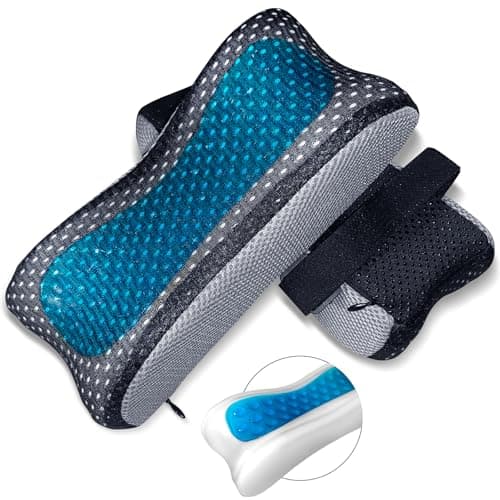 YaZimalu FS-704 Cooling Gel Armrest Pads (set of 2) Most Lift Available | Armrests 3 in too low | 8.4 | $25.99 - View on Amazon #ad disclosure · October 17, 2026 |
| 2 | 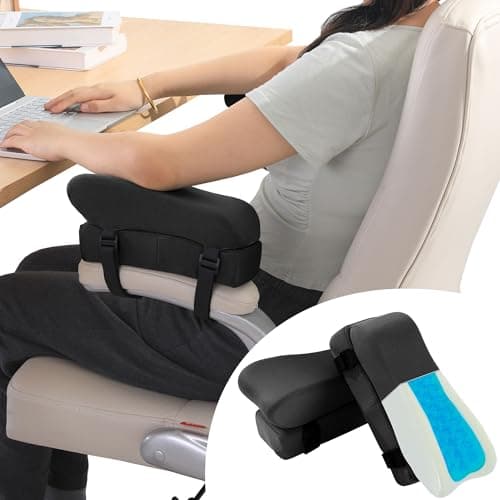 MABOZOO Gel Arm Pads, Height Adjustable (set of 2) Only Adjustable Pad | Choosing 2 in or 4 in | 7.6 | $26.99 - View on Amazon #ad disclosure · October 17, 2026 |
| 3 | 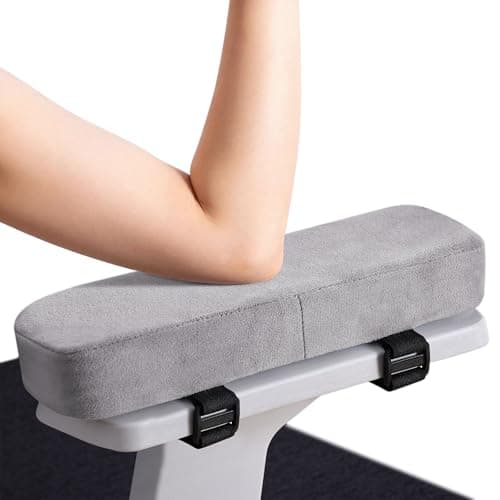 Smiry Memory Foam Armrest Pads (set of 2) Padding Without a Height Change | Armrests already set right | 7.2 | $23.99 - View on Amazon #ad disclosure · October 17, 2026 |
01 · Most Lift Available
YaZimalu FS-704 Cooling Gel Armrest Pads (set of 2)
8.4/10 · scored on the published rubric
The thickest pad here at a published 3 in, which is the whole point of the product: a pad raises your armrest by its own thickness, and 3 in closes most of the gap between a low armrest and a standard desk.
Why you might not: Three inches is too much if your armrests are already at the right height - it will push your shoulders up instead. Measure the gap before you buy this rather than the 1.3 in option.
| Thickness | 3 in |
|---|---|
| Footprint | 9.8 x 4.3 in |
Adjustments published (3): fits chair arms 3 to 6 in wide, as published; dual-sided fastener straps with anti-slip particles; removable machine-washable cover on a hidden zipper.
Not published by the manufacturer: foam density; warranty term; gel layer thickness. We have flagged these rather than guessed.
How this score was built
- Fit range9/10
- Adjustability8/10
- Size & footprint9/10
- Materials & warranty7/10
- Spec coverage9/10
The overall is the mean of these, rounded to one decimal place. Each criterion is computed from a published figure - the rubric is here.
Price as of October 17, 2026. #ad how this is funded
02 · Only Adjustable Pad
MABOZOO Gel Arm Pads, Height Adjustable (set of 2)
7.6/10 · scored on the published rubric
The only armrest pad we found that adjusts at all. The middle layer attaches with hook-and-loop so you build it at either 2 in or 4 in, which means one purchase covers two different gaps.
Why you might not: At 8.6 in it is the shortest pad here, so on a long armrest the back of your forearm sits on bare plastic. MABOZOO also publishes no armrest-width window, so you are measuring blind.
| Thickness | 4 in |
|---|---|
| Footprint | 8.6 x 4 in |
Adjustments published (4): pad height, published as a 2 in or 4 in build via the hook-and-loop middle layer; two extra-long fastener straps; anti-slip rubber base; removable washable cover.
Not published by the manufacturer: foam density; warranty term; armrest width window. We have flagged these rather than guessed.
How this score was built
- Fit range8/10
- Adjustability10/10
- Size & footprint6/10
- Materials & warranty7/10
- Spec coverage7/10
The overall is the mean of these, rounded to one decimal place. Each criterion is computed from a published figure - the rubric is here.
Price as of October 17, 2026. #ad how this is funded
03 · Padding Without a Height Change
Smiry Memory Foam Armrest Pads (set of 2)
7.2/10 · scored on the published rubric
The narrowest fit window published in this field - 3 to 4.5 in - which makes it the one for a slim task-chair armrest that wider pads overhang. It is also the longest pad here at 10.04 in.
Why you might not: 1.34 in of foam will not change your elbow height in any way you notice. Buy this for pressure, not for geometry.
| Thickness | 1.34 in |
|---|---|
| Footprint | 10.04 x 3.35 in |
Adjustments published (3): fits armrests 3 to 4.5 in wide, as published; adjustable buckles plus hook-and-loop double fixation; washable cover on a hidden zipper.
Not published by the manufacturer: foam density; warranty term. We have flagged these rather than guessed.
How this score was built
- Fit range6/10
- Adjustability8/10
- Size & footprint7/10
- Materials & warranty7/10
- Spec coverage8/10
The overall is the mean of these, rounded to one decimal place. Each criterion is computed from a published figure - the rubric is here.
Price as of October 17, 2026. #ad how this is funded
Armrest height by your height
A starting point only - measure yourself rather than using this table, because seated elbow height varies with torso proportion as much as with stature. These figures are derived from the published seated-elbow-height percentiles in Pheasant and Haslegrave's anthropometric tables.
| Your height | Seated elbow height, roughly | So armrests should sit |
|---|---|---|
| 5 ft 0 in | 7.5-8.5 in above the seat | 7.5-8.5 in |
| 5 ft 4 in | 8-9 in | 8-9 in |
| 5 ft 8 in | 8.5-9.5 in | 8.5-9.5 in |
| 6 ft 0 in | 9-10.5 in | 9-10.5 in |
| 6 ft 4 in | 9.5-11 in | 9.5-11 in |
Note how narrow that whole span is: about three and a half inches from the shortest adult to the tallest. That is why a chair with 2 in of armrest travel genuinely does fit most people, and why a chair with none fits almost nobody by accident.
Our limits on this page
The elbow-angle and shoulder targets here are OSHA's published guidance for seated computer work, linked in the sources below. The height table is arithmetic from published anthropometric percentiles, shown rather than asserted.
We are not clinicians and nothing on this site is medically reviewed. Numbness or tingling in the ring and little fingers that persists after you have fixed the pressure is a reason to see someone about it, not a reason to buy a thicker pad.
Questions people actually ask
How high should office chair armrests be?
How do I know if my armrests are too high?
What do I do if my armrests do not adjust?
Should you use armrests while typing?
Can armrest pads fix armrests that are too high?
Is it better to have no armrests?
Why do my elbows hurt even though the height is right?
Read next
Sources
Every figure on this page traces to one of these. Product specifications come from the manufacturer's own listing; prices come from a live lookup and carry the date they were verified.
- OSHA eTool, Computer Workstations - Good Working Positions
- OSHA eTool, Computer Workstations - Chairs
- Pheasant & Haslegrave, Bodyspace: Anthropometry, Ergonomics and the Design of Work - percentile table as tabulated by RoyMech
- ANSI/BIFMA X5.1, General Purpose Office Chairs - test summary (Micom Laboratories)